Can a Trading Bot Withdraw My Funds?
You are about to paste an exchange API key into a piece of software, and a small voice in the back of your head is asking the only question that matters. I'm not putting withdrawal permissions on this, you think. And right behind it: why would I trust something I don't fully control with trade access to my account? Strip away the jargon and it all reduces to one worry. Can a trading bot withdraw my funds?
The short version: only if you let it. A trading bot moves money around inside your exchange account by placing buy and sell orders. Moving money out of the exchange entirely is a separate permission, and a properly built bot never asks for it. I build TradeArmor, a self-hosted crypto trading platform that runs DCA, grid, and futures strategies, built-in BTC/USDC signals, 15 technical indicators, a plain-English AI strategy builder, copy trading, backtesting, and tax exports, all on your own hardware. In three years of running it on my own accounts, it has never once needed permission to withdraw anything. Here is why, and how to confirm the bot you choose works the same way.
What an API key can actually do
An API key is two strings, a public identifier and a secret, that let a program act on your exchange account without your password. Every key carries a set of permissions, and they sit on a ladder from harmless to catastrophic.
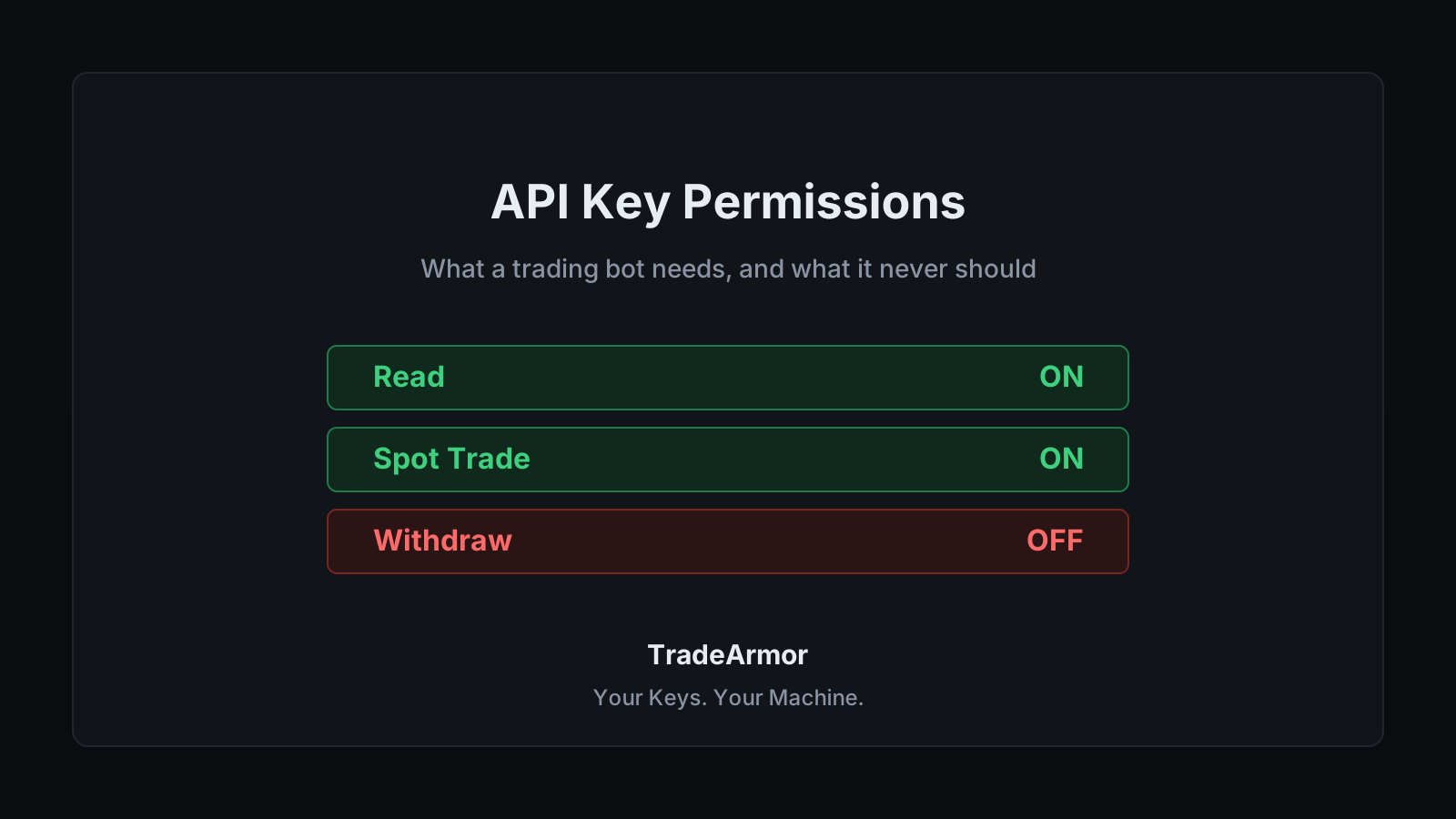
- Read. The bot sees balances, open orders, and trade history. It changes nothing. A read-only key is about as dangerous as a screenshot.
- Spot trade. The bot places, modifies, and cancels orders on the spot market. It buys and sells the assets already on your account. It still cannot move anything off the exchange.
- Margin or futures trade. The bot opens leveraged positions. Risk goes up because leverage can liquidate you, but the funds stay on the exchange.
- Withdraw. The bot sends assets to an external wallet address. This is the line between "can run a strategy" and "can empty the account."
Everything a trading strategy does lives on rungs one and two. Buy low, sell high, gate the next DCA buy, take profit, rebalance a grid. None of it requires the bot to send a coin anywhere. The withdrawal rung is a different machine entirely, and you control whether the bot ever stands on it.
So, can a trading bot withdraw my funds?
So, can a trading bot withdraw my funds? Only if the key you created for it carries withdrawal permission. Disable that permission at the moment you generate the key, and the bot is structurally incapable of withdrawing, regardless of what its code says, what its marketing promises, or who runs its servers. The exchange enforces the rule, not the bot.
This is not a setting you have to trust a vendor to honor. It is a hard boundary on the exchange side. On Binance, for example, withdrawal permission cannot even be turned on for an API key unless you have first locked the key to a specific IP address. No whitelisted IP, no withdrawals, full stop. Most major exchanges default new keys to read-only and make you deliberately opt into anything more. The dangerous permission is the one you have to go out of your way to enable.
So the honest answer to "can a trading bot withdraw my funds" is a question right back at you: did you give it a key that can? If the answer is no, the rest of this is about keeping it that way.
Where the risk actually lives
Once withdrawal is off, the real question stops being "can the bot withdraw" and becomes "where does my key live, and who else can reach it." There are two answers, and they have very different threat models.
A SaaS trading bot stores your keys on its servers so its software can trade for you from its infrastructure. Convenient for you, and a high-value target for everyone else. The marketing word for that arrangement is convenience. The security word is honeypot. One breach exposes every customer at once.
This is not hypothetical. In December 2022, roughly 100,000 3Commas API keys were leaked publicly, and attackers were estimated to have drained around $20 million from affected accounts before it was over. 3Commas spent weeks denying a breach had happened, then confirmed it. The keys had been sitting in one place, and one bad day put all of them in the open at the same time.
A self-hosted bot inverts that. Your key lives on your own machine, encrypted at rest. The attack surface is your laptop or your server instead of a company database holding tens of thousands of other people's credentials. Someone has to come after you specifically. The risk does not vanish, but it shrinks, and what remains is under your control instead of a vendor's patch schedule. If you want the long version of that argument, the crypto trading bot without API key risk guide walks through the full custody model.
How to lock withdrawals out for good
Here is the checklist I run with every new TradeArmor user. It applies to any bot, not just mine.
- Create a dedicated key. One key per bot, never reused from manual trading or tax exports. You can revoke one without breaking the others.
- Enable read plus spot trade only. Turn off withdrawal, transfer, internal transfer, and any sub-account permission you do not specifically need.
- Turn on an account-level withdrawal whitelist. Separate from the key, configure the exchange to allow withdrawals only to addresses you pre-approved. Even if some other path ever granted withdrawal access, funds still could not go to a stranger's wallet.
- Lock the key to an IP. If your exchange supports IP whitelisting, restrict the key to your bot machine's address. A leaked key then works from exactly one place on earth.
- Store the key encrypted, and rotate it. Verify the bot encrypts secrets at rest rather than leaving them in a plaintext config. Generate a fresh key every 90 days and delete the old one.
Do those five things and an API-key loss drops from a real category of risk to a rounding error. No single step carries the whole load. Layered, they are close to airtight.
How a self-hosted bot changes the answer
TradeArmor is concrete about this because "we take security seriously" is the emptiest sentence in software. The bot installs on your own hardware, on macOS, Linux, or Windows. The keys you enter are encrypted before they touch disk and are never transmitted anywhere except directly to the exchange over TLS. The code does not call withdrawal endpoints, period, so even a key created with withdrawal accidentally left on would never be used to move funds. The setup wizard shows you the minimum permissions to enable for your exchange and links straight to its key-creation page.
That self-custody posture is the same reason the platform is a clean landing spot for traders leaving abandoned bots. If you are coming from a tool that stopped shipping, the best ProfitTrailer alternative guide covers migrating your open positions intact, and the best self-hosted crypto trading bot guide lays out the full feature comparison. The keys never leave your machine in any of those workflows, because there is no TradeArmor cloud for them to leave to.
Frequently asked questions
Can a trading bot withdraw my funds? Only if the API key you created has withdrawal permission enabled. Scope the key to read plus spot trade and the bot cannot move a coin off the exchange.
Do I have to trust the bot to honor the no-withdrawal rule? No. The exchange enforces key permissions, not the bot. If withdrawal is off at the exchange, no software can override it.
What if I run a futures strategy? Enable the specific futures or margin permission your bot needs and nothing more. Leverage adds market risk through liquidation, but it still does not let the bot withdraw funds.
Is a SaaS bot automatically unsafe? Not automatically, but it concentrates risk. Your key sits in a vendor database alongside everyone else's, which is exactly the structure that turned the 2022 3Commas leak into a mass event.
Bottom line
A trading bot is boring infrastructure when you scope its access correctly: a self-hosted engine running DCA, grid, futures, signals, indicators, an AI strategy builder, copy trading, backtesting, and tax exports on your own hardware, with a key that can trade and nothing more. The answer to "can a trading bot withdraw my funds" is no, as long as you never hand it a key that can, and you keep that key on a machine you control.
Want the platform built around that principle from the ground up? See how TradeArmor runs on your own server with your keys staying put.