You do not want to hand your exchange API keys to a third party. You watched a SaaS bot get breached, read the part where users lost real money, and decided you are never touching one of those again. At the same time you are tired of the math: a charting subscription, plus a signal service, plus a bot, three bills to do one job, and you suspect you pay more for bot subscriptions than you make trading. The self hosted vs SaaS crypto bot question sits right between those two feelings: run your automation in someone else's cloud, or on your own machine.
This is the full self hosted vs SaaS crypto bot comparison, model by model, with the trade-offs laid out instead of spun. TradeArmor sits on the self-hosted side of this line, and it is worth saying up front what that side actually is now, because it is not what it was five years ago. TradeArmor is a self-hosted crypto trading platform that runs on your own hardware where your API keys never leave your machine, and it covers the whole job: built-in BTC/USDC signals with a multi-year track record, 15 technical indicators, a plain-English AI strategy builder, DCA, grid, futures, copy trading, backtesting, paper trading, and tax exports, all on one engine. The point of this guide is not to tell you self-hosted wins every box. It does not. The point is to show you which boxes each model owns, so you pick the one that fits how you actually trade.
The two models, defined honestly
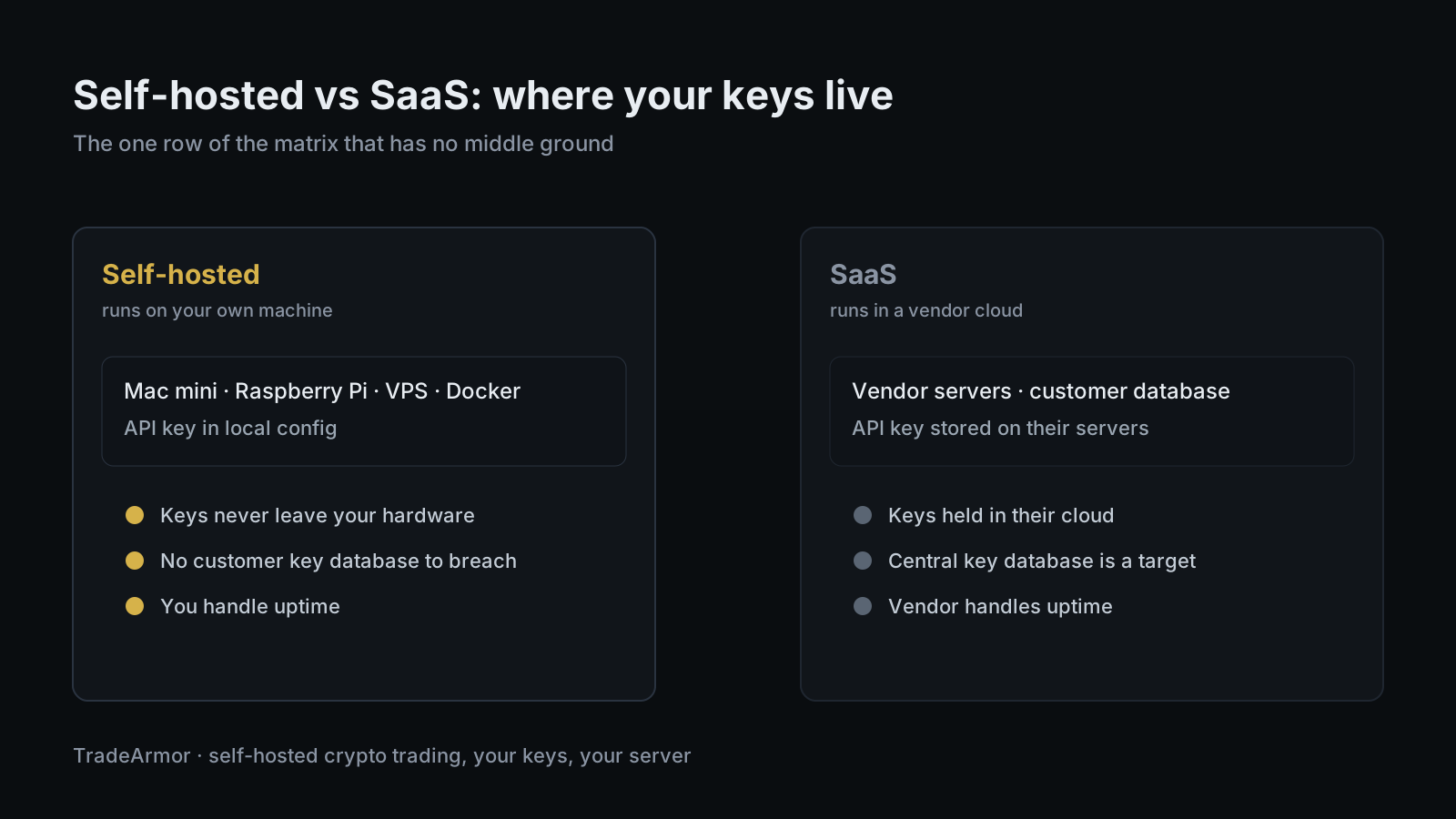
A SaaS crypto bot runs in a company's cloud. You create an account, you connect your exchange by pasting an API key into their dashboard, and from then on the bot places your trades from their servers around the clock. The strength of this model is that there is nothing to install and nothing to keep running. The cost of this model is that your key lives on their infrastructure, and you are trusting that infrastructure with trade access to your account.
A self-hosted crypto bot runs on hardware you control. A Mac mini, a Raspberry Pi, a small VPS, a Docker container, whatever is already on in your house. You install the software, you connect your exchange, and the key sits in a local config file that never gets transmitted anywhere. The strength is custody: there is no vendor server holding your credentials. The historical weakness was that self-hosted meant open-source frameworks with no interface, no signals, and a setup process that assumed you were comfortable in a terminal.
That historical weakness is the part that has changed, and it is why this comparison is worth redoing in 2026 rather than reading a guide from 2021. A managed self-hosted crypto trading bot ships the dashboard, the setup wizard, the signals, and the auto-updates that used to be the SaaS model's whole pitch. The keys still stay home.
The full matrix
Here is the comparison across the dimensions that actually decide the question. Read it by row, not by column, because no single column wins outright.
| Dimension | Self-hosted (managed, e.g. TradeArmor) | Self-hosted (open-source framework) | SaaS bot | Exchange-native bot |
|---|---|---|---|---|
| Where your API keys live | Local config on your machine | Local config on your machine | Vendor's cloud servers | The exchange that also holds your funds |
| Central breach surface | None, no customer key database | None | Vendor key database | Exchange account |
| Setup difficulty | Browser wizard, minutes | Terminal and config files | Account signup, minutes | Built into the exchange |
| Built-in signals | Yes, multi-year track record | No | Sometimes, varies | No |
| Dashboard and monitoring | Real-time web UI plus mobile PWA | Often none by default | Polished web UI | Inside the exchange app |
| Strategy depth | DCA, grid, futures, copy, custom formulas | Code-your-own in Python | Varies by tier | Usually DCA and grid only |
| AI strategy builder | Yes, bring your own key | No | Often, runs on vendor servers | Sometimes |
| Multi-exchange | Six exchanges, one config | Many, you wire each | Many | Locked to that exchange |
| Cost model | One subscription | Free software, your time | Subscription, often stacked | Trading fees |
| Who handles uptime | You | You | Vendor | The exchange |
| Support | Direct support channel | Community forums | Vendor support | Exchange support |
The honest reading of that table: SaaS and managed self-hosted are close on experience now, the exchange-native bots are convenient but narrow and lock you in, and open-source frameworks are free in the way a puppy is free. The single row that does not have a middle ground is the first one. Where your keys live is a binary, and it is the row this entire decision tends to come down to.
If you want to see the managed self-hosted experience in full rather than read about it, the TradeArmor feature set lays out every mode on the engine.
Custody is the line that does not move
Every other dimension in that matrix has a reasonable compromise. Custody does not.
A SaaS bot has to hold a working copy of your API key, because the bot runs on its servers and the server is what places your orders while you sleep. That is not a flaw in any particular company. It is the structural cost of the model. The moment execution lives in someone else's cloud, the credential has to live there too. Which means there is a database, somewhere, with trade access to a lot of people's exchange accounts in it, and that database is a target.
We know how that story goes because it already happened at scale. One of the largest SaaS bots suffered an API key leak that exposed the keys of more than 100,000 users, across breaches in December 2022 and October 2023, with cumulative user losses reported around $22 million. A class action was filed in February 2026, and in March 2026 a US appeals court revived it after a lower court had dismissed it. Those are public, documented facts, not speculation. The lesson traders took from it was not "pick a different SaaS bot." It was "stop putting my keys on a server I do not control."
A self-hosted bot removes that entire category of risk by removing the database. There is no central store of customer keys to breach because the keys are scattered across thousands of individual machines, each one holding exactly one trader's credentials: their own. The right way to scope even that local key is read and trade permission only, never withdrawal, so the key is structurally incapable of moving funds off the exchange in the first place. We walk through that in detail in the guide on running a crypto trading bot without giving up your API keys, and the narrower question of whether a trading bot can withdraw your funds gets its own walkthrough.
This is the row where TradeArmor has an opinion. Keys belong to the owner. We do not run a server that holds them, which means we do not have a customer key database to lose, which means the worst-case breach story that defines the SaaS category structurally cannot happen to a TradeArmor user. That is not marketing. It is arithmetic about attack surface.
Where SaaS genuinely wins
A comparison that pretends the other side has no advantages is not a comparison, it is a pamphlet. SaaS bots earn their place on two real points.
First, uptime is not your problem. A SaaS bot runs in a data center with redundancy and a team watching it. A self-hosted bot runs on whatever you put it on, and if your Raspberry Pi loses power or your laptop sleeps when you close the lid, the bot stops trading until you notice. The fix is to run it on something that stays on, which most self-hosters already have, but the responsibility moves to you. A laptop that sleeps when you close the lid does not make a good trading server. Ask me how I know.
Second, there is genuinely nothing to install. For a trader who has never opened a terminal and does not want to, the SaaS signup flow is shorter than even a good setup wizard. Managed self-hosted bots have closed most of that gap with browser-based setup, but "paste a key into a website" will always be one step shorter than "download, install, then paste a key into a local dashboard." If your priority is the absolute minimum number of steps and you have made peace with the custody trade-off, SaaS is the faster on-ramp.
Those two advantages are real. Whether they outweigh handing a third party trade access to your account is the judgment call only you can make.
Cost: the subscription stack versus one bill
The cost comparison is the one most people get wrong, because they compare a single SaaS subscription to a single self-hosted subscription and call it even. That is not the real stack.
The real SaaS stack for an active trader is often three line items: a charting platform for the analysis, a signal service for the calls, and the bot to execute them. Three subscriptions doing one job. A self-hosted platform with built-in signals collapses that, because the signals ship inside the product and the charts live in the dashboard. TradeArmor's tiers run $19.99, $49.99, and $89.99 per month, and the built-in BTC/USDC signals are included on every one of them, which removes the separate signal-service line entirely.
The catch on the self-hosted side is hardware, and it is worth stating plainly. You supply the machine. For most self-hosters that is a device already running in the house, so the marginal cost is close to nothing, but if you have to buy a Raspberry Pi to run a bot, count it. Open-source frameworks push this further: the software is free, and you pay in setup hours and ongoing maintenance instead of dollars. Free software, your weekends.
Self hosted vs SaaS crypto bot: when each model wins
Strip away the brand names and the decision sorts into a few clean cases.
Pick a SaaS bot if your single highest priority is zero infrastructure, you do not have a machine you are willing to keep on, and you are genuinely comfortable with your keys living on a vendor's servers. That is a coherent position. It is just not the one most burned traders land on.
Pick an open-source framework if you are a developer, you want to write your own strategies in Python, and you treat the absence of signals, UI, and support as features rather than gaps. The ceiling is high and the price is your time.
Pick an exchange-native bot if you only ever trade on one exchange, you want DCA or grid and nothing more, and lock-in does not bother you. It is the most convenient option right up until you want a second exchange or a strategy the exchange does not offer.
Pick a managed self-hosted bot if you want the polished experience, the built-in signals, and the full strategy range, but you are not willing to hand your keys to a third party to get them. This is the case TradeArmor was built for, and it is the case that did not have a good answer until managed self-hosting matured. You get the dashboard and the wizard and the signals, and the keys never leave your hardware.
You ran the SaaS gauntlet or you watched someone else run it. The reason this comparison even has a winner for you is that the self-hosted side finally stopped asking you to choose between custody and convenience.
Closing
The self hosted vs SaaS crypto bot decision is really one question wearing a matrix: are you willing to store the keys to your exchange account on a server you do not control, in exchange for not having to run a machine yourself? If the answer is no, a managed self-hosted platform now gives you the SaaS experience without the SaaS custody risk: built-in signals, 15 indicators, an AI strategy builder, DCA, grid, futures, copy trading, backtesting, and tax exports, all running where your keys stay home. If you are leaving a bot that stopped shipping rather than a SaaS one, the best ProfitTrailer alternative guide covers the same custody logic from the migration angle. See how the tiers line up and what ships in each on the TradeArmor pricing page.
Frequently asked questions
What is the difference between a self-hosted and a SaaS crypto bot? A self-hosted bot runs on hardware you control, so your exchange API keys stay in a local config file and never touch a vendor server. A SaaS bot runs in a company's cloud, which means your keys are stored on their servers and the bot trades on your behalf from there. The trade-off is custody: self-hosted keeps the keys on your machine, SaaS keeps them on someone else's.
Is a self-hosted crypto bot safer than a SaaS one? On one specific axis, yes. A self-hosted bot has no central vendor database of customer API keys to breach, which removes an entire category of risk that has cost SaaS bot users real money. It does not remove market risk, and it does shift uptime and machine security onto you. Safer against breaches, not safer against the market.
Do I need to be a developer to run a self-hosted crypto bot? Not necessarily. Older self-hosted options shipped a bare framework and left setup to you. A managed self-hosted bot like TradeArmor ships a browser-based setup wizard, a real-time dashboard, built-in signals, and auto-updates, so the experience feels like a SaaS product while the keys still stay on your hardware.
Why do SaaS crypto bots need my API keys on their servers? Because the bot runs in their cloud, not on your machine, the server has to hold a copy of your key to place orders around the clock. That is the structural reason a SaaS bot cannot offer self-custody: the execution happens on their side, so the credential lives on their side.
Which model is cheaper, self-hosted or SaaS? It depends on what you count. SaaS bot pricing sits in a wide monthly band, and many users stack a charting subscription and a signal service on top. A self-hosted bot with built-in signals collapses that stack into one bill, though you supply the hardware, which for many people is a device that is already on.
Ed Cava builds TradeArmor and trades with it. He spent years on SaaS bots and open-source frameworks before building the managed self-hosted platform he wanted in the first place.