You are shopping for an AI crypto trading bot again, and the options all look the same this quarter. Every product page grew an AI strategy builder: the assistant that suggests your bot parameters, the engine that scores and rotates your strategies, the chat box that turns a sentence into a trade rule. A year ago "AI-powered" was a selling point. Now it is the default, and the marketing pages blur into each other. Meanwhile you already pay for three things to do one job, TradingView for the charts, a signal service for the calls, and a bot to push the buttons, and now there is a fourth line item waiting for you: the AI tier. Every feature is behind another upgrade. And to use any of it, you hand the same third party your exchange API keys. "I don't want to give my API keys to a third party" was already your position. The AI wave just raised the stakes, because now it is your keys and your strategy logic, both sitting on a server you do not control.
TradeArmor takes the other road. It is a self-hosted crypto trading platform: built-in BTC/USDC signals with a multi-year live track record, 15 real-time technical indicators, a plain-English AI strategy builder, plus DCA, grid, futures, copy trading, backtesting, paper trading, and tax reporting, all running on your own hardware where your API keys never leave your machine. The AI piece is bring your own key. You plug in your own provider, and we pass none of the cost on to you. The strategy you build and the keys it runs on both stay where you can see them.
This is a guide to AI crypto trading done with custody intact. What the AI in a trading bot can actually do and what it cannot, why bring your own key is the only model that makes sense once you think it through, what the cost math really looks like, and how to run the whole thing on your own hardware down to a local model if privacy is the priority. The mechanics matter here more than the marketing, because the AI label hides a design decision that affects your keys.
What AI actually does in a trading bot, and what it does not
Strip the word "AI" of its halo for a second and look at the job. In a trading bot, the useful thing an AI assistant does is translation. You describe a strategy in plain English, "buy when RSI is oversold and Supertrend flips bullish, but only if price is below the 200 EMA," and the assistant converts that into the boolean formula the engine runs:
RSI_BUY && SUPERTREND_BUY && PRICE_BELOW_EMA200
That is genuinely useful. Most traders know exactly what they want and lose an afternoon fighting syntax to express it. The AI closes that gap. It can also read back a formula you already have, explain what it does, flag a condition that will never trigger, and suggest the indicator you forgot. This is the part that earns its place: it makes the strategy builder accessible to people who know markets but do not write code.
Here is what it does not do. It does not know where the market is going. An AI strategy assistant is a language tool, not a crystal ball, and any product implying its model can forecast price is selling the one thing software cannot deliver. The honest framing is narrow and it is the one we hold to: the AI helps you express and validate a strategy faster. Whether that strategy makes money is down to the market, your risk settings, and the discipline to leave a working system alone. The bot removes operational risk, the missed alert, the emotional 3am override, the fat-fingered order. It does not remove market risk, and the moment a vendor's AI copy starts implying it does, you are reading an ad, not a spec.
So the value of AI in a bot is real but bounded. Which means the thing actually worth comparing across products is not whose model is smarter. It is what each product makes you give up to use it.
AI strategy builders are everywhere now. The question is where your strategy lives
This is the shift worth internalizing. As of 2026, AI assistants are standard across the major SaaS bots. Cryptohopper runs an algorithm-intelligence layer that scores and rotates strategies by market condition. Bitsgap ships an AI assistant that suggests bot parameters and portfolio balance across exchanges. 3Commas layers AI tooling over its DCA, grid, and signal bots. Having an AI feature stopped being a differentiator the moment all of them shipped one (roundup of 2026 AI bots).
When everyone has the same feature, the feature is no longer the decision. The architecture under it is.
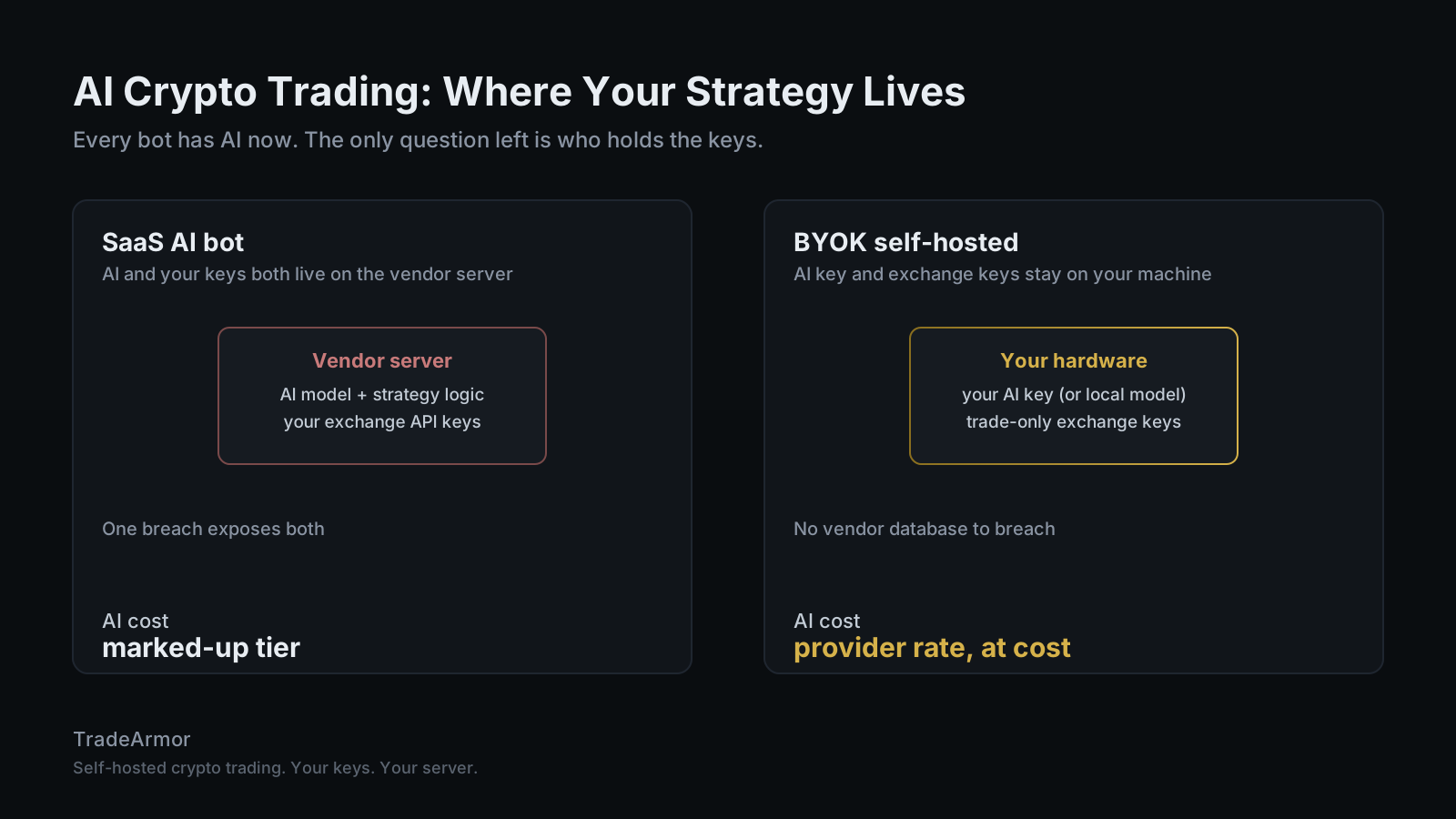
In the SaaS model, that AI assistant runs on the vendor's servers, and to do its job the platform also holds your exchange API keys in its own database. One company, one server, holding both your strategy logic and the keys that move your money. That is a tidy single point of failure. The 2022 breach that exposed thousands of 3Commas-connected API keys was a preview of exactly this risk, and adding AI to the stack does not shrink the target, it adds your strategy data to what an attacker walks away with. The custody question we wrote about in why you should never give a bot withdrawal permission does not go away because the bot got smarter. It gets one layer deeper.
Self-hosted bots invert the model. The bot, the AI integration, and the keys all live on hardware you control. There is no vendor database holding your keys because there is no vendor server in the loop. That is the line that separates the self-hosted approach from the SaaS one, and AI makes it sharper, not softer, because now your strategy logic is part of what you are deciding whether to expose.
If you want to compare every flavor of bot on this one axis, the self-hosted crypto trading bot guide lays out the full landscape and where the custody lines fall. Spoiler: they fall exactly where you would expect once you ask who holds the keys.
What BYOK actually means
BYOK is bring your own key, and in an AI trading context it is doing double duty, because there are two kinds of keys in play.
The first is your exchange API key. On a self-hosted bot that key sits in local config on your machine and carries trade permission only, never withdrawal. The bot can place and cancel orders. It cannot move a coin off the exchange, because you never granted that scope.
The second is your AI provider key. This is the part the SaaS bots quietly take away from you. With BYOK, you create an account directly with a major AI provider, generate a key, and paste it into your own config. The strategy assistant then calls that provider with your key, on your dime, and TradeArmor never sees the key or the bill. You can also point it at a local open-source model running on your own hardware, in which case the text you type never leaves the machine and there is no provider bill at all.
The effect of both keys staying local is that nobody sits between you and your infrastructure. Your exchange relationship is yours. Your AI provider relationship is yours. The bot is the orchestration layer that runs on your hardware and touches both, and it is the only piece you subscribe to. Open-source bots are free, the way a puppy is free, so what you are paying TradeArmor for is the managed experience, the setup wizard, the dashboard, the multi-year signal track record, and the updates, without surrendering either set of keys to get it.
The cost math nobody puts on the pricing page
Here is the part the AI-tier upsell depends on you not thinking about too hard.
When a SaaS bot charges you for "AI features," it is buying inference from a provider in bulk and reselling it to you with a markup baked into a higher subscription tier. You are paying the platform, the platform is paying the model provider, and the spread is the platform's. That is a normal business, but it means your AI cost is whatever the vendor decides the tier should be, not what the compute actually costs.
BYOK collapses the spread to zero. You pay the provider directly at their published rate. A full strategy-building session, where you describe an idea, get it converted to a formula, refine it a few times, and validate it, typically runs a few cents of provider usage. Not a few dollars a month of subscription markup. A few cents, billed to you by your provider, for the actual tokens you used. Run the assistant twice a week and your annual AI spend is closer to a coffee than a software tier.
And if you run a local model, the marginal cost of each AI call is your own electricity. The provider markup is not reduced. It is deleted.
This is the whole argument for BYOK in one line: every bot that bills you for AI is charging you a margin on someone else's compute. The only way to pay cost is to hold the key yourself.
Ready to see the strategy builder, the 15 indicators, and the rest of the platform in one place? See all features.
Running AI crypto trading on your own hardware
The self-hosted path is less work than the word "self-hosted" makes it sound, and the AI layer does not change the setup. You download a ZIP, run pip install -r requirements.txt and python main.py, open the setup wizard at localhost:8080/setup, connect your exchange with a trade-only key, and pick a strategy mode. To turn on the assistant, you paste your AI provider key into config, or point it at a local model. That is the entire AI configuration. No account to create with us, no AI tier to upgrade into.
From there the AI Strategy Assistant lives on its own page in the dashboard. You type what you want in plain language, it returns the formula, and you can drop that formula straight into Custom mode to run a fully autonomous strategy off the 15 indicators, or into Hybrid mode to use it as a filter on top of the built-in BTC/USDC signals. The signals themselves have been running live for more than three years, so a common pattern is to let the proven signal engine generate candidate trades and use an AI-built indicator formula to gate the entries. That is the hybrid sweet spot: signal input you did not have to design, plus a filter layer you described in a sentence.
None of this narrows the platform to a chat box. The AI assistant is one surface on a system that also runs a 20-level DCA engine with cost-basis gating, a grid bot for range-bound markets, futures with stop-loss and trailing take-profit, peer-to-peer copy trading, backtesting across all three strategy modes, paper trading on live data, and one-click tax exports to the usual destinations. The AI helps you build a rule. The platform is what executes it, monitors it, and reports on it, on your machine, under exchange keys that can never withdraw. If you want to see how the rule engine actually decides when to buy, the breakdown of gated DCA versus simple DCA walks through the exact gates an AI-built formula plugs into.
The exchange plumbing under all of it is the open CCXT library, the same connector layer most serious bots use, which is why TradeArmor speaks to eight exchanges out of the box without a vendor account standing in the middle.
How to evaluate an AI trading bot in 2026
Strip the AI marketing and ask five questions. They sort the field fast.
Where does the AI run, on the vendor's servers or on hardware you control. Who holds your exchange API keys, a vendor database or your local config. Can the exchange key withdraw, or is it trade-only. Do you pay for AI at cost through your own provider key, or at a marked-up tier. And can you see the rule the AI built, in plain formula syntax, or is it a black box that just says "trust me."
A self-hosted, BYOK, trade-only, cost-priced, transparent-formula bot answers all five the way a self-custody trader wants. Most SaaS bots answer at least three of them the other way, and the AI tier they are selling you is the one that quietly adds your strategy to the pile of things living on their server. The feature is the same everywhere now. The architecture is the entire decision.
FAQ
What does BYOK mean in AI crypto trading? BYOK stands for bring your own key. You supply your own AI provider key and your own exchange API keys, and both stay in local config on the machine you run the bot on. You pay your AI provider directly at cost, and the trading tool never sits between you and the bill.
Can AI predict crypto prices or guarantee profits? No. The AI in a trading bot is a translation layer that turns plain English into a boolean rule and validates strategies you describe. It does not forecast price. Past performance is not indicative of future results, and signals are algorithmic outputs, not investment advice.
Is a self-hosted AI trading bot more private than a SaaS one? Yes, on the axis that matters: your exchange keys and AI key stay local, and with a local model the AI inference happens on your own hardware. A SaaS bot runs the AI on its servers and stores your keys in its database, so one breach exposes both.
Do I have to pay extra for the AI features in TradeArmor? TradeArmor passes on no AI usage fee. The assistant is bring your own key, so your only AI cost is what your provider charges, usually a few cents per strategy session. The assistant, 15 indicators, custom formulas, and hybrid mode are included on Pro and up at a flat price.
Can I run the AI strategy builder with a local model? Yes. The assistant supports a local open-source model on your own hardware, so the text you type never leaves the machine and there is no per-call bill. It needs enough hardware to run well, so a cloud provider key is the simpler default for most users.
The bottom line
AI crypto trading is no longer a feature you shop for, because every bot has it. What you are actually choosing is an architecture: whether your strategy logic and your exchange keys live on a vendor's server or on your own hardware. TradeArmor is the self-hosted answer, a full platform with built-in signals, 15 indicators, a bring-your-own-key AI strategy builder, DCA, grid, futures, copy trading, backtesting, and tax reporting, all running where your keys never leave your machine and your AI costs are billed to you at cost. Build the strategy in plain English, run it on hardware you control, and pay nobody a markup on someone else's compute. See the plans and get started.