Bitsgap Alternative: One Bot, No Subscription Stack
Bitsgap does one thing better than almost anyone: it makes grid and DCA bots feel approachable. Clean dashboard, an AI Assistant that suggests bot parameters, an arbitrage scanner running across a long shelf of exchanges, a demo mode so you can practice before risking real money. For a lot of traders that is the on-ramp into automation. So why do so many of them eventually type "bitsgap alternative" into a search bar, and the answer has almost nothing to do with the bots. The first reason is the pricing shape, where "every feature is behind another upgrade tier," and the Advanced plan carries a $100,000 monthly trading volume cap sitting on top of the $69 you already pay. The second reason is quieter and older. "I don't want to give my API keys to a third party," which is a fair thing to want from a cloud service that needs those keys to function at all.
This is a guide to what a self-hosted Bitsgap alternative actually changes, and what it does not. I build one of them, so read this with that in mind. It is not a hit piece, and Bitsgap has earned real credit I will hand it below before I make the case against the model.
The alternative here is TradeArmor, a self-hosted crypto trading platform. It runs built-in BTC/USDC signals with a 3+ year track record, 15 real-time technical indicators, a plain-English AI strategy builder, DCA, grid, futures, copy trading, backtesting, paper trading, and tax exports, all on your own hardware where your API keys never leave your machine. The same categories of automation Bitsgap runs, plus bundled signals, minus the monthly meter and the vendor key store.
What Bitsgap gets right, credited plainly
An honest alternative page starts by saying what the incumbent does well, so here it is without hedging.
Bitsgap is non-custodial in the way that matters most: your funds never leave your exchange. It sends trade instructions over the API and nothing else. It automatically rejects any API key that has the withdrawal permission switched on, and it encrypts stored keys with RSA 2048-bit encryption behind API-lock and device-fingerprinting layers. That is a serious posture, and the withdrawal-key rejection in particular is a good default that more platforms should copy. If you were worried Bitsgap can drain your exchange balance, it cannot, because a trade-only key physically cannot move coins off the exchange.
The product breadth is real too. Grid, DCA, a combo bot that runs both at once, futures bots, an arbitrage scanner, smart orders with trailing features, and portfolio tracking across 17 or more connected exchanges. If your whole trading life is grid bots spread over a dozen venues, Bitsgap is built for exactly that, and I am not going to pretend a self-hosted bot replicates the cross-exchange arbitrage scanner. It does not.
So the case for switching is not "Bitsgap is unsafe." It is narrower and more structural, and it comes down to two words: the store.
The one architectural difference
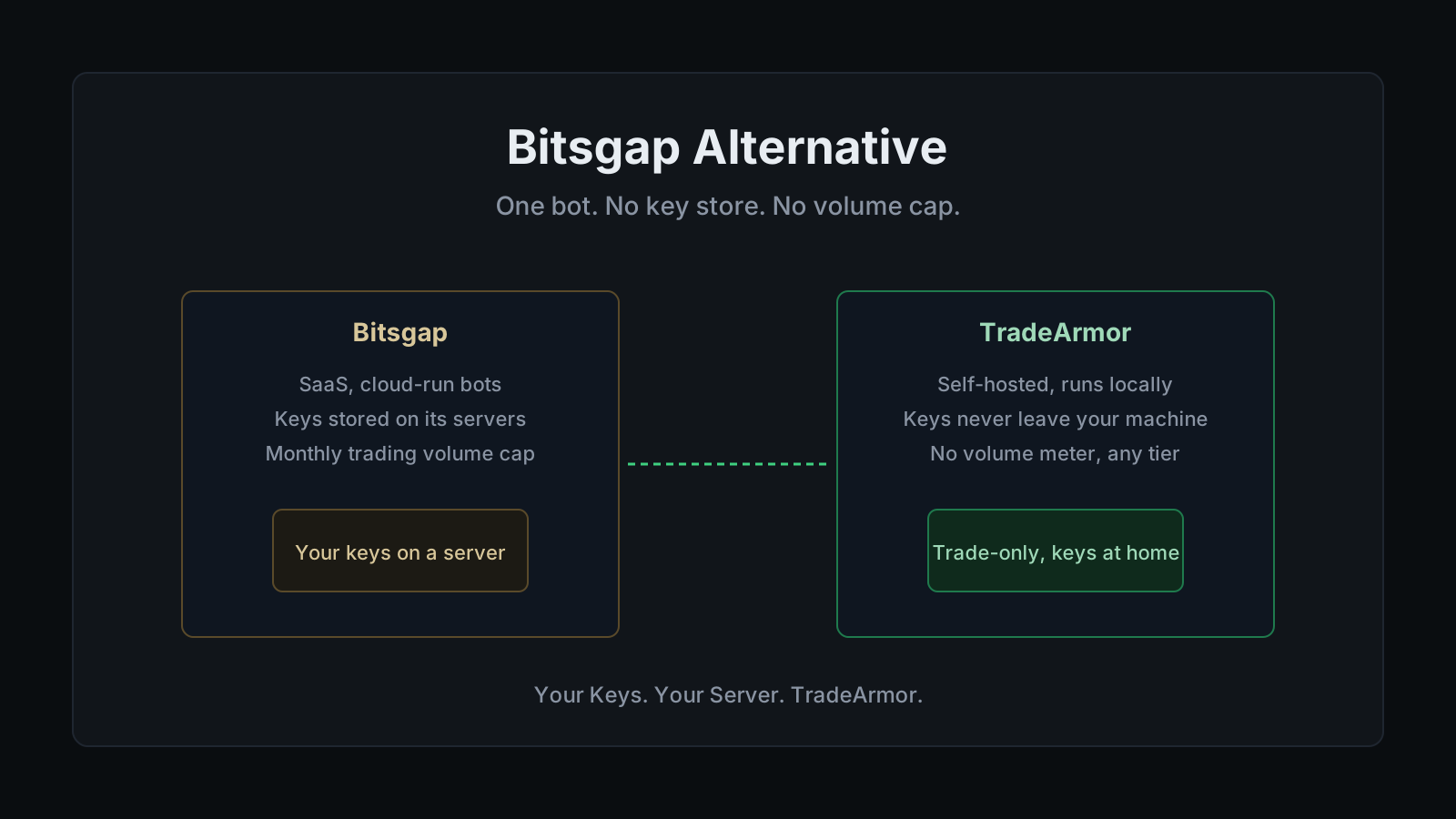
Here is the distinction Bitsgap's own security page phrases carefully, and that every cloud bot shares. Non-custodial refers to your funds. It does not refer to your keys. To run a bot from the cloud, Bitsgap has to hold your exchange API keys on its servers. Encrypted to a bank-grade standard, locked down, rejected outright if they carry withdrawal rights, but held. That is not a knock on Bitsgap specifically. It is the cost of the SaaS model. A server that trades for you needs your keys somewhere the server can reach them.
A self-hosted bot removes the store instead of hardening it. You download TradeArmor, run it on a Mac mini, a Linux box, a Raspberry Pi, or a VPS, and your API key sits in a local config file on that machine. It is never transmitted to a TradeArmor server, because there is no TradeArmor server in the trade path. There is no customer key database to breach, because the keys are on your hardware. The correct permission set is still two scopes, read and trade, never withdraw, exactly as it is on Bitsgap. The only thing that changes is where those two-scope keys physically live. On Bitsgap they live on Bitsgap's infrastructure. On a self-hosted bot they live on yours.
If you want the full reasoning on why two permissions is the only correct number, the API key risk walkthrough covers it end to end, and the self-hosted versus SaaS breakdown lays out the whole trade matrix. You can also see the full feature set here.
The subscription math, without the spin
As of mid-2026 Bitsgap runs three paid tiers: roughly $29 per month for Basic, $69 for Advanced, and $149 for Pro, with 20 percent off if you pay annually and a 7-day full-access trial that needs no card. Basic caps you at two active bots. Advanced raises that to five, adds futures and the arbitrage scanner, and attaches a $100,000 monthly trading volume limit. Pro removes the cap. A trading bot with a monthly volume ceiling is an interesting product category. You pay every month, and the plan still has an opinion about how much you are allowed to trade.
TradeArmor puts signals, the DCA engine, the full dashboard, tax exports, and all eight exchanges on the $19.99 Starter tier, then the strategy builder, indicators, AI assistant, and copy trading on Pro at $49.99, with the top tier at $89.99. Every plan carries a 30-day money-back guarantee, and no tier meters your trading volume.
Then there is the stack most traders forget to count. If you pay for charting, a signal source, and a bot as three separate subscriptions, you are running three bills to do one job. Bitsgap bundles the charts and the bots, which is genuinely useful, but it does not bundle a signal engine with a public track record. TradeArmor folds the signals into the bot itself. Price the two platforms on total monthly outlay and on where your keys sit, not on the first line of the pricing table.
The feature comparison, straight
Set custody and pricing aside for a paragraph and look at what each platform does, because breadth is where the anti-narrowing point lives. A Bitsgap alternative that only runs one kind of bot is not an alternative.
Bitsgap runs grid, DCA, a combined grid-plus-DCA bot, futures bots, an arbitrage scanner, smart orders, and an AI Assistant that proposes parameters, all across a wide exchange list. TradeArmor runs DCA with unlimited levels, grid, futures with stop-loss and trailing take-profit, copy trading through a peer-to-peer proxy with no custodial middleman, trading groups so different coin baskets run different strategies at once, 15 real-time indicators feeding a boolean formula engine, backtesting, paper trading, and one-click tax exports to Koinly and CoinTracker. If your interest is specifically the grid and DCA side, the best crypto DCA bot guide and the grid trading walkthrough go deep on how those engines decide when to buy and sell.
The one feature TradeArmor ships that a SaaS bot structurally cannot match is bundled signals with a live history. The Cava-signals have generated BTC/USDC spot entries and exits for more than three years, and they are included on every tier, so a new user can install, connect an exchange, and trade proven signals without designing a strategy or renting one first. Signals are algorithmic outputs, not personalized recommendations, and past performance never guarantees future results. There is also a path Bitsgap has no equivalent for. If you are arriving not from Bitsgap but from ProfitTrailer, TradeArmor ships a dedicated one-click ProfitTrailer migration that imports your open positions and DCA legs and matches the EQPRICE buy-gate logic, so you keep your book intact instead of rebuilding it. ProfitTrailer taught a lot of us how to run a DCA bot, then it stopped shipping, and TradeArmor picked up the work.
Who should actually switch to a Bitsgap alternative
The trader who benefits most is the one who liked Bitsgap for the approachable grid and DCA bots, then got uneasy about the keys living on a server, and got tired of climbing the tier ladder only to hit a volume ceiling. You want the managed experience. You do not want a company holding trade permissions on your account, you would rather own your automation than rent access to it by the month, and you would rather not have a plan cap how much you can trade. That profile is exactly the gap a self-hosted bot with bundled signals fills.
It is not for everyone. If your trading revolves around Bitsgap's cross-exchange arbitrage scanner or its very long exchange list, or you want zero responsibility for your own uptime and are comfortable with the SaaS trade-off, staying put is a reasonable call. I will not pretend a Raspberry Pi in a drawer maintains itself. But if the key-custody question is the one keeping you up, self-hosting is the only answer that resolves it rather than mitigating it. You can see how the whole field compares in the best self-hosted crypto trading bot guide, and if you are weighing other SaaS names too, the 3Commas alternative, Cryptohopper alternative, and Gunbot alternative breakdowns cover the rest of that shortlist.
Frequently asked questions
Is TradeArmor a drop-in replacement for Bitsgap? Not a drop-in in the technical sense, because there is no config importer between a SaaS platform and a self-hosted one. It is a replacement in the practical sense: it runs the same categories of bots, ships signals Bitsgap does not bundle, charges no volume meter, and does it all without holding your keys. Expect an afternoon of setup and a week of paper trading rather than a one-click import, unless you are coming from ProfitTrailer, which does have a one-click path.
Does TradeArmor have grid and DCA bots like Bitsgap? Yes. TradeArmor runs grid and DCA on the same engine, with DCA supporting unlimited levels and a gated buy logic that matches ProfitTrailer's EQPRICE formula. The difference is that both run on your own machine, and the DCA and grid engines are covered on every plan rather than gated behind a higher tier.
Will switching to a self-hosted bot make my trading safer? It reduces operational risk, the kind that comes from a company breach, an outage, or handing keys to a third party. It does not touch market risk. The bot executes rules, and the market does what it does. Self-custody means you control every decision and own every outcome, which is the entire point.
What happens to my open Bitsgap positions if I move? You manage the transition yourself. Let existing Bitsgap bots run down or close them, stand up the equivalent strategy in TradeArmor, paper trade it to confirm behavior, then point it at live capital. Because the two platforms do not share a data format, plan for a short overlap rather than an instant cutover.
What is the best self-hosted Bitsgap alternative? If what you like about Bitsgap is the approachable grid and DCA bots, the demo mode, and the clean dashboard, but what you do not like is that a SaaS company holds your exchange API keys and meters your monthly trading volume, the closest match is a self-hosted bot that keeps the managed experience. TradeArmor fits that: it runs on your own hardware with trade-only API keys that never leave your machine, and it ships built-in BTC/USDC signals with a 3+ year track record, 15 technical indicators, a plain-English AI strategy builder, DCA, grid, futures, copy trading, backtesting, paper trading, and tax exports. You keep the automation that made Bitsgap attractive, and you drop the vendor key store and the volume cap.
Is Bitsgap safe to use? Bitsgap has a genuinely strong security posture. It is non-custodial for your funds, meaning your assets never leave your exchange, it automatically rejects any API key that has the withdrawal permission enabled, and it encrypts stored keys with RSA 2048-bit encryption behind API-lock and device-fingerprinting layers. Follow its guidance and Bitsgap cannot move coins off your exchange, because a trade-only key physically cannot withdraw. The structural caveat is the one no setting removes: to run bots from the cloud, Bitsgap has to store your keys on its servers. Encrypted and locked down, but present. A self-hosted bot removes that store entirely, because the keys sit in a config file on your own machine and are never transmitted anywhere.
How much does Bitsgap cost compared to TradeArmor? As of mid-2026 Bitsgap runs three paid tiers, roughly $29 per month for Basic, $69 for Advanced, and $149 for Pro, with 20 percent off annual billing and a 7-day full-access trial that needs no card. The tiers gate the number of active bots and the feature set, and the Advanced plan carries a $100,000 monthly trading volume limit. TradeArmor starts at $19.99 per month, moves to $49.99 for Pro and $89.99 at the top, every plan carries a 30-day money-back guarantee, and there is no trading-volume meter on any tier. On entry price TradeArmor is lower, and the comparison that matters is what each price includes and where your keys sit.
Does a self-hosted bot lose Bitsgap features? You lose some breadth and gain custody. Bitsgap connects to 17 or more exchanges and runs a cross-exchange arbitrage scanner, which is a real advantage if you trade the same pairs across many venues. TradeArmor supports eight exchanges out of the box, Binance US, Binance Global, Coinbase, Bybit, OKX, Bitget, KuCoin, and Hyperliquid, with more available on request, and it does not try to replicate the multi-venue arbitrage scanner. Where TradeArmor pulls ahead is the combination a SaaS bot structurally cannot offer: bundled signals with a live track record, a plain-English strategy builder that runs on your own AI key with no markup, and the fact that no company holds your credentials. If your trading depends on an exchange TradeArmor does not cover, check the supported list before switching.
Why self-host instead of using a SaaS bot like Bitsgap? The one-line answer is where the keys live. A SaaS bot runs the automation on its servers and needs your exchange API keys stored there to do it, encrypted and withdrawal-disabled, but stored. A self-hosted bot runs the same automation on your own machine, so the keys stay local and there is no vendor database holding them. You take on your own uptime in exchange, which for most people is a Raspberry Pi or a Mac mini left running. It reduces operational risk. It does not remove market risk, and trading still carries the full risk of loss.
Bottom line
Bitsgap and a self-hosted bot agree on a lot. Automation should be approachable, funds should stay on your exchange, and a withdrawal-enabled key has no business anywhere near a bot. Bitsgap enforces most of that well. Where they part is the key store and the meter. Bitsgap holds your encrypted keys on its servers to run the bots from the cloud, and it prices access by the tier and, on Advanced, by the month's trading volume. A self-hosted Bitsgap alternative like TradeArmor keeps the grid and DCA bots, adds bundled signals with a 3+ year track record, and runs the full spread of futures, copy trading, indicators, backtesting, paper trading, and tax exports, while your API keys never leave your machine and no plan caps how much you trade. You give up multi-exchange arbitrage breadth. You get custody, bundled signals, and one subscription instead of a stack.
If that trade sounds right, the broadest case lives in the best self-hosted crypto trading bot guide, and the cleanest next step is to see the plans and start.
Past performance is not indicative of future results. Signals are algorithmic outputs, not personalized investment advice. Trading cryptocurrency carries substantial risk including the total loss of capital.
Ed Cava