Cryptohopper Alternative: Signals Included, Keys Stay Local
Cryptohopper's whole identity is the marketplace. Strategies to rent, signals to subscribe to, copy bots that mirror a trader you have never met, an AI designer that stitches 130 indicators into a rule set, all wrapped in a polished cloud dashboard. It is a lot of product. The reason people still end up typing "cryptohopper alternative" into a search bar has almost nothing to do with any of that. It is the line in the setup guide that asks you to hand your exchange API keys to a company server, sitting next to the slow realization that the features you actually want keep living one tier up. "I don't want to give my API keys to a third party" and "every feature is behind another upgrade tier" are the two sentences under most of these searches.
Cryptohopper, to its credit, is honest about the security shape. Its own guidance tells you to disable the withdrawal permission on the API key, turn on two-factor authentication, and whitelist Cryptohopper's server addresses so trades can only fire from its infrastructure. That is good advice, and you should follow it on any platform. It also quietly concedes the architecture. Your keys are encrypted in Cryptohopper's database and stored on its servers, because that is the only way a cloud bot can trade for you. Trade-only permission is the smart setting. It is not the same as the keys simply not being there to steal.
The self-hosted option here is TradeArmor, which I build, and this is not a hit piece. TradeArmor is a self-hosted crypto trading platform with built-in BTC/USDC signals carrying a 3+ year track record, 15 technical indicators, a plain-English AI strategy builder, DCA, grid, futures, copy trading, backtesting, paper trading, and tax exports, all running where your API keys never leave your machine. The same categories of bots Cryptohopper runs, minus the part where your credentials sit in a vendor database waiting to become interesting to someone.
The one difference that drives every other difference
Most alternative guides bury custody halfway down. This one leads with it, because for a cloud bot it is the whole conversation.
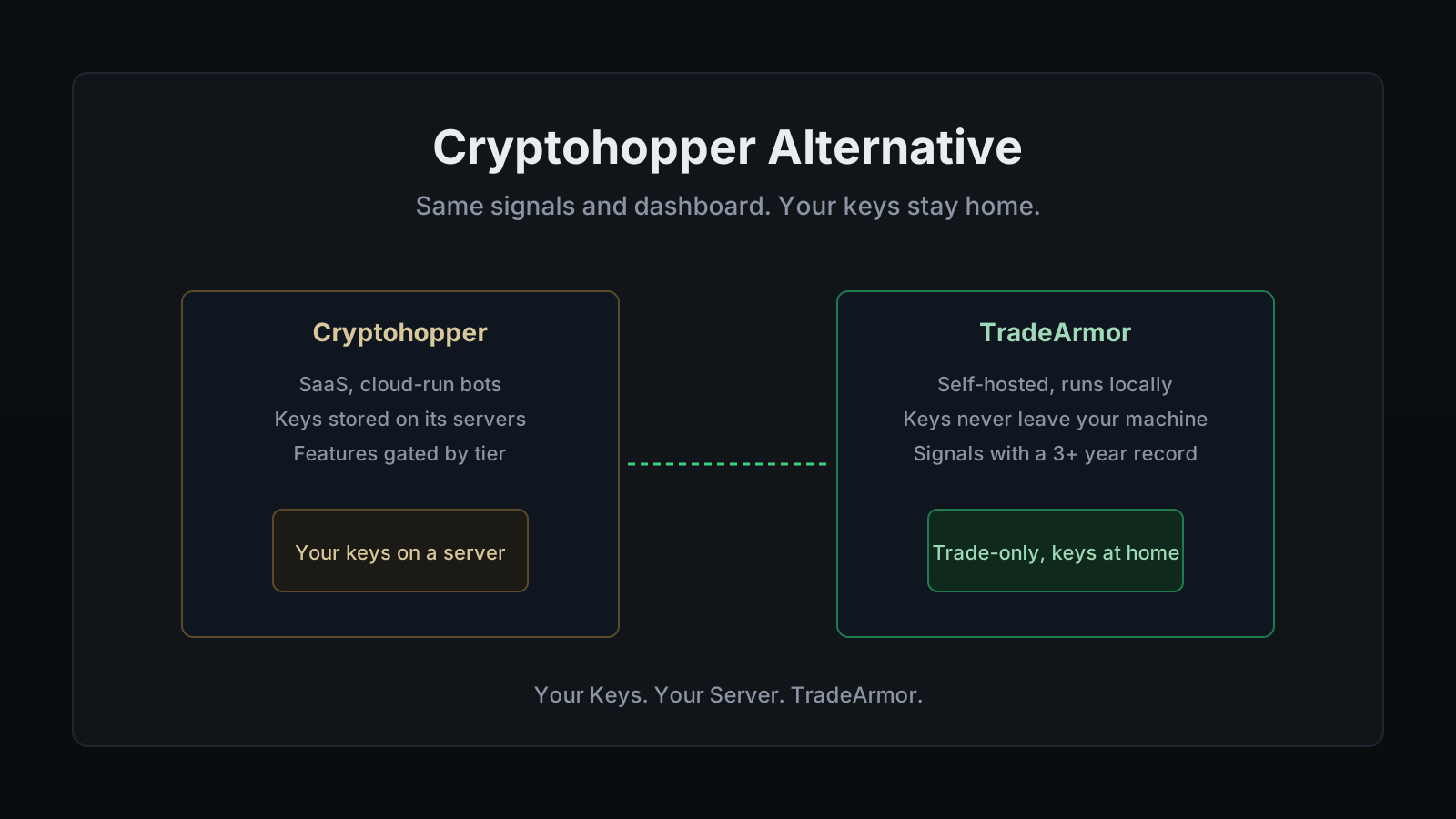
Cryptohopper is Software-as-a-Service. You connect your exchange by giving Cryptohopper an API key, that key gets stored on its infrastructure, and its cloud runs your bots against your account. The model is genuinely convenient. It is also why a breach of the company, an outage, or an insider mistake can become a problem in your account, and why "trade-only" permissions, while correct, are a mitigation rather than a removal of the risk. The store still exists. Any store of trade-enabled keys is a target.
TradeArmor inverts that. You run the bot on your own hardware, a Mac mini, a Linux box, a Raspberry Pi, or a VPS, and the API key sits in a local config file that never gets transmitted anywhere. There is no TradeArmor customer database holding keys, because the keys are on your machine. The correct permission set is two scopes, read and trade, and never the third one, withdraw. If you want the full mechanics of why two is the only right number, the API key security walkthrough covers it end to end, and the deeper security guide goes further into what each permission actually exposes.
So if you are choosing between Cryptohopper and a self-hosted bot, you are really answering one question. Do you want the automation running on a company's servers with your keys, or on your own machine with your keys? Everything else is a detail. This one is the architecture. If you want the wider frame first, the self-hosted versus SaaS breakdown lays out the full trade matrix, and you can see the whole feature set here.
Is Cryptohopper safe? The honest answer
This question gets searched almost as often as the alternative one, so it deserves a straight answer instead of a scare.
Cryptohopper is a real company that has operated for years, encrypts stored keys, runs behind a web application firewall, and publishes clear instructions for locking a key down to trade-only with IP whitelisting. Do all of that and the platform cannot withdraw your coins, because a key without withdrawal permission physically cannot move funds off the exchange. In that narrow sense, yes, it is safe to use.
The honest caveat is the one that applies to every SaaS bot, Cryptohopper included. Safety on this model depends on a chain of things you do not control: the company's servers not being breached, its staff not making a mistake, and its key store staying encrypted and intact. You are trusting an operator, and most of the time that trust is well placed. Self-hosting changes the question from "do I trust this operator" to "do I trust my own machine," which is a question you can actually answer. That is the difference between reducing a risk and removing it.
What you give up, honestly
A fair alternative guide admits what the incumbent does better, so here it is.
Cryptohopper has scale and a marketplace culture. It connects to 16 or more exchanges, it runs a large ecosystem of rentable strategies, templates, and copy bots, and its AI Strategy Designer lets you assemble rules from a deep indicator library. If your goal is to browse and subscribe to other people's automation, that marketplace is a real feature and TradeArmor does not try to replicate it. Pretending otherwise would insult your intelligence.
TradeArmor supports eight exchanges out of the box, Binance US, Binance Global, Coinbase, Bybit, OKX, Bitget, KuCoin, and Hyperliquid, with more available on request through the same framework. If your trading lives on an exchange outside that list, check the supported set before you switch, because that is a genuine reason to stay put. The AI story is also different, and this is where the model matters. Every SaaS bot that charges for an AI tier is billing you for provider tokens with a markup on top. TradeArmor's AI strategy builder is bring-your-own-key: you plug in your own AI provider, and none of that cost passes through us. The honest summary is that you trade some marketplace breadth for custody. For the trader who came looking for a Cryptohopper alternative in the first place, that is usually the right trade.
The feature comparison, straight
Set custody aside for a paragraph and look at what each platform actually does, because breadth is where the anti-narrowing point lives. A Cryptohopper alternative that only does one thing is not an alternative.
Cryptohopper runs DCA, grid, an indicator-driven strategy designer, a signal and strategy marketplace, and copy bots, gated across its tiers. TradeArmor runs DCA with unlimited levels, grid, futures with stop-loss and trailing take-profit, copy trading through a peer-to-peer proxy with no custodial middleman, trading groups so different coin baskets run different strategies at once, 15 real-time indicators feeding a boolean formula engine, backtesting, paper trading, and one-click tax exports to Koinly and CoinTracker. The one feature TradeArmor ships that a SaaS bot structurally cannot match is bundled signals with a live history. Cava-signals have generated BTC/USDC spot entries and exits for more than three years, and they are included on every tier, so a new user can install, connect an exchange, and trade proven signals without designing a strategy or renting one from a marketplace first.
There is also a path Cryptohopper has no equivalent for. If you are arriving not from Cryptohopper but from ProfitTrailer, TradeArmor has a dedicated one-click ProfitTrailer migration that imports your open positions and DCA legs and matches the EQPRICE buy-gate logic, so you keep your book intact instead of rebuilding it.
Pricing, without the spin
As of mid-2026 Cryptohopper runs a free Pioneer plan that only covers manual trading and portfolio management, then paid automation tiers billed annually at roughly $24.16 per month for Explorer, $57.50 for Adventurer, and $107.50 for Hero, with a short trial on Explorer. The free plan is real, but it does not automate, so the first tier that actually runs a bot is Explorer.
TradeArmor puts signals, the DCA engine, the full dashboard, tax exports, and all eight exchanges on the $19.99 Starter tier, and the strategy builder, indicators, AI assistant, and copy trading on Pro at $49.99. The top tier is $89.99, which lands under Cryptohopper's Hero. Every plan carries a 30-day money-back guarantee.
Then there is the stack most traders forget to count. If you are paying for charting, a signal source, and a bot separately, you are running three subscriptions to do one job. Bundling the signals into the bot is not a rounding error. Price the two platforms on total monthly outlay and on where your keys sit, not on the first line of the pricing table.
Who should actually switch to a Cryptohopper alternative
The trader who benefits most is the one who liked Cryptohopper for the dashboard and the built-in automation, then got uneasy about the keys living on a server, and got tired of watching the good tools sit one tier up. You want the managed experience. You do not want a company holding trade permissions on your account, and you would rather own your automation than rent it from a marketplace. That profile is exactly the gap a self-hosted bot with bundled signals fills.
It is not for everyone. If your trading revolves around Cryptohopper's marketplace, or you want zero responsibility for your own uptime and are comfortable with the SaaS trade-off, staying put is a reasonable call, and I will not pretend a Raspberry Pi in a drawer maintains itself. But if the key-custody question is the one keeping you up, self-hosting is the only answer that actually resolves it. You can see how the whole field compares in the best self-hosted crypto trading bot guide, and if you are weighing other SaaS names too, the 3Commas alternative and Gunbot alternative breakdowns cover the rest of that shortlist.
Frequently asked questions
Is TradeArmor a drop-in replacement for Cryptohopper? Not a drop-in in the technical sense, because there is no config importer between a SaaS platform and a self-hosted one. It is a replacement in the practical sense: it runs the same categories of bots, ships signals Cryptohopper does not bundle, and does it all without holding your keys. Expect an afternoon of setup and a week of paper trading rather than a one-click import, unless you are coming from ProfitTrailer, which does have a one-click path.
Does TradeArmor have an AI strategy builder like Cryptohopper's AI Designer? Yes, and the difference is where it runs and what it costs. TradeArmor's builder takes a plain-English description and turns it into a boolean rule the bot executes, and it runs on your own AI provider key with no cost marked up and passed on. Your strategy and your keys stay on your hardware instead of on a vendor's servers.
Will switching to a self-hosted bot make my trading safer? It reduces operational risk, the kind that comes from a company breach, an outage, or handing keys to a third party. It does not touch market risk. The bot executes rules; the market does what it does. Self-custody means you control every decision and own every outcome, which is the point.
What happens to my open Cryptohopper positions if I move? You manage the transition yourself. Let existing Cryptohopper bots run down or close them, stand up the equivalent strategy in TradeArmor, paper trade it to confirm behavior, then point it at live capital. Because the two platforms do not share a data format, plan for a short overlap rather than an instant cutover.
What is the best self-hosted Cryptohopper alternative? If what you like about Cryptohopper is the managed dashboard, the built-in signals, and the range of automation, but what you do not like is that a SaaS company stores your exchange API keys, the closest match is a self-hosted bot that keeps the managed experience. TradeArmor fits that: it runs on your own hardware with trade-only API keys that never leave your machine, and it ships built-in BTC/USDC signals with a 3+ year track record, 15 technical indicators, a plain-English AI strategy builder, DCA, grid, futures, copy trading, backtesting, paper trading, and tax exports. You keep the polish that made Cryptohopper attractive, and you drop the part where your keys live in a company database.
Is Cryptohopper safe to use? Cryptohopper is a legitimate company with real security practices. Its own guidance is sound: disable the withdrawal permission on your API key, enable two-factor authentication, and whitelist Cryptohopper's server IP addresses so trades can only originate from its infrastructure. Follow that and your funds stay on the exchange, because a trade-only key cannot move coins off it. The structural caveat is the one no configuration removes: to run your bots from the cloud, Cryptohopper has to store your keys on its servers. Encrypted, firewalled, and IP-locked, but present. A self-hosted bot removes that store entirely, because the keys sit in a config file on your own machine and are never transmitted anywhere.
How much does Cryptohopper cost compared to TradeArmor? As of mid-2026 Cryptohopper runs a free Pioneer plan that only allows manual trading, then paid automation tiers billed annually at roughly $24.16 per month for Explorer, $57.50 for Adventurer, and $107.50 for Hero, with a short trial on Explorer. TradeArmor starts at $19.99 per month with a 30-day money-back guarantee. On the entry price, TradeArmor is lower and it includes automation, where Cryptohopper's free tier does not. The comparison that matters is what each price includes and where your keys sit: Cryptohopper gates indicators, bots, and its AI designer by tier and stores your keys on its servers, while TradeArmor puts signals, DCA, and all eight exchanges on the entry tier and keeps every key local.
Does a self-hosted bot lose Cryptohopper features? You lose some breadth and gain custody. Cryptohopper connects to 16 or more exchanges and runs a large strategy marketplace built over years, which is a genuine advantage if you want to browse and rent other people's bots. TradeArmor supports eight exchanges out of the box, Binance US, Binance Global, Coinbase, Bybit, OKX, Bitget, KuCoin, and Hyperliquid, with more available on request. Where TradeArmor pulls ahead is the combination a SaaS bot structurally cannot offer: bundled signals with a live track record, a plain-English strategy builder that runs on your own AI key with no markup, and the fact that no company holds your credentials. If your trading depends on an exchange TradeArmor does not cover, check the supported list before switching.
Can I move my Cryptohopper strategies to TradeArmor? There is no one-click importer, because Cryptohopper configurations live inside its cloud platform rather than in a portable file. What transfers is the intent: a DCA ladder with its spacing and safety-order sizing, a grid range, a set of indicator conditions, a take-profit percentage all map onto TradeArmor's strategy builder. Rebuild the bot, paper trade it for a week against live market data, then commit capital. If you are coming from ProfitTrailer instead, that path is easier, because TradeArmor ships a dedicated one-click ProfitTrailer migration that imports open positions and DCA legs.
Why self-host instead of using a SaaS bot like Cryptohopper? The one-line answer is custody. A SaaS bot runs the automation on its servers and needs your exchange API keys stored there to do it. That is convenient, and it also means a company breach, outage, or insider mistake can reach your trading account. A self-hosted bot runs the same automation on your own machine, so the keys stay local and there is no vendor database holding them. You take on your own uptime in exchange, which for most people is a Raspberry Pi or a Mac mini left running. It reduces operational risk. It does not remove market risk, and trading still carries the full risk of loss.
Bottom line
Cryptohopper and a self-hosted bot agree on one thing: automation should be polished and it should include the tools you need. They disagree on the thing that matters most, which is where your keys live. Cryptohopper stores them on its servers to run the bots, encrypted and locked down, but stored. A self-hosted Cryptohopper alternative like TradeArmor keeps the polished dashboard, the bundled signals with a 3+ year track record, and the full spread of DCA, grid, futures, copy trading, indicators, backtesting, paper trading, and tax exports, while your API keys never leave your machine. You give up marketplace breadth. You get custody, bundled signals, and one subscription instead of a stack.
If that trade sounds right, the broadest case lives in the best self-hosted crypto trading bot guide, and the cleanest next step is to see the plans and start.
Past performance is not indicative of future results. Signals are algorithmic outputs, not personalized investment advice. Trading cryptocurrency carries substantial risk including the total loss of capital.
Ed Cava