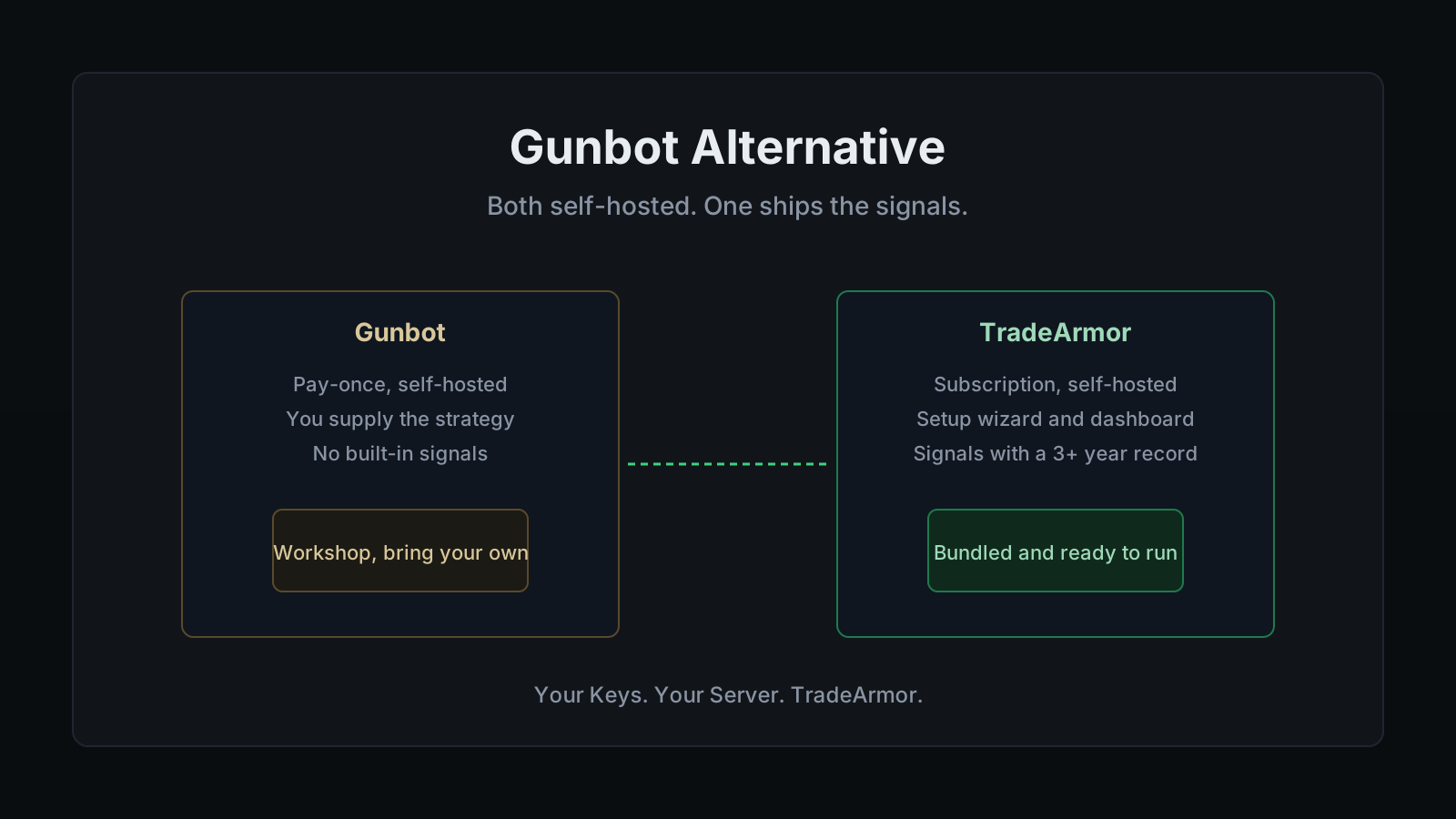
Gunbot Alternative: Self-Hosted, With the Signals Included
Gunbot will trade almost anywhere. Hundreds of exchanges, DeFi venues like PancakeSwap and dYdX, twenty-plus strategy presets, and a pay-once license you own for good. It has been around since 2016 and it is a genuinely serious tool. It is also why a certain kind of trader ends up looking for a Gunbot alternative around midnight: the power is real, and so is the setup. You wanted a bot. You got a strategy IDE.
That is the honest tension. If you have ever thought "I need something between plug-and-play and write-your-own," or "I don't want to write JavaScript strategies just to run a DCA ladder," you have found the exact edge where Gunbot's freedom turns into homework. Gunbot gives you a workshop full of tools and trusts you to build the thing. Some people want that. Some people want the thing.
This guide is for the second group, and it is not a takedown. Gunbot earns its reputation. The self-hosted option here is TradeArmor, which I build: a self-hosted crypto trading platform with built-in BTC/USDC signals carrying a 3+ year track record, 15 technical indicators, a plain-English AI strategy builder, DCA, grid, futures, copy trading, backtesting, paper trading, and tax exports, all running where your API keys never leave your machine. Same self-custody foundation as Gunbot. A very different amount of assembly required.
First, the thing both bots agree on
Most alternative guides open by contrasting custody. This one cannot, because Gunbot and TradeArmor are on the same side of that line.
Gunbot is self-hosted. You download it, you run it on your own machine or a VPS, and your API keys and strategies stay on your hardware. That is correct, and it is the best thing about it. TradeArmor works the same way. Neither product is a SaaS bot that stores your keys in a cloud database waiting to be breached. Both connect to your exchange with an API key that should carry exactly two permissions, read and trade, and never the third one, withdraw. If you want the full mechanics of why two is the only right number, the API key security walkthrough covers it, and it applies equally to both bots.
So put custody aside. If you are choosing between Gunbot and TradeArmor, you have already made the self-hosted decision. The real question is narrower and more useful: once the keys are safe, how much of the trading brain do you want to build yourself?
Where the two bots actually diverge
Gunbot's model is maximum control. It ships strategy presets like stepgrid, Bollinger Bands, and MACD, and past that it hands you the parameters and, on the Pro tier, a JavaScript API to write whatever logic you want. There is no native signal service inside it. If you want entries and exits generated for you, you wire in external TradingView webhooks or you scroll the community forum for ideas. The forum is a real asset, genuinely. It is also where "what strategy should I run" goes to become a forty-page thread.
TradeArmor's model is managed control. It ships the same kinds of bots, but it puts a strategy engine and a signal source underneath them so you are not starting from a blank config file. Three things carry most of that difference.
Signals come in the box. TradeArmor includes cava-signals, a BTC/USDC spot signal engine that has run live for three years and is included on every tier. A brand-new user can install, connect an exchange, and let the bot trade proven signals without designing a strategy first. Gunbot has no equivalent built-in feed. That is the single biggest practical gap between them for a hands-off trader.
The on-ramp is a wizard, not a manual. TradeArmor installs from one ZIP, opens a browser setup wizard, and runs a real-time dashboard. No JavaScript, no hand-editing config to place your first trade. And when you do want a custom strategy, the plain-English AI strategy builder lets you describe it in words and writes the formula for you, on your own AI key with no markup passed on.
The platform is broad on day one. This is the anti-narrowing point. TradeArmor is not just a DCA tool or just a signals tool. It is DCA, grid, futures, copy trading, 15 indicators, backtesting, paper trading, and one-click tax exports to Koinly and CoinTracker, on one instance. You grow into features instead of buying add-ons.
If you want the wider category view before you commit, the best self-hosted crypto trading bot guide lays out how the whole field stacks up, and you can see the full feature set here.
The pricing question, answered straight
This is where Gunbot has a real advantage, and pretending otherwise would be dishonest.
Gunbot sells a one-time lifetime license. Current pricing runs roughly $199 for Standard, around $300 for Pro, and about $500 for the DeFi tier, with free updates for the life of the product and a Gunthy ERC-20 token tied to your license that you hold rather than spend. Over a long enough horizon, buy-once beats subscribe-forever on raw cost. If you are going to run the same bot for five years, the math favors Gunbot, full stop. The token licensing is one more wallet to not lose, but it works.
TradeArmor is a subscription, starting at $19.99 per month, with a 30-day money-back guarantee. What that recurring cost buys is not the software alone. It is the ongoing signal feed with a live track record, priority support, and continuous updates you never manage yourself. A one-time license is a purchase. A subscription with a maintained signal service is closer to a service you keep receiving.
Neither model is objectively right. Price them on what you actually get. If you want to pay once, own it, and author your own strategies, Gunbot's model is built for exactly that. If you would rather trade a monthly fee for signals, a managed setup, and support, that is the trade TradeArmor makes.
When Gunbot is the better call
I will not pretend TradeArmor wins every profile, because it does not.
If you trade across a long tail of exchanges and DeFi protocols, Gunbot's coverage is wider, and that breadth matters if HyperLiquid or PancakeSwap is central to what you do. If you genuinely enjoy tuning parameters and writing your own strategy logic, Gunbot rewards that appetite in a way a more managed bot deliberately does not. And if paying once is a hard requirement, a subscription is simply the wrong shape for you, no matter what it includes.
The honest line is the same one I gave in the self-hosted versus SaaS breakdown: pick the tool that matches how much you want to build. Gunbot is a workshop. TradeArmor is a workshop with the first three projects already assembled and running.
Who should switch to a Gunbot alternative
The trader who benefits most from a Gunbot alternative is the one who chose Gunbot for the self-hosted, self-custody model and then hit the wall where the freedom became a second job. You do not want to give up local keys. You do not want to keep authoring strategies from scratch or babysitting a config file to get a signal. You want the bot to already know how to trade BTC while you keep your keys at home.
If you are coming from ProfitTrailer rather than Gunbot, the path is even shorter, because TradeArmor has a dedicated one-click ProfitTrailer migration that imports open positions and DCA legs and matches the EQPRICE buy-gate logic. Gunbot users do not get an importer, but the strategy intent moves over cleanly with an afternoon of setup and a week of paper trading.
Frequently asked questions
Is TradeArmor open source like some Gunbot competitors? No. TradeArmor is proprietary self-hosted software, not an open-source framework. The distinction that matters for your keys is self-hosted versus SaaS, and TradeArmor is self-hosted: it runs on your hardware and your credentials stay local. You get that custody benefit without the DevOps burden that open-source bots like Freqtrade or Hummingbot ask of you.
Do I lose Gunbot's exchange breadth if I switch? Some of it, honestly. TradeArmor supports eight exchanges out of the box, Binance US, Binance Global, Coinbase, Bybit, OKX, Bitget, KuCoin, and Hyperliquid, with more available on request. Gunbot's supported venue list is longer, especially on the DeFi side. If your trading lives on exchanges TradeArmor does not cover, that is a real reason to stay.
Can I still use my own TradingView signals? Yes. TradeArmor accepts TradingView webhook signals through the same execution engine as its built-in signals, so bringing your own signal source is fully supported. The difference from Gunbot is that you are not required to, because the built-in feed is there if you want it.
Will switching make my trading safer? Both bots keep your keys local, so on the custody axis they are even. What changes with a managed bot is operational risk, fewer missed signals, less hand-configuration to get wrong, a maintained signal feed instead of a strategy you have to keep tuning. That reduces the ways a setup mistake can cost you. It does not remove market risk, and trading still carries the full risk of loss.
What is the best self-hosted Gunbot alternative? If you like that Gunbot runs on your own hardware but you want the strategy work done for you, the closest match is a self-hosted bot that ships signals in the box. TradeArmor fits that: it runs locally with trade-only API keys, and it includes built-in BTC/USDC signals with a 3+ year track record, 15 technical indicators, a plain-English AI strategy builder, DCA, grid, futures, copy trading, backtesting, paper trading, and tax exports. You keep the self-custody that made you choose Gunbot, and you skip the part where you also have to be the strategy author.
How much does Gunbot cost compared to TradeArmor? Gunbot sells a one-time lifetime license, roughly $199 for Standard, around $300 for Pro, and about $500 for the DeFi tier, with free updates and a Gunthy token tied to the license. TradeArmor is a subscription starting at $19.99 per month. Over a long enough horizon, pay-once is cheaper, and that is a real point in Gunbot's favor. The subscription buys you something different: ongoing signals with a live track record, priority support, and updates you never have to think about. Price the two on what you actually get, not just the sticker.
Does Gunbot come with trading signals? Not natively. Gunbot ships strategy presets and lets you wire in external TradingView webhook signals or build your own logic, but there is no built-in signal service generating entries and exits for you. TradeArmor includes cava-signals, a BTC/USDC spot signal engine that has run live for 3+ years, so a new user can start on plug-and-play mode without designing a strategy first. If you prefer your own signals, TradeArmor also accepts TradingView webhooks, so you are not locked out of that path either.
Can I migrate a Gunbot setup to TradeArmor? There is no one-click importer for Gunbot, because its strategies live in config files and JavaScript specific to its own engine. What transfers is the intent: a grid range, a DCA ladder and spacing, a take-profit percentage all map onto TradeArmor's strategy builder. If you are coming from ProfitTrailer instead, that path is different and easier, because TradeArmor has a dedicated one-click ProfitTrailer migration that imports open positions and DCA legs. For Gunbot, rebuild the strategy, paper trade it for a week against live data, and confirm the behavior before you commit capital.
Is Gunbot hard to set up? Gunbot is powerful, and that power has a learning curve. It exposes a large number of adjustable parameters, and custom strategies on the Pro tier are written in JavaScript against its API. Traders who enjoy tuning love this. Traders who want to be trading this week sometimes do not. TradeArmor takes the other approach: a one-ZIP install, a browser setup wizard, and a plain-English AI strategy builder so you describe a strategy in words instead of writing code. Same self-hosted model, a gentler on-ramp.
Bottom line
Gunbot and TradeArmor agree on the thing that matters most: your keys, your machine, your funds on an exchange you control. Where they part ways is assembly. Gunbot hands you a deep, pay-once toolkit and asks you to supply the strategy. A self-hosted Gunbot alternative like TradeArmor keeps the same self-custody model and ships the signals, the setup wizard, and the dashboard already built, so you can trade this week instead of studying this month. On top of that you get DCA, grid, futures, copy trading, 15 indicators, backtesting, paper trading, and tax exports in one platform.
If that trade sounds right, the broadest case lives in the best self-hosted crypto trading bot guide, and the cleanest next step is to see the plans and start.
Past performance is not indicative of future results. Signals are algorithmic outputs, not personalized investment advice. Trading cryptocurrency carries substantial risk including the total loss of capital.
Ed Cava