Pionex Alternative: A Self-Hosted, Self-Custody Option
Pionex is genuinely clever. It put 16 trading bots straight inside an exchange, charged a flat 0.05% on fills, and skipped the part where you wire up API keys. You deposit, you pick a Grid Bot or a DCA Bot, you go. For a lot of people that is the easiest on-ramp to automated trading there is.
It is also why some of those same people eventually go looking for a Pionex alternative. The thing that makes it easy is the thing that makes it hard to leave: your funds live on the Pionex exchange, because that is where the bots live too. There is no key to revoke, no balance sitting somewhere you control. If you have ever said "why would I trust a platform I don't control with trade permissions on this much crypto," or you just want your keys on your own machine and your bot too, the convenience starts to feel like a leash.
This guide is for that moment. It is not a takedown. Pionex does what it says and does it well. It is a walk through the one trade Pionex asks you to make, and what changes when you run the same kinds of bots on your own hardware instead. The self-hosted option here is TradeArmor, which I build: a self-hosted crypto trading platform with built-in BTC/USDC signals carrying a 3+ year track record, 15 technical indicators, a plain-English AI strategy builder, DCA, grid, futures, copy trading, backtesting, paper trading, and tax exports, all running where your API keys never leave your machine.
The trade Pionex asks you to make
Every automated trading setup has the same two halves: the automation, and the funds it acts on. The interesting question is where those two halves live.
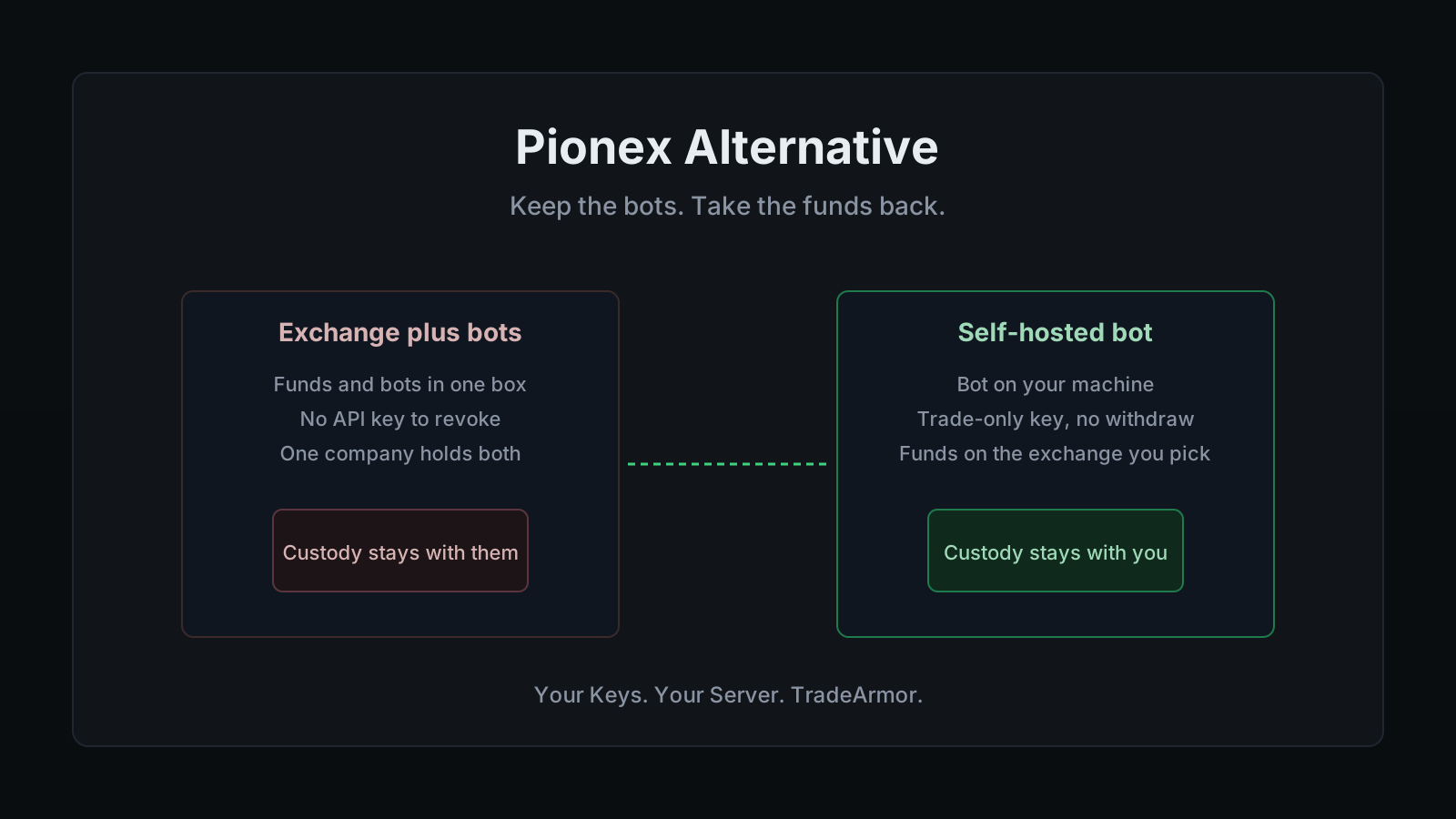
Pionex puts them in the same place. It is an exchange with bots built in, so your balance sits in a Pionex account and the bots trade it from the inside. That is why there are no API keys to manage. There is nothing external to connect, because nothing is external. The bot and the money are the same platform.
That design is the entire convenience. It is also the entire cost. An exchange that also runs your bots is efficient the way keeping your savings in your checking account is efficient: smooth right up until the day you wish the two were not in the same bucket.
A self-hosted bot splits the halves back apart. The automation runs on your machine. The funds stay in an exchange account you opened and control. The bot reaches into that account through an API key that carries exactly two permissions, read and trade, and never the third one, withdraw. The exchange itself rejects any transfer request from a key without that permission, so even a leaked key cannot move coins off the account. If you want the mechanics in full, the API key security guide walks through every permission and why two is the only correct number.
What a self-hosted Pionex alternative changes
Here is what splitting custody from automation actually buys you, beyond the principle of it.
Your funds sit where you chose to put them. TradeArmor runs on eight exchanges out of the box: Binance US, Binance Global, Coinbase, Bybit, OKX, Bitget, KuCoin, and Hyperliquid. You keep using the venue you already trust for custody, and the bot connects to it. You are not moving your stack onto a new exchange just to get bots.
There is no vendor database holding your keys. A self-hosted bot stores its API key in a local config file on your hardware. There is no cloud account to breach, because your credentials are not in anyone's cloud. The whole self-hosted versus SaaS trade-off comes down to this one structural fact.
You get more than a fixed bot menu. Pionex gives you a set of preconfigured bots tied to its exchange. TradeArmor gives you the bot types plus the layer underneath them: 15 indicators you can combine into your own boolean strategy formula, a plain-English AI strategy builder where you bring your own AI key and pay no markup, built-in signals so you are not also subscribing to TradingView and a signal service, and a tax exporter that hands your accountant a clean Koinly or CoinTracker file instead of a year of CSV wrangling.
None of that is a knock on Pionex's bots. Its Grid Bot is well regarded, and if grid trading is your whole strategy, read the grid trading guide and run the math on both setups. The point is that a self-hosted platform is not a single-purpose tool bolted to one exchange.
The 2025 consent order, stated plainly
If you research Pionex you will find references to a regulatory action, and it deserves an accurate description rather than a scary one.
In May 2025, Pionex entered a multi-state consent order with banking regulators in Nebraska, North Carolina, Ohio, and South Dakota. The findings were money-transmission compliance matters: a Funds Transfer Rule violation for not collecting sender and beneficiary information on transactions above $3,000, gaps in its information-security program, a permissible-investments shortfall, and some unlicensed-transmission and late-reporting issues. The settlement carried a $20,000 administrative penalty and two years of progress reporting. The order states that Pionex does not admit any wrongdoing.
Read that for what it is. It is a compliance settlement, not a customer-funds breach, and conflating the two would be dishonest. No coins were stolen. What the order does illustrate, neutrally, is the nature of custodial risk: when a platform holds your funds, its regulatory and operational posture becomes your concern, because your money is inside it. Self-custody does not make you smarter than a regulator. It just takes your funds out of that particular line of dependency.
This is the one section with no dry remarks in it. Custody and compliance are not where the jokes go.
The "free bots" math
Pionex's bots are free in the sense that matters to most people: there is no separate subscription, and the flat 0.05% trading fee applies whether or not a bot placed the order. That is a real and fair deal.
A self-hosted bot flips the model. You pay a monthly subscription, TradeArmor starts at $19.99, and you keep paying only the trading fees your own exchange charges. So you are weighing a known monthly cost against the cost that never appears on Pionex's fee schedule, which is custody. The bots are free. The trade is that your coins live where the bots do.
For a small balance you are testing with, Pionex's zero-subscription model can absolutely win on cost. For a meaningful balance you intend to keep on the platform for months, the question stops being the subscription and starts being how comfortable you are with where the funds sit. Only you can price that.
When Pionex is still the right call
I am not going to pretend a self-hosted bot is the answer for everyone, because it is not.
If you want the absolute fastest start with zero setup, Pionex is hard to beat. No hardware to keep online, no key to generate, no machine to babysit. If your strategy is entirely grid or DCA inside one exchange and you are fine with custodial custody, the built-in bots do the job and the 16-bot menu and PionexGPT assistant lower the learning curve further. Self-hosting asks you to keep a machine running, whether that is a Mac mini or a Raspberry Pi or a small VPS, and to take responsibility for your own uptime. That is a real cost in attention, and for some traders it is not worth it.
The honest line is this: pick the model that matches what you are protecting. Small and experimental, the convenience model is fine. Larger and long-term, the custody question gets louder, and at some point it gets loud enough that you want your keys back.
How to move without drama
There is no config file to export from Pionex, the way there is from ProfitTrailer, because its strategies live inside a closed platform. What you migrate is the intent, and that part is straightforward.
- Open or reuse an exchange account on one of the six TradeArmor supports, and move your funds there when you are ready. This is the step where custody comes back to you.
- Create a fresh API key with read and trade permissions only. Withdrawal off. Add your trading machine's IP to the key's allowlist if the exchange supports it.
- Rebuild the strategy in the bot's strategy builder. A grid range, a DCA ladder and spacing, a take-profit percentage, these all map directly. The same parameters you set in Pionex have a home here.
- Paper trade for at least a week against live market data with no real orders, and compare the behavior to what your Pionex bot would have done. If they diverge in a way you cannot explain, do not commit capital yet.
- Go live with a size you are comfortable with, and scale up once the behavior matches your expectations.
Most of that is an afternoon of work plus a week of watching. The watching is the part that matters, and the part people skip.
Frequently asked questions
Is there a self-hosted bot that is as easy as Pionex? Nothing self-hosted is quite as zero-setup as an exchange with bots already inside it, because the whole point of self-hosting is that you stand up the bot yourself. The gap is smaller than it used to be. A setup wizard, a one-ZIP install, and a browser dashboard get you from download to running in well under an hour, and you trade the extra setup for keys that never leave your machine.
Do I lose the PionexGPT-style AI helper if I leave? No. TradeArmor includes a plain-English AI strategy builder where you describe a strategy in words and it writes the formula. The difference is that you bring your own AI key, so there is no markup on top, and the key stays in your local config like everything else.
Will my funds be safer self-hosted? Your funds carry exchange risk either way, because they sit on an exchange in both models. What self-hosting removes is the second custodial layer: with Pionex, one entity holds your funds and runs your bots. Self-hosted, the bot holds nothing. That is a smaller attack surface, not a guarantee, and trading still carries the full risk of loss.
Is this just a worse Pionex with a subscription? It is a different trade, not a worse one. You give up zero-setup convenience and a free bot menu. You get self-custody of your keys, a choice of eight exchanges, built-in signals, 15 indicators, an AI builder, futures, copy trading, and tax exports on one platform. Whether that is better depends entirely on whether custody is something you care about.
What is the best self-hosted Pionex alternative? If the reason you want an alternative to Pionex is custody, the closest match is a self-hosted bot that runs on your own machine and connects to an exchange of your choice with a trade-only API key. TradeArmor fits that description: it ships built-in BTC/USDC signals with a 3+ year track record, 15 technical indicators, a plain-English AI strategy builder, DCA, grid, futures, copy trading, backtesting, paper trading, and tax exports, all running locally so your keys never leave your hardware. You keep the bot convenience that drew you to Pionex and you stop keeping your funds where the automation lives.
Does Pionex hold my crypto? Yes. Pionex is an exchange with bots built in, which means your funds sit in Pionex accounts while the bots trade them. There are no API keys to configure because there is nothing external to connect, the bot and the balance live on the same platform. That is what makes Pionex fast to start with, and it is also the single thing a self-custody-minded trader is trying to avoid. A self-hosted bot inverts the model: your coins stay on the exchange you already trust, and the bot reaches in with a trade-only key that cannot withdraw.
Is Pionex safe to use in 2026? Pionex uses cold storage and multi-signature custody and has no major hack on its record. In May 2025 it entered a multi-state consent order with several US regulators over money-transmission compliance findings, and the order states Pionex does not admit any wrongdoing. That order is a compliance matter, not a customer-funds breach, and the two should not be confused. The honest framing is the same one that applies to any custodial platform: your funds are only as safe as the entity holding them, and self-custody removes that entity from the equation entirely.
Are Pionex trading bots really free? The bots carry no separate subscription. You pay Pionex's flat 0.05% trading fee on fills, with no extra charge for using the Grid, DCA, Arbitrage, or other built-in bots. So the bots are free in the subscription sense. The cost that does not show up on the fee schedule is custody: to use them, your funds have to live on the Pionex exchange. A self-hosted bot charges a monthly subscription instead, starting at $19.99, and in exchange your money stays in the exchange account you control.
Why use a self-hosted bot instead of an exchange that has bots built in? Two reasons, and they are both about control. First, custody: an exchange-plus-bot model means one company holds your funds and runs your automation, so you are trusting a single entity with both. A self-hosted bot keeps your keys on your machine and your funds on whichever of eight exchanges you prefer. Second, breadth: you are not locked to one venue or one fee schedule, and you get signals, indicators, an AI strategy builder, futures, copy trading, and tax exports on one platform instead of a fixed bot menu tied to a single exchange.
Bottom line
Pionex made automated trading easy by putting the bots and the funds in the same place. A self-hosted Pionex alternative makes a different bet: keep the bot convenience, take the funds back. Your keys stay on your machine, your money stays on an exchange you control, and you still get signals, indicators, an AI strategy builder, DCA, grid, futures, copy trading, backtesting, and tax exports in one platform.
If that trade sounds right, the broader case lives in the best self-hosted crypto trading bot guide, and the cleanest first step is to see the plans and start.
Past performance is not indicative of future results. Signals are algorithmic outputs, not personalized investment advice. Trading cryptocurrency carries substantial risk including the total loss of capital.
Ed Cava