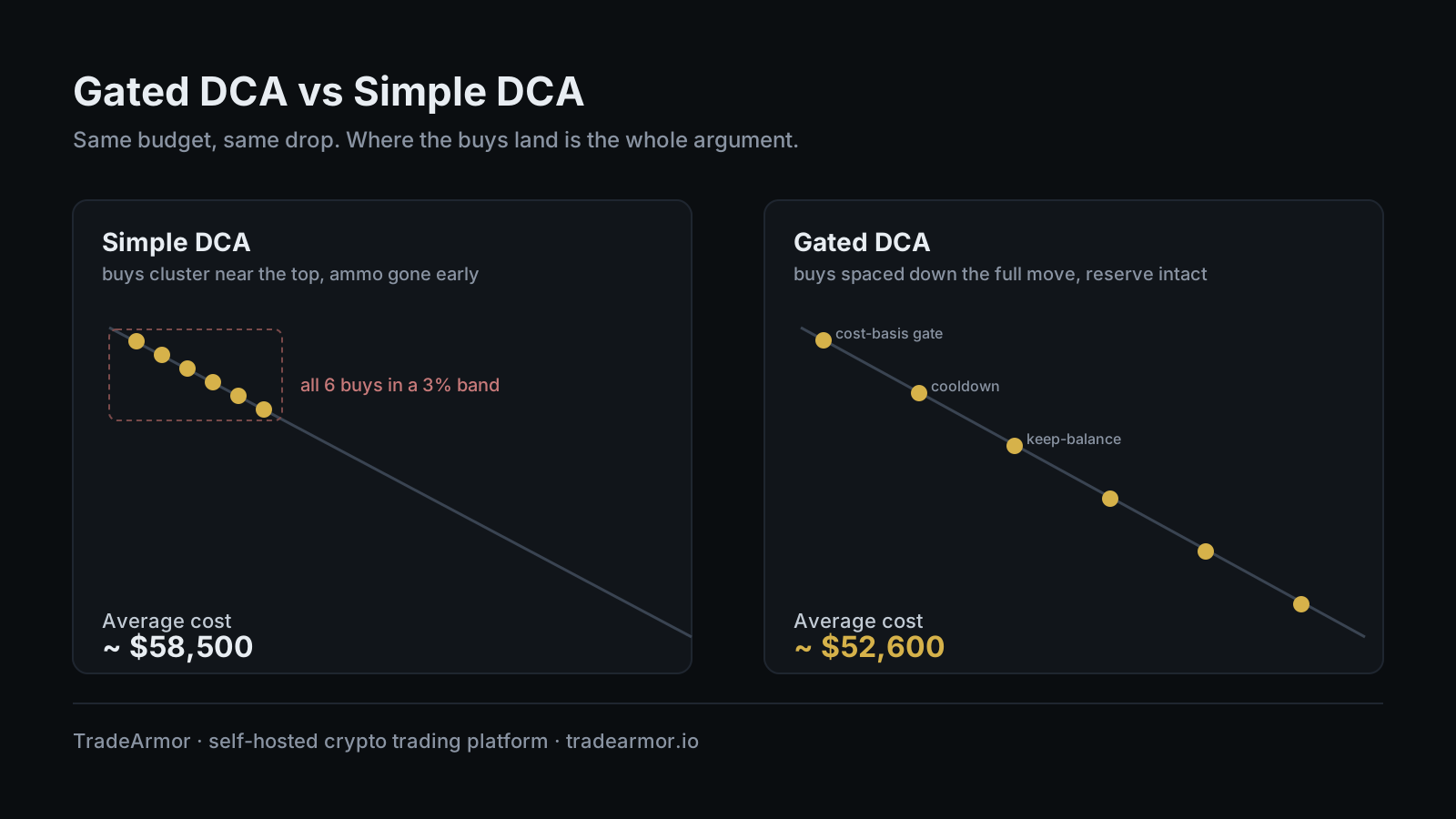
You wanted the thing that just runs. Buy the dips, lower the average, do it without you watching a chart at 3am, and let you see exactly what it did in the morning. So you set up a DCA bot to average down, walked away, and came back to find it had fired every buy it had inside a four percent window near the top of the move, then sat flat and out of ammunition while the market kept falling another twenty. That is not a black box failing you. That is the gated DCA vs simple DCA gap in one chart: simple DCA doing precisely what you told it to do, which is the problem.
The fix is not a better guess about the bottom. Nobody has that. The fix is gating: a set of rules that decide whether a buy is allowed to fire, not just whether the price ticked down. That is the whole of the gated DCA vs simple DCA question, and it is worth understanding the mechanics before you trust real money to either one. This is where TradeArmor lives, but the point of this guide is the math, not the product. TradeArmor is a self-hosted crypto trading platform that runs on your own hardware where your API keys never leave your machine, and the DCA engine is one mode on it alongside built-in BTC/USDC signals, 15 technical indicators, an AI strategy builder, grid, futures, copy trading, backtesting, and tax exports. The DCA part is what we are pulling apart today.
What simple DCA actually is
Dollar cost averaging, in the original sense, is dead simple. You invest a fixed amount on a regular schedule, regardless of price, so you buy more units when the asset is cheap and fewer when it is expensive. Investor.gov and FINRA both describe it the same way: a discipline that removes timing and emotion from a long accumulation. Buy $200 of an index fund every payday for ten years and never sell. That is textbook DCA, and it works because the time horizon is effectively infinite and the budget is effectively a stream.
A crypto DCA bot borrows the name and changes the job. It is not accumulating forever on a salary. It is averaging down inside one open trade, with a finite pile of capital, trying to lower the cost basis of a position it intends to exit at a profit. Same words, different math. The schedule-based discipline that makes simple DCA safe for a retirement account is exactly the part that gets dangerous when you point it at a single position with a fixed budget and a falling chart.
See how the full platform handles strategy modes, or keep reading for why the unspaced version breaks.
Why simple DCA breaks the moment you automate it
A simple DCA bot fires on one trigger. Either a fixed time interval, buy every four hours, or a fixed dip, buy every one percent down. It does not look at where your other buys landed. It does not check how much money you have left. It just buys when the trigger trips.
Run that into a real drawdown and the failure is mechanical. Set twenty buys at half a percent spacing and every order you own clusters inside a ten percent range. When a genuine crash arrives, and crypto delivers 30 to 50 percent drawdowns several times a year, you have already spent everything in the first ten percent. The position is now deep underwater with no capital left to average. A DCA bot that buys every time the price ticks down is not a strategy. It is a very patient way to run out of money.
The single most common mistake in bot DCA, the one every honest guide warns about, is setting up safety orders you cannot afford to fill. Simple DCA makes that mistake easy because nothing in it is watching your budget. It treats your account like an infinite stream when it is a finite tank.
Gated DCA vs simple DCA: the three gates
Gated DCA adds rules that have to clear before a buy is allowed. The buy trigger is necessary but no longer sufficient. Three gates do the work.
The first is the cost-basis gate. A new buy only fires if the price is meaningfully below your existing legs, and past a configurable depth the rule hardens: the price must be below your lowest unsold leg, in TradeArmor's engine below that leg times 0.999, before the next buy is allowed at all. This is the EQ-price gate, and it matters because it guarantees a deep buy actually lowers your average instead of stacking near a level you already hold. ProfitTrailer users will recognize it as EQPRICE logic. TradeArmor matches that behavior on purpose, which is why a migrated ProfitTrailer position keeps averaging the same way it always did.
The second is the time gate. A per-level cooldown stops the bot from firing five buys in the ten minutes of a flash crash. Without it, a sharp wick can chew through several legs before the dust settles, and you end up with three buys at nearly the same bad price. The cooldown spaces them in time so each leg is a considered move, not a panic reflex the bot had on your behalf.
The third is the capital gate. A keep-balance rule reserves a percentage of your total portfolio value, measured as available cash plus the current market value of open positions, and refuses to spend it. The bot can average down hard, but it structurally cannot go all-in during a drawdown, because the reserve is walled off. Twenty safety orders crammed into a ten percent band is not averaging down. It is averaging sideways, with extra steps.
The math that matters
Here is the same money, into the same drop, run both ways. Budget is $900 across six buys of $150. The market falls 25 percent from $60,000 while the bot averages down.
| Simple DCA (1% spacing) | Gated DCA (5% spacing + gates) | |
|---|---|---|
| Buy 1 | $60,000 | $60,000 |
| Buy 2 | $59,400 | $57,000 |
| Buy 3 | $58,800 | $54,150 |
| Buy 4 | $58,200 | $51,400 |
| Buy 5 | $57,600 | $48,900 |
| Buy 6 | $57,000 | $46,400 |
| Capital spent | $900 (all of it) | $900 (all of it) |
| Average cost | about $58,500 | about $52,600 |
Same six buys, same $900, same starting price. The simple DCA version emptied its budget inside a three percent band near the top and finished with an average around $58,500. With the price now near $46,000, that position is roughly 21 percent underwater and has nothing left. The gated version spread the identical money down the whole move and landed an average near $52,600, about $5,900 per coin lower, and in a real deployment the keep-balance reserve would still be sitting there untouched.
That $5,900 gap is the entire argument. It is not a better forecast. Neither version knew where the bottom was. The gated version simply refused to spend its ammunition until each shot was worth taking, and the cost-basis math did the rest. Averaging down only helps if every buy lands below your average, and the gate is what enforces that instead of hoping for it.
When each model wins
Strip the names off and the gated DCA vs simple DCA choice sorts cleanly.
Simple, schedule-based DCA wins when you are accumulating an asset over years, buying a fixed amount on a cadence, and you have no intention of selling. That is the Investor.gov definition, it is a genuine discipline, and a gate would only get in the way of a stream that never runs dry. If your plan is buy and hold forever, the simplest version is the right one.
Gated DCA wins the moment a bot is managing an open position with a finite budget and an exit in mind. That is most automated crypto trading. The gates are not complexity for its own sake. They are the difference between a bot that lowers your cost basis through a crash and a bot that runs out of money in the first dip and leaves you holding the bag it helped you fill. You also want to see the rules it is following, not just the result, which is why the gate logic shows up in the position inspector instead of hiding in a setting.
A quick word on trust, since it touches both. Whichever model you run, run it where your keys stay yours. A DCA bot needs read and trade permission on your exchange and nothing more, never withdrawal, and a self-hosted bot that never puts your keys on a vendor server is the only way to be sure of that. Custody is a separate fight from strategy, and it is one you should not lose by default.
Closing
The gated DCA vs simple DCA decision comes down to one honest question: is your bot drinking from a stream or a tank? Simple, scheduled DCA is right for the stream, the long accumulation that never runs dry. Gated DCA is right for the tank, the open position with a finite budget where every buy has to earn its place by landing below your lowest leg, waiting out its cooldown, and respecting your reserve. TradeArmor runs the gated engine with up to 20 levels, configurable spacing, cooldowns, EQ-price logic, and a keep-balance floor, on your own hardware where your keys never leave your machine, and you can prove out any configuration first on the free DCA backtester before a cent is at risk. When the math checks out, see how the tiers line up on the pricing page.
Frequently asked questions
What is the difference between gated DCA and simple DCA? Simple DCA buys on a fixed trigger, either a set schedule or a fixed percentage dip, and keeps buying regardless of what the rest of your position looks like. Gated DCA only buys when a set of conditions clears first: the price has to sit below your lowest unsold buy by a real margin, a cooldown timer has to expire, and you have to have reserve capital left. The gates are what stop a falling market from emptying your account in a tight price band.
Does gated DCA give a lower average cost than simple DCA? Usually, into a deep drop, yes. Because gated DCA forces each new buy to land below your cheapest existing leg and spaces the buys wider, the same budget gets spread across a bigger range and pulls your average down further. Simple DCA tends to cluster its buys near the top of the move and run dry before the real bottom. The gates do not predict the bottom, they just make sure each buy you do fire actually lowers your cost basis.
What is the EQ-price gate in a DCA bot? The EQ-price gate is a rule that, past a configurable DCA level, blocks the next buy until the market price is below the price of your lowest unsold leg, in TradeArmor's case below that leg times 0.999. It guarantees a deep DCA buy genuinely reduces your average instead of stacking near a price you already hold. TradeArmor's gate matches the EQPRICE logic that ProfitTrailer users relied on, which is why migrating positions behave the same way.
Is simple DCA ever the better choice? For long-horizon accumulation where you buy a fixed dollar amount every week and never sell, simple time-based DCA is fine and is exactly what most brokerages mean by the term. The gating matters once a bot is averaging down inside an open trade with a finite budget, because that is where unspaced buys exhaust capital before the move is over. The model you want depends on whether you are accumulating forever or managing a position you intend to exit.
How many DCA levels and what spacing should I use? There is no universal number, but the failure mode to avoid is well documented: twenty buys crammed into a narrow band leave you out of capital when a 30 percent drop arrives. Wider spacing on the early legs and a hard cost-basis gate on the deep ones cover a larger range with the same money. TradeArmor supports up to 20 levels with per-level spacing, size multipliers, and cooldowns, and you can test any configuration on historical data before risking capital.
Ed Cava builds TradeArmor and trades with it. He ran ProfitTrailer for years before building the self-hosted platform he wanted, and he still runs the DCA engine on his own machine.