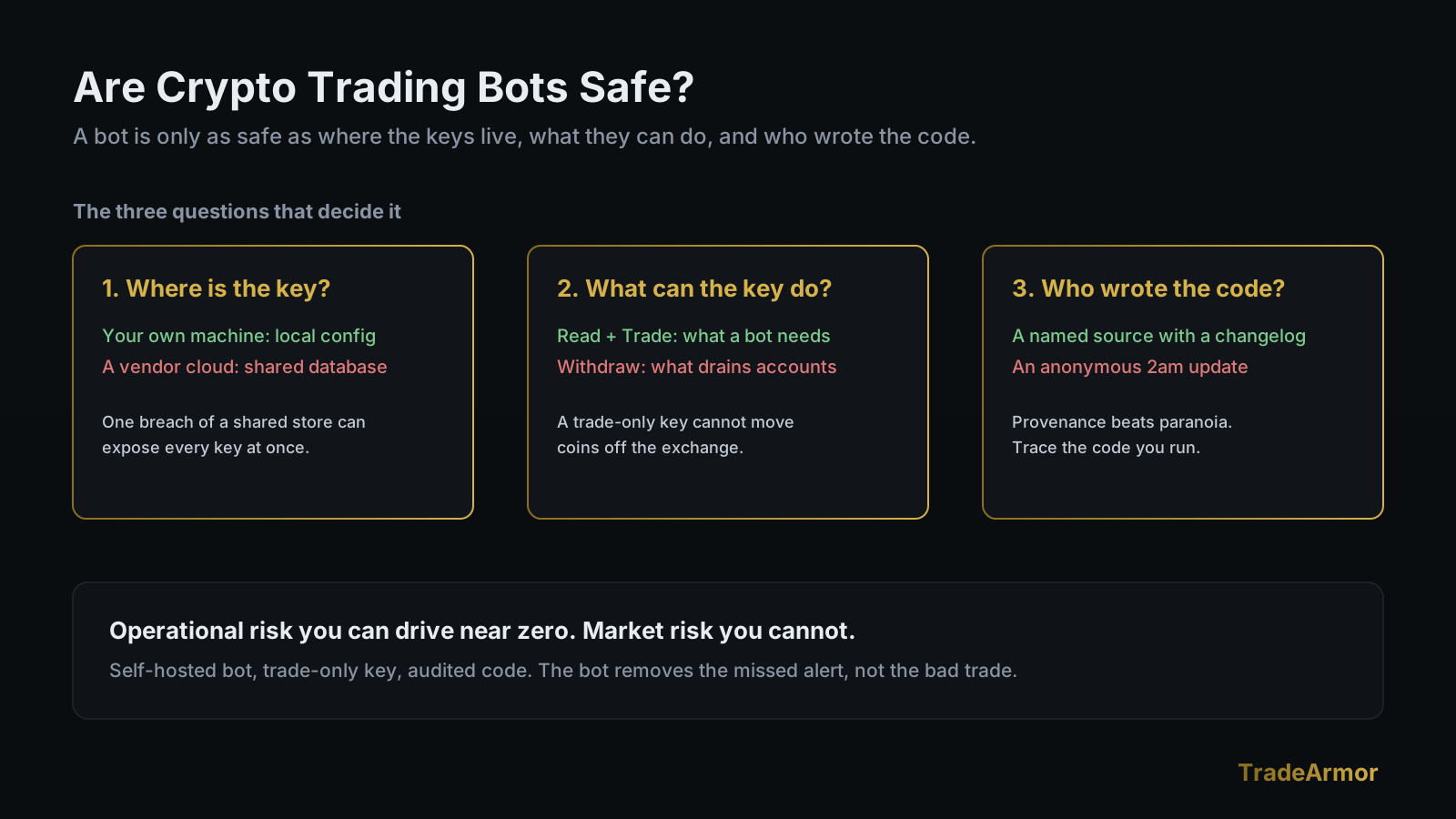
You have watched the videos, read the threads, and you still cannot get past one question. Are crypto trading bots safe, or are you about to hand a stranger a live connection to your exchange account. It is the right question to sit on. The forums are full of the aftermath of people who did not: "3Commas got hacked and I'm never touching a SaaS bot again" is a sentence you can find a thousand times over, and behind every one of them is someone who found out the hard way that the bot was never the real risk. The custody model around it was.
So here is the honest answer, before the marketing version: a crypto trading bot is exactly as safe as where your keys live, what those keys are allowed to do, and where the code came from. Everything else is detail. A well-built bot running on your own hardware with a locked-down key is close to boring from a security standpoint. A polished SaaS bot holding your withdrawal-enabled key in a shared cloud database is a different animal, no matter how clean the dashboard looks. The question "why would I trust a server I don't control with trade permissions on a meaningful amount of crypto" answers itself once you see how the pieces fit.
That distinction is the entire reason TradeArmor exists. It is a self-hosted crypto trading platform: built-in BTC/USDC signals with a multi-year live track record, 15 real-time technical indicators, a plain-English AI strategy builder, plus DCA, grid, futures, copy trading, backtesting, paper trading, and tax reporting, all running on your own machine where your API keys never leave your hardware. The features are the reason to run a bot. Custody is the reason to run this one. The rest of this guide walks the three real risks so you can judge any bot, ours included, on the mechanics instead of the pitch.
Are crypto trading bots safe? It comes down to where your keys live
Strip away the branding and every trading bot does the same thing. It connects to your exchange through an API key and places orders on your behalf. That connection is the whole security surface. It is not the strategy, not the interface, not the number of indicators. It is a single credential and the question of who can reach it.
That means "are crypto trading bots safe" is really three narrower questions wearing a trench coat. Where is the key stored. What is the key allowed to do. And can you trust the code that holds it. Get all three right and the bot is safe in any meaningful sense. Get one wrong and the other two will not save you. We will take them in the order that actually drains accounts.
Want to see the dashboard and strategy engine that run on a key that never leaves your machine? See all features.
Risk one: custody, and the shared database problem
This is the big one, and it is structural, not a matter of any single company being careless.
A SaaS bot runs in a vendor's cloud. For that cloud to trade for you, it has to hold your API key on its servers. That is not a bug in the product; it is how the model works. The consequence is that one company ends up storing live exchange keys for thousands of customers in one place. A database of working keys is what a vendor's marketing calls convenience and what an attacker calls a shortlist.
We are not speaking in hypotheticals. In December 2022, the SaaS bot platform 3Commas confirmed that roughly 100,000 customer API keys had been exposed, with users reporting around $22 million in losses across multiple major exchanges (BleepingComputer's report on the incident). Note what failed. The individual users did nothing wrong on the day it happened. Their keys were correct, their strategies were fine, their passwords were uncompromised. They simply had their keys stored in a place they did not control, and one breach of that place was enough.
A self-hosted bot inverts the model. The key sits in a local config file on your own machine, and the bot reads it from there. There is no vendor database holding it, because there is no vendor server in the loop. A breach of the company you bought the software from exposes nothing, because that company never had your key. This is the core of self-hosted versus SaaS as a safety question, and it is why the honest answer to "are crypto trading bots safe" starts with an address, not a feature list.
Risk two: permissions, and the word "safe" pointed the wrong way
Where the key lives decides how many keys go down in one breach. What the key can do decides how bad each one is.
An exchange API key carries three families of permission. Read lets the holder see your balances and orders. Trade lets it place and cancel orders. Withdraw and transfer lets it move funds off the exchange entirely. A bot needs the first two. It never needs the third. A trade-only key can buy and sell inside your account, but the coins stay on the exchange, and a leaked trade-only key is an annoyance rather than a catastrophe.
The industry earns its reputation right here. Some setup guides tell you to enable withdrawal permission anyway, framed as making things smoother or avoiding errors later, often with the phrase "to be safe." The word "safe" is aimed in precisely the wrong direction. A key with withdrawal permission is the difference between a leak that costs you a few unwanted trades and a leak that empties your account to an address you will never claw back. We walk the exact permission checkboxes in the API key security guide, and the short version of what a bot can and cannot do with your key lands on one line: a trade-only key cannot withdraw, full stop, no matter who holds it.
If a product, a guide, or a support agent ever tells you a bot needs withdrawal access to function, that is not a setup instruction. That is the moment to close the tab.
Risk three: the code itself, and the supply-chain trap
The third risk is the one people forget because it does not fit the SaaS-versus-self-hosted story cleanly. Self-hosting removes the vendor database. It does not automatically mean the code you are running is trustworthy.
Open-source bots are free, the way a puppy is free, and most of them are run by serious people doing honest work. But "self-hosted" and "safe" are not synonyms when you are pulling code from a repository maintained by strangers. In late 2025, security researchers at SlowMist flagged a Polymarket trading bot circulating on GitHub that carried a hidden payload designed to read the .env file on the host and exfiltrate the secrets inside it, which is exactly where API keys and wallet credentials tend to sit (AInvest's write-up of the disclosure). Free and open is a genuine virtue right up until an anonymous maintainer ships a quiet update at two in the morning.
The defense is not paranoia, it is provenance. Run code you can trace to a named source that stands behind it, that publishes what it changed in each release, and that has an incentive to not poison its own customers. A managed self-hosted product sits in the useful middle here: you get the local-custody model of open source, plus a vendor whose entire business dies the day it ships malware. That is the security posture TradeArmor is built on, with a documented changelog on every release and code that only ever asks for a trade-only key.
Operational risk is not market risk
One more distinction, because it is where honest and dishonest bot marketing part ways.
Everything above is operational risk: the chance of a key leaking, a database breaching, a payload stealing your secrets. A safe bot drives that risk close to zero by holding a trade-only key on hardware you control, running code from a source you trust. What it does not touch is market risk. A perfectly secured bot can still lose money if your strategy is wrong or the market moves against you, and any tool that implies otherwise is selling you something. The bot removes the risk of a missed alert, a fat-fingered order, and a 2am emotional exit. It does not remove the risk of the trade itself.
So the complete answer to "are crypto trading bots safe" is this. From an operational standpoint, a self-hosted bot with a trade-only key and audited code is about as safe as automated trading gets. From a market standpoint, no bot is safe, ours included, and you should distrust anyone who tells you different. Those are two separate questions, and conflating them is how people end up surprised in both directions.
FAQ
Are crypto trading bots safe to use? A bot is as safe as three things you control: where the key lives, what the key can do, and where the code came from. Audited code on your own machine holding a trade-only key that cannot withdraw carries very little theft risk. A shared server storing your key, or unaudited code from an anonymous source, carries much more. The custody model decides safety, not the software alone.
Can a crypto trading bot steal my funds? Not with a trade-only key, because that key has no withdrawal permission and cannot move coins off the exchange. The theft cases come from withdrawal-enabled keys and from SaaS platforms storing thousands of keys in one database. The 2022 3Commas breach, roughly 100,000 keys exposed, is the standard example.
Are self-hosted trading bots safer than SaaS bots? On the dimension that matters most, yes. Self-hosted keeps your key in local config on your own hardware, so there is no vendor database to breach. A SaaS bot stores your key on its servers, so one breach exposes every key it holds. Self-hosting removes the shared target.
Is it safe to give a trading bot my exchange API key? It is, if the key carries only read and trade permission, never withdrawal, and you know where it is stored. Disable withdrawal and transfer, add an IP whitelist if your bot runs from a stable address, and prefer a bot that keeps the key on hardware you control.
What is the safest way to run a crypto trading bot? Run audited software on your own machine with a trade-only key, add an IP whitelist, and rotate the key every three to six months. That removes the shared-database risk, the withdrawal risk, and most of the code-supply risk. It does not remove market risk, which no bot can.
The bottom line
Are crypto trading bots safe? The bot is rarely the risk. Where its key lives, what that key can do, and who wrote the code are the risks, and all three are things you can decide before you ever place a trade. TradeArmor is the self-hosted answer to all three: a full platform with built-in signals, 15 indicators, a bring-your-own-key AI strategy builder, DCA, grid, futures, copy trading, backtesting, and tax reporting, running where your trade-only key never leaves your machine and could not withdraw if it did. Hold your own keys, run code you can trace, and let the bot do the boring part. See the plans and get started.