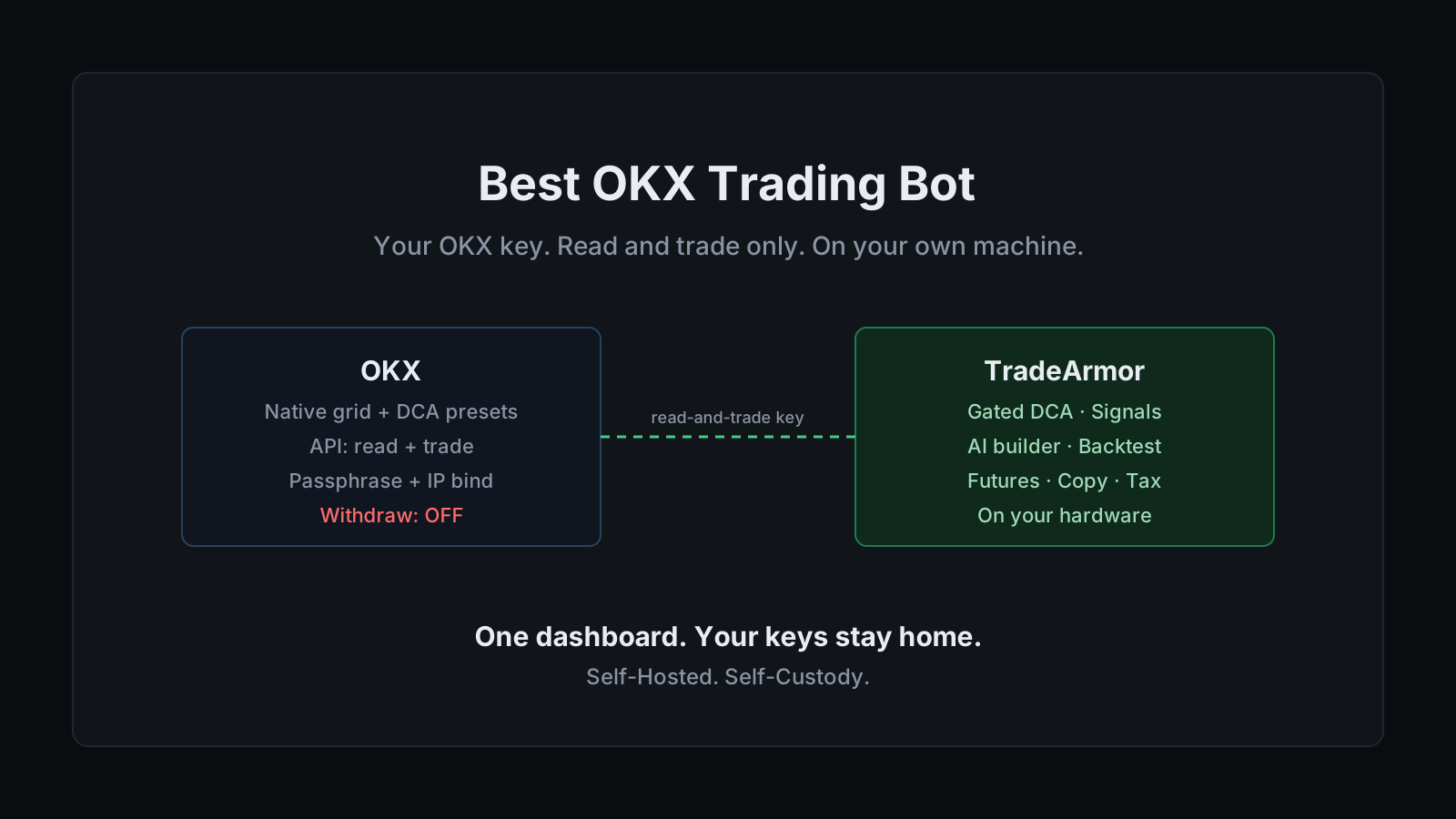
You trade on OKX, you have already tried its built-in bots, and you have hit the same ceiling twice. OKX is one of the few exchanges that ships native trading bots, and for a grid in a sideways market they do the job. But the moment you want a rule more specific than the presets allow, buy when RSI is oversold and Supertrend flips bullish, or run the same strategy across two exchanges at once, the native menu runs out. So you go shopping for an outside okx trading bot, and you hit the second ceiling immediately: the first decent-looking option wants you to paste your OKX API key onto its servers. "I want more than the presets give me without building it from scratch" is a reasonable ask. So is "I don't want to give my API keys to a third party," which is the default posture of anyone who read the breach post-mortems this category has lived through. Stack on the charts subscription, the signal service, and now a bot, and it is three bills to do one job.
That second ceiling is the one worth understanding before you connect a single key, because it is structural, not bad luck. An OKX native bot runs inside the same company that custodies your funds. An external SaaS bot runs on a server you do not control and keeps your key there. Both put the automation somewhere other than your own hands. The only model that does not is a bot that runs on hardware you own and reaches into OKX over the API, where the key never leaves the machine.
That is where a real okx trading bot earns its place. TradeArmor is a self-hosted crypto trading platform: built-in BTC/USDC signals with a multi-year live track record, 15 real-time technical indicators, a plain-English AI strategy builder, plus DCA, grid, futures, copy trading, backtesting, paper trading, and tax reporting, all running on your own hardware where your API keys never leave your machine. OKX is one of eight exchanges wired into the setup wizard out of the box, so it connects on day one, no request form, no waiting. On an OKX account, that self-hosted clause is the whole point, because the key to your exchange is exactly the one you least want sitting on someone else's server.
What OKX's native bots do, and where they stop
Give OKX its due. It is genuinely ahead of most exchanges on this front: grid bots, DCA bots, and a set of automated presets built right into the app, no external anything required. For a grid in a range-bound market, a native OKX bot is a reasonable tool and costs you nothing extra beyond trading fees. If a preset grid is all you need, you may not need this article at all.
The presets are also a fixed menu, and fixed is where they stop. A native bot will not take a boolean rule you wrote and run it on every candidate trade. It will not filter its entries through a signal you brought from somewhere else. It will not run the identical strategy on OKX and Coinbase simultaneously so one dashboard covers both. And it cannot, by construction, keep your key off the exchange, because it is the exchange. The bot and the custodian are the same entity.
That last point is quieter than the others and it matters more. When the thing running your automation is also the thing holding your coins, self-custody is not part of the conversation, because there is nothing self-hosted about it. That is the same trade-off you make with any SaaS bot versus a self-hosted one, just wearing the exchange's logo instead of a third party's.
Want to see the dashboard, the signals, and the strategy engine a self-hosted setup gives you? See all features.
What OKX traders actually want from an external bot
Strip away the marketing and the asks are consistent. People who go looking for an okx trading bot beyond the native presets want four things.
They want their own entry logic. Not a preset grid, but a rule like buy when RSI is oversold and Supertrend flips bullish, written once and run automatically on every candidate. TradeArmor's formula engine takes exactly that, either in plain language through the AI strategy builder or as a boolean formula directly, no Python required.
They want DCA that behaves. Averaging into a spot position is the bread and butter of an OKX account, and most simple DCA tools keep buying straight into a crash with no brakes. TradeArmor's DCA engine runs unlimited levels with cooldown gates and an EQ-price buy gate that holds the next buy until price clears the lowest unsold leg, so the averaging is gated instead of blind. That is the difference between dollar-cost averaging and catching a falling knife on a timer.
They want futures that do not blow up, where they have access to them. OKX is a real futures venue globally, and TradeArmor's futures mode ships stop-loss and trailing take-profit so leverage comes with brakes attached. US accounts are spot only, which is a limit set by OKX, not the bot.
And they want their keys to stay theirs. "My keys, my coins" is a tired phrase right up until the week a custodian proves the point for you, and then it is the only phrase that matters.
How a self-hosted OKX trading bot runs
The mechanics are deliberately boring. You create a Read-and-Trade API key on OKX, set the passphrase OKX requires, paste the key, secret, and passphrase into the setup wizard at localhost:8080/setup, pick your strategy mode, and the bot connects over the OKX API and runs your rules 24/7. The key sits in local config on your machine. There is no TradeArmor account holding it, because there is no TradeArmor server in the path at all.
Because OKX is one of the six default exchanges, there is no coverage caveat here. You pick OKX from the dropdown and go. On top of the connection you get the full position engine: the gated DCA logic, partial sells that trim exposure without losing the cost-basis anchor, take-profit and trailing take-profit, and indicator-based or signal-based exits. The built-in BTC/USDC signals, which have run live for over three years, work the same on OKX as anywhere else, and you can filter them through your own indicators, run them straight, or ignore them and run a fully custom strategy.
You also get to run OKX alongside your other venues on one instance. Trading groups let a single bot run gated DCA on OKX spot, a custom formula on Bybit, and something else on Coinbase, each with its own rules, all on one dashboard. That is the piece a native, exchange-locked bot structurally cannot do.
Locking down your OKX API key
This is the part that actually protects your money, so it gets the detail.
An OKX API key carries three named permissions: Read, Trade, and Withdraw. A trading bot needs a precise two of them. Enable Read so it can see your balance and order state. Enable Trade so it can place and cancel orders. Leave Withdraw switched off. Withdrawal is the only permission that lets a key move money off the account, and automation has no use for it. The worst case if a Read-and-Trade key ever leaks is unwanted trades inside the account, never coins leaving it. The mechanics of why this holds on every exchange are in the API key security guide, and the short version of whether a bot can drain your funds is: not without a permission you control.
OKX adds two details worth knowing. First, the passphrase. On top of the key and secret, OKX makes you set a passphrase at creation, sent as a header on every request, and it is shown once and never again. Store it with the key, because a lost passphrase means deleting the key and starting over. Second, the IP whitelist. OKX lets you bind a key to as many as 20 IP addresses, and a Read-and-Trade key pinned to the one address your bot runs from is a key a thief cannot use from anywhere else. There is a bonus to binding the IP: OKX auto-deletes a Trade-enabled key after 14 days of inactivity if it is not tied to an IP, so the IP binding both secures the key and keeps it from quietly vanishing. It is the kind of exchange-specific gotcha that a bot built by people who actually run these connections already accounts for.
Setting it up, start to finish
The whole path, in order:
- Create the API key on OKX. Enable Read and Trade. Leave Withdraw off. Set the passphrase and store it with the key, because OKX shows it only once.
- Bind an IP allowlist. Pin the key to the address your bot runs from. It locks the key to one exit point and stops OKX from auto-deleting an unbound Trade key after 14 days.
- Install TradeArmor. Download the ZIP, run
pip install -r requirements.txt, thenpython main.py. Around 512 MB of RAM and 100 MB of disk is enough, which is why a Pi or an always-on Mac mini makes a fine host. - Run the setup wizard. Open
localhost:8080/setup, pick OKX, and paste the key, secret, and passphrase. Choose a strategy mode: built-in signals, hybrid with your own indicator filters, or fully custom. - Paper trade first. Run the strategy against live OKX data with a simulated balance before a single real order fires. When it behaves, flip one setting to go live.
Most OKX users start on spot with gated DCA and the built-in signals, then grow into custom formulas once they trust the engine. The product is built to grow with you rather than make you switch bots when you outgrow the starter setup, which is the trap the native presets eventually spring.
TradeArmor turns an OKX account into a fully automated trading operation you actually own: built-in signals with a multi-year track record, 15 indicators, a plain-English AI strategy builder, gated DCA, grid, futures with real stops, copy trading, backtesting, paper trading, and one-click tax exports, all running on your hardware where your keys never leave the machine. If that is the version of an okx trading bot you want, see the pricing and get started.