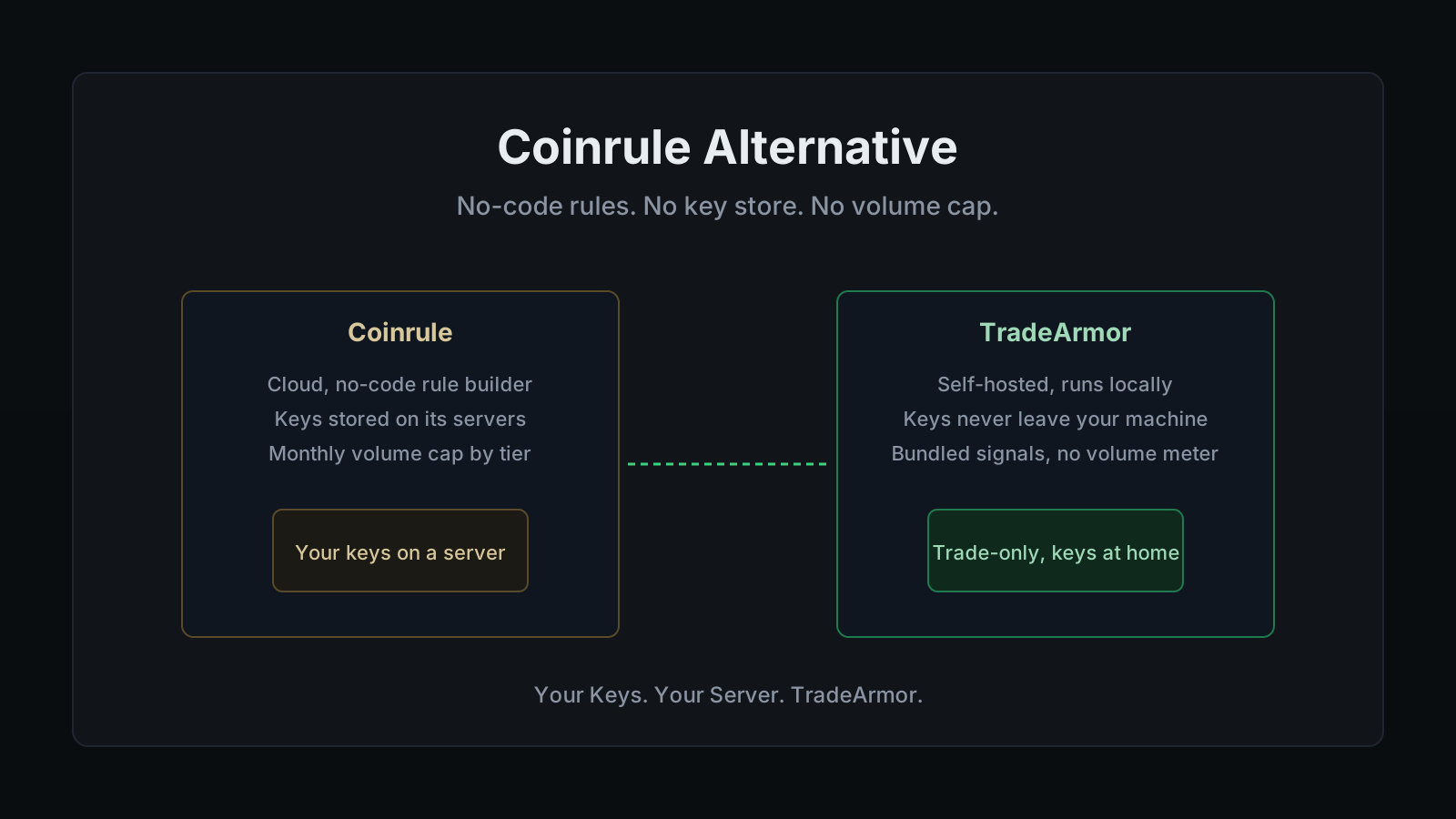
Coinrule Alternative: Self-Hosted, Keys Stay Local
Coinrule did one thing better than almost anyone: it made automated trading feel like using Zapier. You drag an if-this-then-that block, pick "if RSI drops below 30, then buy," and the rule runs 24/7 without you touching a chart. That is a real accomplishment, and it is why the platform has 350 or more templates and a large beginner following. The reason people still end up searching for a Coinrule alternative has almost nothing to do with the builder. It is the moment the account hits a ceiling: a monthly trade volume cap, a hard limit on how many live rules you can run, and a jump from $29.99 to $59.99 to $449.99 as you outgrow each tier. "I pay more for bot subscriptions than I make trading" and "every feature is behind another upgrade tier" are the two sentences sitting under most of these searches.
There is a second, quieter reason, and it shows up once someone has been in crypto long enough to have watched a company get breached. The rules run in Coinrule's cloud, which means Coinrule holds your exchange API keys to execute them. More on that below, because Coinrule actually handles it better than most, but "I don't want to give my API keys to a third party" is a line I hear constantly, and it is the exact problem a self-hosted bot exists to solve.
The self-hosted option here is TradeArmor, which I build, so read the rest with that in mind. This is not a hit piece. TradeArmor is a self-hosted crypto trading platform with built-in BTC/USDC signals carrying a 3+ year track record, 15 technical indicators, a plain-English AI strategy builder, DCA, grid, futures, copy trading, backtesting, paper trading, and tax exports, all running where your API keys never leave your machine. The same no-code automation Coinrule pioneered, minus the cloud key store and minus the meter on how much you are allowed to trade.
Where the ceiling actually is
Coinrule's pricing tells you exactly what it is optimized for. The free Starter plan gives you two active rules, which is enough to learn the interface and nothing more. Hobbyist runs $29.99 per month billed annually and unlocks seven live rules, three connected exchanges, and up to $300,000 in monthly trade volume. Trader runs $59.99 per month for fifteen live rules, five exchanges, and up to $3,000,000 in monthly volume. Pro is $449.99 per month for the version without the caps.
Read that again with a trader's eye. The product does not just gate features by tier, it gates how much of your own money you are allowed to move through your own exchange account each month. Cross $300,000 in volume on the Hobbyist plan, which a couple of active DCA ladders on a decent account can do in a busy month, and you are upgraded into the next bracket whether your strategy improved or not. That is a subscription model wearing the costume of a trading tool.
If you want the full frame on why this architecture exists at all, the self-hosted versus SaaS breakdown lays out the whole trade matrix, and you can see the entire TradeArmor feature set here.
Credit where it is due: Coinrule does custody right on funds
I am a self-custody maximalist, and I will still say this plainly: Coinrule handles the fund-custody question well. It is non-custodial, meaning it never holds your coins. It connects through API keys configured with trade-only permission, so the bot can place orders but cannot withdraw or transfer anything off the exchange. It encrypts those keys with AES-256. If a reader is choosing between Coinrule and some anonymous Telegram bot that asks for withdrawal access "to optimize returns," Coinrule is the adult in the room, and it is not close.
So the honest wedge is not "Coinrule will steal your money." It will not, and pretending otherwise would fail the only test that matters, which is the truth. The wedge is narrower and more structural. To run your rules from the cloud, Coinrule has to store those encrypted, trade-only keys on its servers. Encrypted and permission-limited, but present, in a database, indexed by user. That store is the thing a self-hosted bot does not have, because there is nothing to store when the key sits on your own machine.
The one difference that drives the rest: where your keys live
Every real difference between Coinrule and a self-hosted Coinrule alternative traces back to one architectural fork. A cloud bot runs on the vendor's servers, so your keys have to live there too. A self-hosted bot runs on your hardware, so the keys live in a local config file that is never transmitted anywhere.
TradeArmor takes the second road. You run the bot on a Mac mini, a Linux box, a Raspberry Pi, or a cheap VPS, and the API key sits in a file on that machine. There is no TradeArmor database holding customer keys, because the keys are on your side of the wire. The correct permission set is the same two scopes Coinrule already teaches, read and trade, and never the third one, withdraw. If you want the full mechanics of why two is the only right number, the API key security walkthrough covers it end to end.
The trade-only key is a good lock. Self-hosting removes the door it is locking. Both matter, and only one of them is available from a cloud platform.
Signals, not just templates
Here is the feature gap that surprises people. Coinrule's automation is built on templates and your own rules. That is powerful, and 350 templates is a serious library, but a template is a starting recipe, not a live call. You still have to decide which conditions to trust and when.
TradeArmor bundles something Coinrule structurally does not: a built-in BTC/USDC signal feed with a 3+ year live track record, running since 2022, included on the entry tier rather than sold as a separate subscription. You still keep the no-code builder, the fifteen indicators, DCA, grid, and the rest. The signals are an additional input you can route into your own rules or run on their own. Signals are algorithmic outputs, not personalized advice, and past performance never guarantees future results. But there is a meaningful difference between a library of recipes and a chef who has been cooking the same dish live for three years.
What you give up, honestly
Switching to a self-hosted Coinrule alternative is a real trade, not a free lunch, and the cringe move would be pretending otherwise.
You give up breadth of connections. Coinrule supports 30 or more exchanges and brokers as of 2026, including some on-chain and traditional-market venues. TradeArmor supports six exchanges out of the box, Binance US, Coinbase, Bybit, OKX, Bitget, and KuCoin, with more available on request through the CCXT framework. If your trading depends on a venue outside that list, check the supported set before you switch.
You give up the fully-managed experience. Coinrule maintains the uptime for you. Self-hosting means you maintain your own, and a laptop that sleeps when you close the lid is not a trading server. A Raspberry Pi in a drawer works. Ask me how I know. What you get back is custody, no volume cap, and one price instead of a tier ladder.
Pricing, side by side
TradeArmor's Starter plan is $19.99 per month with a 30-day money-back guarantee, and it includes the bundled signals, the no-code builder, DCA, and all six exchanges, with no monthly trade-volume cap. Coinrule's comparable automation tiers are $29.99 and $59.99 per month billed annually, each with a hard volume ceiling, and the uncapped Pro plan is $449.99 per month.
The comparison that matters is not the headline number, it is what the number buys and where it puts your keys. Coinrule meters your volume and stores your keys on its servers to run cloud automation. TradeArmor puts signals, indicators, and every supported exchange on the entry tier, caps nothing, and keeps every key on your machine. If you are pricing the rest of the field too, the Bitsgap alternative, 3Commas alternative, and Cryptohopper alternative breakdowns cover the other SaaS names on the shortlist.
Who should switch to a Coinrule alternative
Stay with Coinrule if the no-code cloud experience is exactly what you want, your monthly volume lives comfortably under the cap, and you would rather a company own the uptime than run your own box. That is a reasonable position and I am not going to talk you out of it.
Move to a self-hosted Coinrule alternative if the volume cap is throttling a strategy that is otherwise working, if the tier ladder is costing you more than the trading returns, or if the cloud key store is the thing you keep circling back to at 2 a.m. Self-hosting is the only answer that actually resolves that last one, because it removes the store instead of hardening it. If you are arriving from ProfitTrailer rather than Coinrule, the path is even shorter: TradeArmor ships a one-click ProfitTrailer migration that imports your open positions and DCA legs and matches the EQPRICE buy-gate logic.
Frequently asked questions
Is TradeArmor a drop-in replacement for Coinrule? Not a drop-in in the technical sense, because there is no config importer between a cloud no-code platform and a self-hosted one. It is a replacement in the practical sense: it runs the same categories of automation, ships bundled signals Coinrule does not, and never stores your keys on a server. Expect an afternoon of setup and a week of paper trading rather than a one-click import, unless you are coming from ProfitTrailer, which does have a one-click path.
Is Coinrule safe to use? Coinrule is a legitimate, Y Combinator backed company and it does custody correctly on the important axis: it never holds your funds, it connects through trade-only API keys that cannot withdraw, and it encrypts those keys with AES-256. Follow its own guidance and your coins stay on the exchange. The structural caveat is the one no setting removes: to run your rules from the cloud, Coinrule has to store your encrypted keys on its servers. A self-hosted alternative removes that store entirely, because the key sits in a config file on your own machine and is never transmitted anywhere.
Does TradeArmor have a no-code rule builder like Coinrule? Yes. TradeArmor's strategy builder takes a plain-English description, such as buy when RSI is oversold and Supertrend flips bullish, and turns it into a boolean rule the bot executes. It is the same if-this-then-that mental model Coinrule popularized, with an AI assistant that runs on your own provider key, so no AI cost is marked up and passed on to you.
Does Coinrule cap how much I can trade? Yes, and this is the ceiling most people hit. As of mid-2026 Coinrule caps monthly trade volume by tier: roughly $300,000 on the $29.99 Hobbyist plan and $3,000,000 on the $59.99 Trader plan, with unlimited volume reserved for the $449.99 Pro plan. TradeArmor puts no cap on trade volume, because it runs on your hardware against your own exchange account. The exchange enforces limits, not the bot.
What is the best self-hosted Coinrule alternative? If what you like about Coinrule is the no-code rule builder and the template library, but what you do not like is that a cloud company stores your exchange API keys and meters your trade volume, the closest match is a self-hosted bot that keeps the managed experience. TradeArmor fits that: it runs on your own hardware with trade-only API keys that never leave your machine, and it ships built-in BTC/USDC signals with a 3+ year track record, 15 technical indicators, a plain-English AI strategy builder, DCA, grid, futures, copy trading, backtesting, paper trading, and tax exports.
Can I move my Coinrule rules to TradeArmor? There is no one-click importer, because Coinrule rules live inside its cloud platform rather than in a portable file. What transfers is the intent: an if-this-then-that rule with its entry conditions, a DCA ladder, a take-profit percentage, a rebalancing schedule all map onto TradeArmor's strategy builder. Rebuild the rule, paper trade it for a week against live market data, then commit capital. If you are coming from ProfitTrailer instead, that path is easier, because TradeArmor ships a dedicated one-click ProfitTrailer migration that imports open positions and DCA legs.
Why self-host instead of using a cloud bot like Coinrule? The one-line answer is custody plus control. A cloud bot runs your rules on its servers and needs your exchange API keys stored there to do it, and it can meter your usage by tier. A self-hosted bot runs the same automation on your own machine, so the keys stay local, there is no vendor database holding them, and no monthly volume cap sits between you and your own account. You take on your own uptime in exchange, which for most people is a Raspberry Pi or a Mac mini left running. It reduces operational risk. It does not remove market risk, and trading still carries the full risk of loss.
Bottom line
Coinrule and a self-hosted bot agree on the thing that beginners get wrong most often: your keys should be trade-only and your funds should stay on the exchange. Coinrule earns real credit there. They part ways on two structural points. Coinrule stores those keys on its servers to run cloud automation, and it meters how much you are allowed to trade each month. A self-hosted Coinrule alternative like TradeArmor keeps the no-code builder and adds bundled BTC/USDC signals with a 3+ year track record, plus DCA, grid, futures, copy trading, indicators, backtesting, paper trading, and tax exports, while your API keys never leave your machine and nothing caps your volume. You give up connection breadth and hand yourself the uptime. You get custody, no meter, and one subscription instead of a ladder.
If that trade sounds right, the broadest case lives in the best self-hosted crypto trading bot guide, and the cleanest next step is to see the plans and start.
Past performance is not indicative of future results. Signals are algorithmic outputs, not personalized investment advice. Trading cryptocurrency carries substantial risk including the total loss of capital.
Ed Cava