A copy-trading platform's homepage says the word free in ninety-six-point type, right above a leaderboard of traders promising life-changing returns. The fee schedule lives three clicks deep, in a help-center article written in the passive voice usually reserved for things a company would rather you didn't read closely. Nothing about a percentage sign is confusing. Burying it usually is the point.
Crypto copy trading fees explained honestly comes down to one question: does whoever's running your allocation get paid a flat number you can see today, or a slice of whatever you make, calculated after the fact? I pay more for bot subscriptions than I make trading is the complaint that surfaces the moment someone actually totals a profit-share bill across a real month. My keys, my coins. My keys, my bot too. is the other half of it, usually voiced by someone who noticed the platform charging the performance fee is also the platform holding the funds it's calculating that fee against.
TradeArmor runs on a machine I own, not someone else's server: three years of live BTC/USDC signal history, 15 real-time indicators, a plain-English AI strategy builder, and DCA, grid, futures, copy trading, backtesting, paper trading, and tax exports, all on one engine. See the full feature set before the rest of this, because the fee question underneath copy trading only makes sense once you know what's actually being charged for, and what isn't.
Crypto Copy Trading Fees Explained: The Layer Nobody Puts in the Hero Image
Every copy-trading fee schedule is really two separate charges wearing one label. The first is a trading fee, the ordinary cost of executing an order, paid on every trade whether it wins or loses. The second is a performance or profit-share fee, paid only when a copied trade closes in the green, calculated as a percentage of the gain. A platform advertising "free" copy trading is almost always talking about the second charge, or occasionally neither, while staying quiet about which one it actually collects.
The distinction matters because it changes who has an incentive to do what. A flat trading fee doesn't care whether you win. A profit share means the platform, or the trader you're copying, only gets paid when you do, which sounds aligned right up until you notice it's also a number that grows every time your account grows, with no ceiling volunteered up front.
How eToro, Zignaly, and BingX Actually Charge
eToro doesn't charge a separate copy-trading fee or commission on the act of copying itself. What it charges instead sits inside the trade: roughly a 1% spread on crypto buys and 0.6% to 1% on sells, applied to every position the copied trader opens, whether that specific trade wins, loses, or goes nowhere. Move funds off the platform into eToro's own wallet and there's a further 2% on top. A trader who rotates positions often can run up spread costs across a month that a flat subscription would have beaten outright, and none of it shows up as a line item called a fee.
Zignaly runs the more familiar profit-share model: roughly 10% to 15% typically lands with the trader being copied, standard exchange trading fees apply on top, and the arithmetic is public. Set a 20% success fee as the trader, and Zignaly keeps 5% of it, the trader keeps 15%, and the follower keeps the remaining 80% of whatever gain the position produced. Nothing is owed on a flat or losing month, which is the pitch. Something is always owed on a good one.
BingX runs a version of the same model with a wider range. Lead traders generally earn somewhere around 8% to 10% of a follower's profit as a baseline, but the follower-facing performance commission can run as high as 15% to 20% depending on the trader, and BingX's Elite Program advertises up to 32% profit share for qualifying lead traders under its newer Copy Trading tier. Every performance-fee schedule advertises its number in "up to." Up to 32% is a real figure for approximately no one reading this sentence, in the same way a card's "up to 5% cash back" is real for the one category you buy nothing in.
BitMEX Wrote the Fee Page Nobody Else Wanted To
Credit where it's due: BitMEX publishes an article literally titled "Crypto Copy Trading Fees Explained," and it says the quiet part out loud. Two charges apply. Trading fees hit every copied trade, because the follower's account executes its own order rather than mirroring a balance. On top of that, a profit share applies only when a copied trade closes in profit, and the trader sets that number personally, anywhere from 0% to 50%. BitMEX's own published example: profit $1,000 on a trade, a trader charging 15% takes $150, the follower keeps $850. Lose money, and nothing is owed to the trader, though the trading fees and any funding payments on a held perpetual position still apply either way.
A trader who sets a fifty percent profit share isn't naming a partnership. They're pricing themselves like a business, and a business that keeps half your upside on a good month is easy to describe honestly: expensive. Calling that cut alignment of interest is one way to put it. The other way is a fee.
Why a Custodial Middleman Can't Charge Zero
None of the four platforms above are being dishonest by charging something. They're custodial, meaning they hold the funds, run the matching engine, carry the compliance and KYC overhead, and absorb the custody risk of a large pool of other people's money sitting on their servers. That infrastructure costs money to run, and the cost has to land somewhere: baked into a spread if it's not itemized, or carved out of the winning trades if it is. The profit-share structure itself isn't new. It's the classic hedge-fund performance-fee model, the same high-water-mark logic that's governed managed-money fee schedules for decades, repackaged for a copy-trading app.
A platform that doesn't hold your funds doesn't have that overhead to recover in the first place, which is the structural difference underneath everything else in this post, and the same structural difference behind the broader self-hosted-versus-SaaS comparison: custody is where most recurring fees actually originate, copy trading included.
TradeArmor's Model: Subscription Only, Zero Performance Fee
TradeArmor's copy trading is peer-to-peer through the proxy network, not custodial. A provider publishes signals from their own bot. A follower's own bot receives them and executes on the follower's own exchange, through the follower's own API key. Provider Mode and Follower Mode both run this way by construction, which is also why neither side's exchange key ever has to leave the machine it lives on.
Because there's no custodial account in the middle, there's nothing for TradeArmor to calculate a performance fee against, even if that were the plan. Copy trading is included starting on Pro at $49.99 a month, flat, whether a follower's month closes up 20% or down 5%. Zero performance fee isn't a promotional rate that reverts after an introductory period. It's a consequence of how the architecture works: no custody, no pool of funds to skim a percentage from, no reason to build the billing logic that a profit share would require.
Followers deciding how to weigh a bot-trading approach against following someone else's signals entirely don't have to choose just one. Trading Groups let a copied strategy run in the same account as a self-built one, on the same self-hosted engine, without a second custodial relationship or a second fee schedule to track. It's the same subscription-stacking complaint ProfitTrailer refugees have been making for years, just showing up in a copy-trading wrapper instead of a bot-subscription one: paying once should mean paying once.
The Worked Example: $10,000, a Good Month, Four Fee Schedules
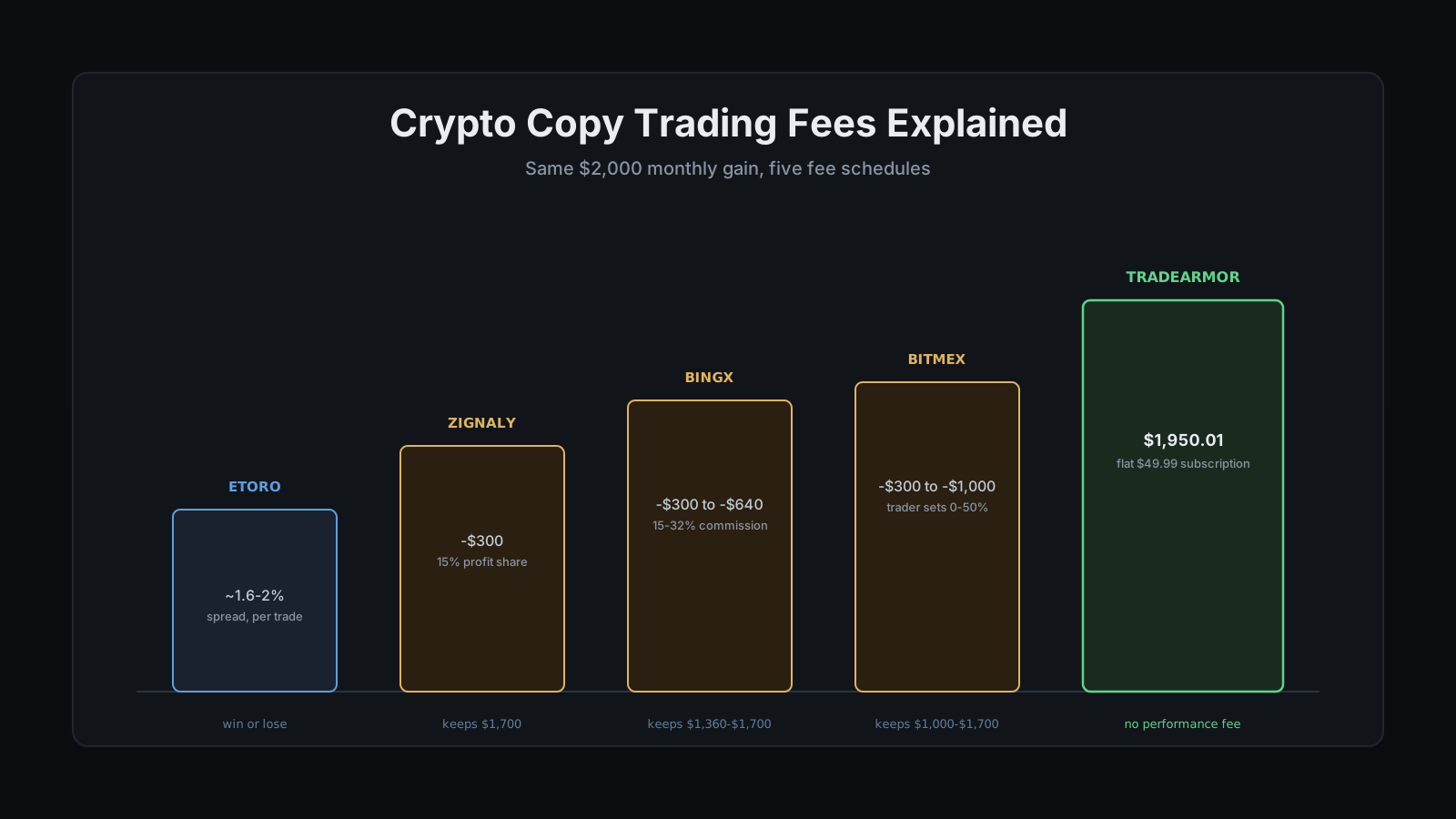
Take a $10,000 follower allocation through a genuinely good month: a 20% gross gain, $2,000 in profit before any fee is applied. Here's roughly what each model leaves on the table, using the disclosed ranges above.
- eToro: no explicit performance fee, but the underlying spread cost on the trades that produced the gain runs 1.6% to 2% per round trip. A trader who rotated through several full positions during the month can plausibly consume $150 to $300 or more in spread alone, charged on the trading activity itself rather than the profit, which means it's owed whether that specific trade won or lost.
- Zignaly: a 15% profit share (the trader-keeps-15%-of-a-20%-fee example above) takes $300 of the $2,000 gain. The follower keeps $1,700, minus small perpetual trading fees.
- BingX: a mid-range 15% performance commission takes $300; at an Elite lead trader's top advertised tier of 32%, that climbs to $640. The follower keeps somewhere between $1,360 and $1,700, depending entirely on which trader they picked.
- BitMEX: using the platform's own 15% example, $300 goes to the trader, $1,700 stays with the follower. A trader who sets the maximum 50% takes $1,000, cutting the follower's result in half.
- TradeArmor: a flat $49.99 Pro subscription for the month. The follower keeps $1,950.01 of the $2,000 gain, and that number doesn't move whether the month produced $200 or $20,000, because a subscription doesn't share in upside and doesn't care about win rate. The provider running the strategy keeps 100% of their own trading result too, with nothing extra owed to publish signals through Provider Mode beyond the subscription they're already paying.
That's the honest shape of it: three models that take a bigger bite the better you do, one model that takes a cut regardless of the outcome, and one flat number that was true in January and is still true now.
TradeArmor bundles cava-signals, 15 real-time indicators, an AI strategy builder, and DCA, grid, futures, copy trading, backtesting, paper trading, and tax exports into one self-hosted engine where your API keys never leave your hardware. If the honest question was always what copy trading costs once the marketing page stops talking, the answer here is a subscription you already know, not a percentage that shows up after the fact. The broadest case for that engine lives in the best self-hosted crypto trading bot guide.
Past performance is not indicative of future results. Signals are algorithmic outputs, not personalized investment advice.