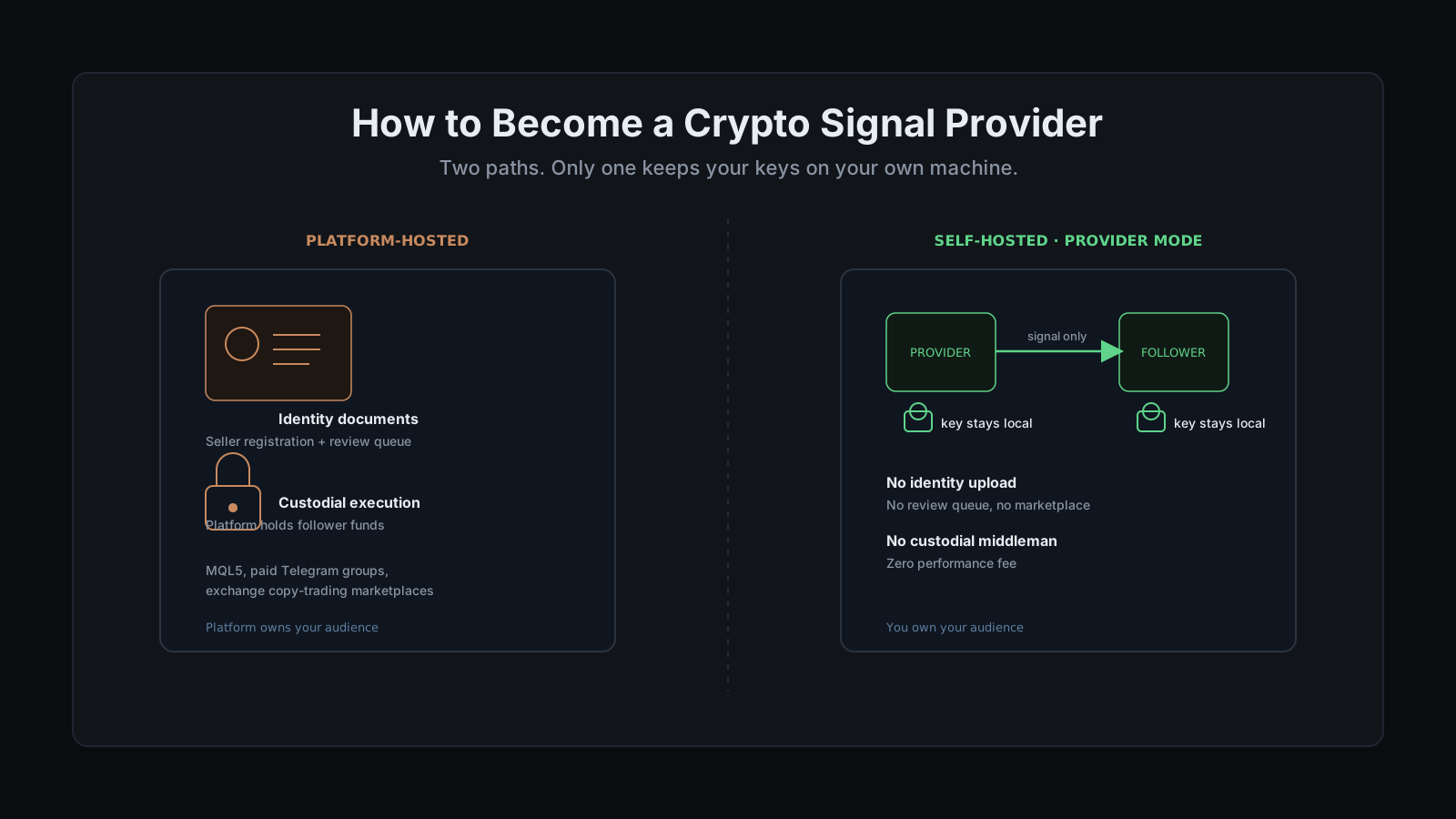
The signup flow for becoming a paid signal provider on MQL5, MetaTrader's own marketplace, asks for a copy of a government ID before it asks what the strategy actually does. Register an account, apply as a Seller, submit contact details and identity documents, wait through a verification step, and only then are you allowed to name a subscription price and open the doors. The entire premise of selling a signal is supposedly an edge nobody else has. The onboarding wants your face and your passport number before it wants your edge.
That's not a MetaTrader problem specifically. It's the default shape of how to become a crypto signal provider almost everywhere the question gets asked, whether the venue is a paid Telegram group, an exchange's built-in copy-trading marketplace, or a SaaS bot's signal store bolted onto its dashboard. Somewhere in the onboarding you hand a platform your identity, your funds, or your exchange API key, sometimes two of the three, just for permission to publish your own opinion. Why would you put your own trade permissions on a server you don't control, just to tell people what you're trading?
There's a second path, and it doesn't route through anyone's marketplace at all. A follower who's actually serious was never going to trust a subscribe button anyway. Show me the rules it's following, not just the result, is closer to what earns real trust than a marketplace badge or a review-queue stamp of approval. I've traded through TradeArmor for three years now, self-hosted on a machine I control end to end, with 15 real-time indicators, a plain-English AI strategy builder, and DCA, grid, futures, copy trading, backtesting, paper trading, and tax exports all living on that same engine. See the full feature set before the rest of this, because the rest of this is the narrower question underneath the broad one: what it actually takes to build a following as a signal provider once identity checks and custodial marketplaces are off the table.
How to Become a Crypto Signal Provider: The Two Paths
Every route to selling or sharing trading signals collapses into one of two models. The first is platform-hosted. A marketplace, an exchange's native copy-trading tab, or a signal-selling bot sits between you and your subscribers, handles discovery, handles billing, and in a lot of cases handles execution too, meaning follower funds sit in an account the platform controls, not the follower's own exchange login. You get distribution. The platform gets a cut, your identity on file, or both.
The second is self-hosted. No marketplace, no discovery algorithm doing the finding for you, no platform taking a slice of what a follower pays you if they pay you anything at all. What you get instead is a direct line: your signals reach a follower's own bot, running on their own hardware, executed through their own exchange key. This post is about that second path in full, and it links out to the deeper mechanics of TradeArmor's Provider and Follower Mode for the button-by-button setup rather than repeating it here.
The self-hosted path suits a specific kind of trader, and it's worth being honest about who that is. It's not someone looking for a side income stream from a strategy they haven't tested. It's someone who already runs a real strategy, on real capital, for long enough to have something worth showing, and who'd rather build a direct following than hand a cut of it to a marketplace that also happens to hold custody of the people following them. If that isn't where you are yet, the honest move is to keep trading and publishing your own history first. A following built on an unproven strategy is a liability with a subscribe button attached to it.
What the Platform-Hosted Model Actually Costs You
The MQL5 process above is the most explicit version of the trade-off, but it's not unique to forex. A paid Telegram or Discord signal group skips the identity check, and usually skips custody too, but the entire model runs on manual trust: a subscriber reads an alert, opens their own exchange app, and places the trade by hand, with whatever slippage happens between the alert landing and the trade actually going in. Proof of performance in that world is almost always a screenshot, frequently with the account number blurred out for privacy that conveniently also makes the numbers unauditable. A blurred number is not an audit, it is a screenshot with extra steps.
Exchange-native copy-trading marketplaces solve the manual-execution problem but reintroduce custody at scale. A major exchange's copy-trading tab typically requires the provider to pass a verification step, sometimes maintain a minimum balance on their own listed account, and the platform itself executes the mirrored trades against funds it holds for followers. That's a real, working model for a lot of people. It's also, structurally, the same custodial arrangement 3Commas or Cryptohopper run for a bot subscriber, just wearing a "copy trading" label instead of a "bot" one. The follower's funds sit somewhere they don't control, and the provider's reputation is built on a platform that owns the relationship, not the provider.
There's a quieter cost underneath all three models worth naming directly: the platform owns your audience, not you. Get delisted from a marketplace, banned from a Telegram bot's payment processor, or deprioritized by an exchange's discovery algorithm, and the followers you spent months earning don't come with you. They belonged to the platform's storefront the entire time. A provider who builds a following through their own word of mouth, their own visible track record, and their own relationships doesn't have that exposure, because there was never a storefront in the middle to lose access to.
Provider Mode: The Self-Hosted Alternative
Provider Mode skips all three costs at once. There's no seller registration, no identity upload, no review queue, because there's no marketplace standing between you and a subscriber to review anything for. You turn Provider Mode on, your bot's signals become available to whoever you choose to share them with, and sharing controls let you decide what gets published rather than a platform's terms of service deciding for you. TradeArmor tracks your follower count and basic performance metrics on your own dashboard. Nobody else's server is the source of truth for either number.
The part that actually matters for custody: your exchange API key never leaves your own machine to make any of this work, the same trade-only, no-withdrawal permission model that governs every other mode on the platform. Followers' keys stay on their machines too. The signal travels. The keys don't. That's the whole structural difference from every platform-hosted option above, stated as plainly as it actually works.
There's also no minimum follower count, no review committee deciding your signals are good enough to list, and no waiting period before you're technically allowed to start. That cuts both ways. Nothing stops you from turning Provider Mode on the same week you start trading, and nothing about the software will tell you that's a bad idea. The gate here isn't technical, it's the track record covered further down, and no platform's approval process was ever a substitute for that anyway.
See how self-hosted copy trading works end to end, including the setup steps for turning Provider Mode on.
Sharing Controls, and What a Follower Actually Sees
Sharing controls are yours: what gets published, and to which followers, is a decision you make, not a platform's algorithm surfacing your signals to whoever it thinks will convert. What a follower sees on their end is the signal itself, the entry and exit your strategy generated, delivered straight into their own bot. What they don't see is your account balance or your exact position sizes, because position sizing on the follower's side is computed independently: a fixed percentage, a fixed dollar amount, or pro-rata to your own sizing, never a mirrored copy of your account. Your balance never has to be exposed for that math to work, which also means a bad week in your personal position sizing doesn't broadcast itself to every subscriber.
A follower deciding whether to trust you at all is still doing real due diligence, just aimed somewhere more useful than a subscribe button. Running your provider signals inside Trading Groups alongside your own account's other strategies is a reasonable way to demonstrate you trade the same signals you publish, not a curated highlight reel pulled from a separate account that only exists to look good.
Honest Expectations: This Isn't Passive Income
Nothing about Provider Mode automates the part that actually builds a following. You still have to be right often enough, explain the calls that go wrong, and keep showing up with your name attached to every signal for as long as anyone is watching. Followers who lose money on a bad call remember who sent it, self-hosted or not.
The general bar serious followers apply, whether they say it out loud or not, is a track record spanning at least twelve months across more than one kind of market, verified against something real, an exchange API history or an on-chain record, not a story. A sixty-day run through a favorable stretch isn't a track record. It's a lucky streak with a caption. The CFTC's guidance on digital asset fraud documents the recurring version of this gone wrong: social media recruiting into a group chat, someone posing as an expert, and a pitch built on guaranteed or unrealistically high returns from a trading signal or bot, run right up until the platform behind it turns out to be fake. A group chat with a paywall is not a fund, it just has better graphics.
None of that is a reason to skip becoming a provider if you actually have something worth following. It's a reason to treat reputation as the whole product, not a formality between you and a subscribe button.
The providers who actually keep followers past the first month tend to do one unglamorous thing consistently: they publish the losing trades with the same visibility as the winning ones. A curated highlight reel is easy to build and easy to see through. A full log, wins and losses, both landing in a follower's dashboard through the same Follower Mode feed, is harder to fake and it's the version of proof that survives a follower actually checking. If a track record only exists as a story you tell, it isn't one yet. Twelve months of a full history a follower can pull up themselves is the version that is.
TradeArmor's self-hosted engine carries all of it at once: cava-signals, 15 real-time indicators, an AI strategy builder, DCA, grid, futures, copy trading, backtesting, paper trading, and tax exports, with your API keys never leaving hardware you own. If you're actually weighing how to become a crypto signal provider, the marketplace paperwork was never the hard part. The hard part is whether you're willing to put your name on every call, in public, for as long as people keep watching.
Past performance is not indicative of future results. Signals are algorithmic outputs, not personalized investment advice.