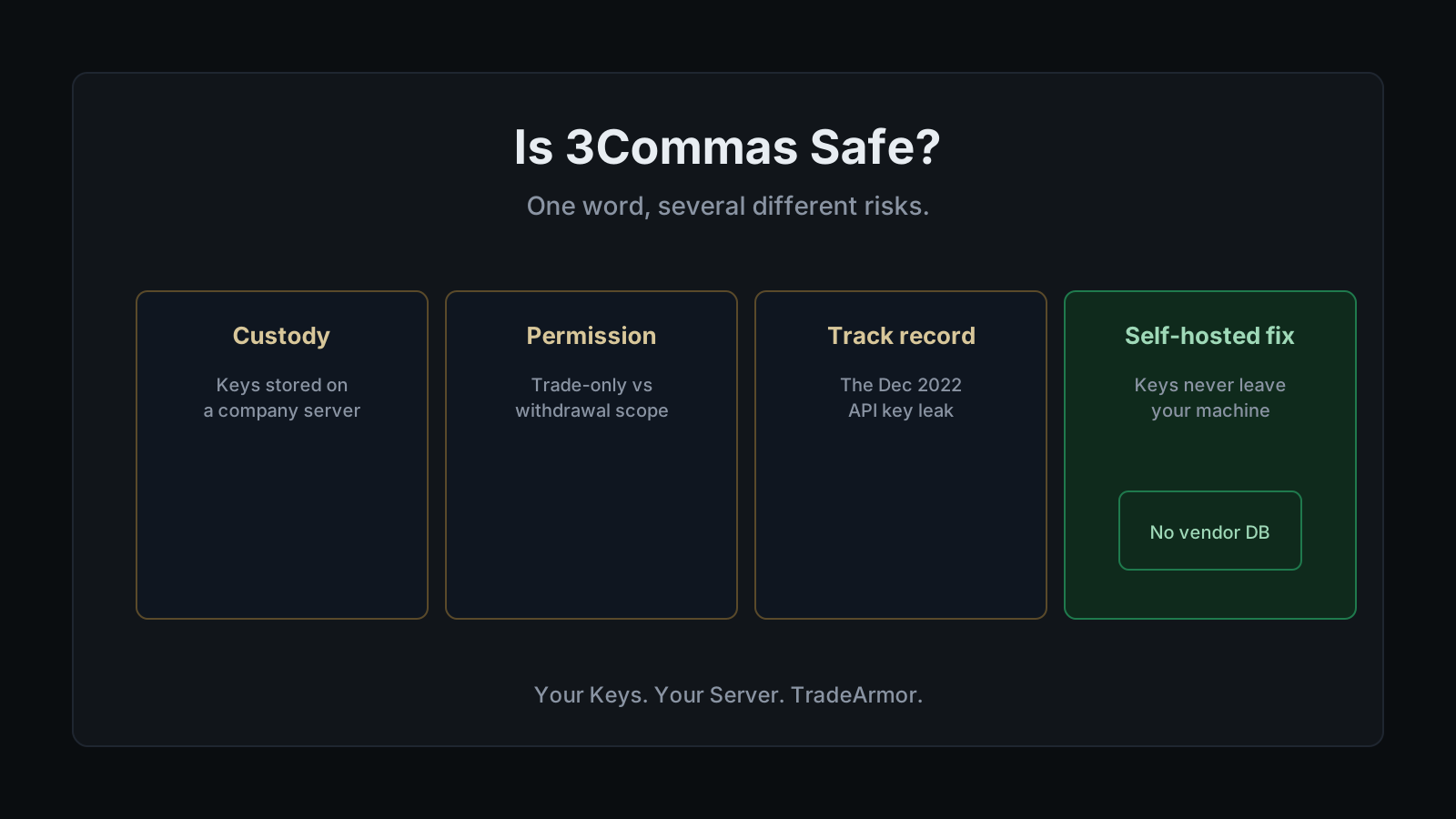
Is 3Commas Safe? A Custody-First Answer
Type "is 3Commas safe" into a search bar and the results split cleanly into two camps. 3Commas' own security page lists encryption, isolated key storage, and zero withdrawal access, and every claim on it is accurate. A trader in a Reddit thread writes some version of "3Commas got hacked and I'm never touching a SaaS bot again" and links a Pastebin post from December 2022 with more than 100,000 API keys in it. Both are describing the same platform correctly. Unlike a couple of its competitors, where the unsafe argument is mostly theoretical, 3Commas is the rare case where "why would I trust a server I don't control with trade permissions on my account" has an actual incident behind it, not just a hypothetical one.
Here is the short version before the mechanics, because the mechanics decide which camp you land in. In December 2022, a database compromise exposed API keys belonging to more than 100,000 3Commas users, and a documented set of victims lost real money as a direct result. In the years since, 3Commas rebuilt its key-storage architecture, added stricter encryption, and shipped controls that were not there before. Neither fact cancels the other out. This piece takes them both seriously and breaks "safe" into the four things people actually mean when they type it.
I run the self-hosted argument for a living, so you should know where I sit. TradeArmor keeps your exchange API keys on hardware you control, ships signals with a three-year live history baked in, and runs the same categories of automation, DCA, grid, futures, copy trading, an AI-assisted strategy builder, backtesting, and tax exports, without a company database anywhere in the trade path. That bias is on the table. It does not change what actually happened to 3Commas' users in 2022, and it does not erase the real work the platform has done since.
Risk one: custody, where the keys physically sit
3Commas is Software-as-a-Service. You connect an exchange API key, that key gets stored on 3Commas infrastructure inside what the company calls its Sign Center, isolated at both the network and access level, and the platform's servers ask the Sign Center to sign each trade request rather than handling the raw key directly. That is a genuinely better architecture than a flat database entry, and it is worth crediting as such.
It is still a store. For a cloud service to trade on your behalf while you sleep, a key capable of trading your account has to exist somewhere the cloud can reach, and that somewhere is 3Commas' own infrastructure, not yours. Isolation reduces the blast radius of a compromise. It does not relocate the target. The 2022 incident happened inside exactly this kind of store, before the current isolation model existed, which is the whole reason the isolation model exists now.
Risk two: permission, what the key can actually do
This is the layer 3Commas gets right by design, and it deserves a fair hearing on its own terms. An exchange API key carries separate scopes. Read lets a bot see balances. Trade lets it place orders. Withdraw lets it move funds off the exchange. 3Commas states plainly that it has zero access to withdraw or transfer funds, and its platform architecture does not request that scope in the first place.
Two details go further than the basics. A 3Commas API key gets bound to your specific account, so a stolen key cannot simply be pasted into a stranger's dashboard and put to work, which closes off the most common path a leaked credential would otherwise take. IP whitelisting is available on most supported exchanges too, letting you lock a key to 3Commas' published IP ranges so a copy sitting anywhere else is refused before it ever executes a trade. Every SaaS bot's security page reaches for "bank-level encryption" at some point. Whether an actual bank would sign off on the comparison is a separate question, and 3Commas at least backs the phrase with specifics: account binding, IP scoping, and a documented storage redesign.
Correct scoping stops fund theft. It does not stop bad trades placed with valid trade access, and it does not change the fact that a server somewhere holds a key that can act without you touching a keyboard. For the full scope-by-scope breakdown, the API key security guide and the no-key-custody explainer go deeper than one section can. You can also see the full TradeArmor feature set here.
Curious what running the same categories of automation looks like with nothing to whitelist because there is no server to protect? Start the 30-day trial.
Risk three: track record, the part reviews keep landing on
This is where the 3Commas question genuinely differs from asking the same thing about a platform with a clean history. On December 28, 2022, a Pastebin post surfaced containing more than 100,000 3Commas user API keys, and on-chain researchers traced the underlying database compromise back to October of that year, weeks before it became public. A class action followed, alleging the company failed to properly encrypt the data it stored.
3Commas disputes the framing. Its position is that the keys were phished from individual users rather than stolen from its own systems, and it denies fault in the underlying compromise. You can read that dispute either way, and reasonable people do. What is not in dispute is the scale: a verified group of 44 victims lost a combined $14.8 million from their exchange accounts, and the class action that followed, filed by 13 plaintiffs, put cumulative losses near $22 million.
A company can be right about the mechanism of a leak and still be the reason the leak was possible in the first place. Both of those can be true on the same Tuesday.
What happened afterward matters too, and skipping it would be its own kind of dishonesty. By 3Commas' account, the platform rewrote its key-storage model around the isolated Sign Center described above, tightened encryption standards, and added rate-limiting and behavioral analytics designed to flag account activity that does not look like the account's owner. Those are concrete engineering changes, not just a reassuring paragraph on a security page, and they lower the odds of a repeat. They do not turn back the clock on 2022, and they do not change the structural fact that trade-enabled keys still have to live on a server somewhere for the automation to work.
Risk four: operational trust, the part no incident report covers
The last risk has nothing to do with any single breach. On any SaaS bot, your automation depends on a chain you cannot fully inspect: the company staying solvent, its infrastructure staying up, its staff not making a mistake, its newly hardened key store staying hardened against whatever comes next. Most of the time that chain holds, for most operators, most years. You are trusting the whole chain permanently either way, and 2022 is the reminder of what it looks like when one link gives.
Self-hosting swaps that chain for one you own outright. Your uptime becomes your job instead of a vendor's SLA, and a machine left running in a closet does not maintain itself. That is a real cost, not a free upgrade. For a trader who already lived through a leaked-key headline once, trading a company's chain of trust for your own chain of chores is usually the exact trade they came looking to make. The wider version of that trade-off lives in the self-hosted versus SaaS breakdown.
So is 3Commas safe, or not?
Both halves of the search results are defensible, and that is why the question keeps getting typed instead of settled. 3Commas has genuinely never had withdrawal access, binds keys to a single account, supports IP whitelisting, and has rebuilt its key infrastructure since 2022 in ways that are documented and specific, not just marketing copy. It also had a real breach in 2022 that cost real victims real money, and no encryption upgrade retroactively un-happens that.
The structural point from are crypto trading bots safe at all applies directly here: a bot is only as safe as where its keys live. 3Commas has made where they live meaningfully more defensible than it was three years ago. It still is not your own machine. If a self-hosted bot with the same categories of automation and a bundled signal history is the trade you are weighing, the 3Commas alternative comparison lays out that decision in full, including where 3Commas still wins on exchange breadth and feature maturity.
Frequently asked questions
Is 3Commas legit or a scam? Legit. It is an established platform running since 2017 with a large user base and a real product team behind it. It also had a genuine security incident in December 2022, unlike some competitors whose safety questions are mostly hypothetical. Being legitimate and having a documented breach in your history are not contradictions. Both are true here.
Can 3Commas withdraw or steal my funds? Not through the API connection. 3Commas states it has zero access to withdraw or transfer funds, and it structurally cannot request that scope even if it wanted to, because the platform is built to operate on trade permissions only. A correctly scoped key cannot move coins off the exchange no matter who is asking, 3Commas included.
Is it safe to give 3Commas my exchange API keys? Safer than it was before the 2022 incident, and the company has published real infrastructure changes since. It is never as safe as a key that is never transmitted to a third party at all. That gap between encrypted-but-stored and never-stored is the entire difference between a SaaS bot and a self-hosted one, and no amount of post-incident hardening closes it.
Did 3Commas actually get hacked in 2022? A Pastebin post in December 2022 exposed more than 100,000 3Commas user API keys, tied to a database compromise on-chain researchers trace back to October 2022. Verified victims lost millions across dozens of accounts, and a class action followed. 3Commas maintains the keys were phished from users rather than stolen from its own systems, and disputes fault. Both the exposure and the dispute are on the public record.
What has 3Commas changed since the breach? By its own account, it rebuilt key storage around an isolated Sign Center, added stricter encryption, and layered in rate-limiting and behavioral monitoring to catch unusual account activity. Those are substantive changes, not just a blog post. They reduce the odds of a repeat. They do not change the underlying model, which still requires a company server to hold something that can trade your account.
Does self-hosting actually make my trading safer? It reduces operational risk, the kind that comes from a company breach, an outage, or a server holding a key you cannot see. It does not touch market risk. The bot runs your rules, and the market does whatever it is going to do regardless of who holds the API key. Self-custody means you own every decision and every outcome, which is the actual trade.
Bottom line
"Is 3Commas safe" does not have a one-word answer, because the platform genuinely earns credit on permission design and has genuinely paid the cost of a real breach on its record. Both facts belong in the same sentence. What has not changed, no matter how good the Sign Center gets, is that trading through 3Commas means a company holds a key that can act on your exchange account, and you are trusting its infrastructure, its staff, and its next security review to hold.
TradeArmor removes that trust requirement instead of hardening it. Same categories of automation, bundled signals with a three-year track record instead of none, and an API key that never leaves your own hardware because there is no server in the trade path to leak it from. You are not trading breadth for safety here so much as trading a company's promise for your own machine. If that is the swap you were weighing, see the plans and start.
Past performance is not indicative of future results. Signals are algorithmic outputs, not personalized investment advice. Trading cryptocurrency carries substantial risk including the total loss of capital.
Ed Cava