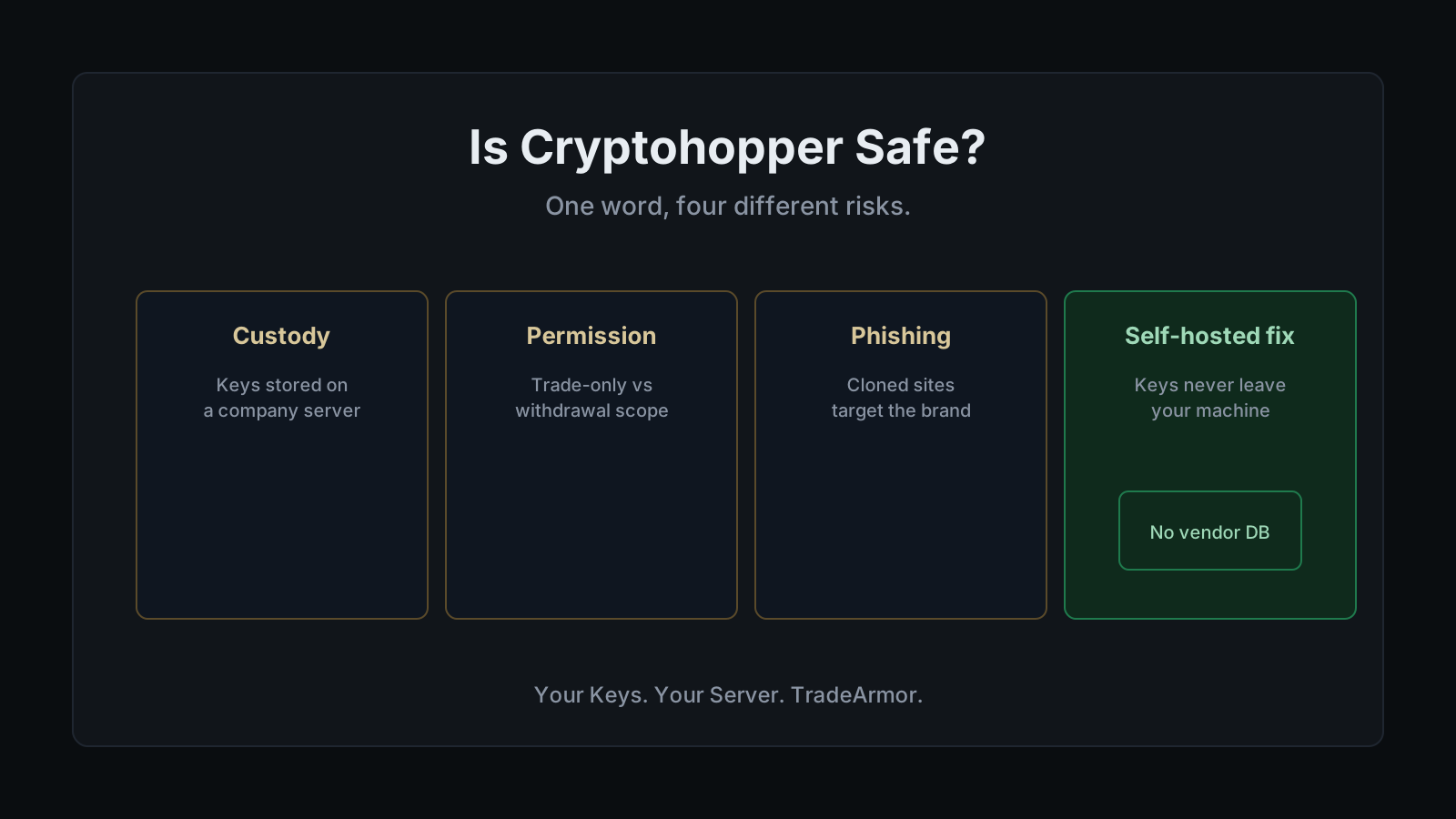
Is Cryptohopper Safe? A Custody-First Answer
You are about to connect a bot to an exchange account that holds real money, and the setup screen wants an API key. That is the moment the question shows up. Is Cryptohopper safe, or are you about to hand a stranger the keys to your trading account. The people typing that search are not tire-kickers. They are traders who already run a book and are one careful step away from automating it, thinking some version of "I don't want to give my API keys to a third party" or the blunter "3Commas got hacked and I'm never touching a SaaS bot again."
Here is the short version, and then the mechanics, because the mechanics are the entire point. Cryptohopper is a real, long-running company that encrypts stored keys, sits behind a web application firewall, and tells you plainly to disable withdrawal permission, turn on two-factor authentication, and whitelist its server addresses. Do all of that and the platform physically cannot move your coins off the exchange. In that specific sense, yes, it is safe to use. The word "safe" is just carrying more weight than one sentence can hold, so let us take it apart.
The reason I care about this is that I build the self-hosted side of the argument. TradeArmor is a self-hosted crypto trading platform with built-in BTC/USDC signals carrying a 3+ year track record, 15 technical indicators, a plain-English AI strategy builder, DCA, grid, futures, copy trading, backtesting, paper trading, and tax exports, all running where your API keys never leave your machine. So I am not neutral on custody. But this is not a hit piece, and Cryptohopper does a lot right. The honest answer to "is Cryptohopper safe" is that it depends on which risk you are actually asking about, and there are four of them hiding inside the one word.
Risk one: custody. Where do the keys actually live?
Cryptohopper is Software-as-a-Service. You give it an exchange API key, that key is encrypted and stored on its infrastructure, and its cloud runs your bots against your account 24/7 whether your laptop is on or off. That always-on convenience is the product. It is also the shape of the risk. For the cloud to trade while you sleep, the key has to sit somewhere the cloud can reach it, which means a store of trade-enabled keys exists on a server you do not control.
Encryption helps. It does not make the store disappear. Any database of trade-enabled keys is a target, and the value of the target scales with the number of users behind it. This is not a Cryptohopper-specific flaw. It is the defining trade-off of every SaaS bot, 3Commas and Bitsgap included. The self-hosted versus SaaS breakdown lays out the full matrix, but the one-line version is this: a SaaS bot asks you to trust an operator's security forever, and a self-hosted bot asks you to trust your own machine. Only one of those is a question you can personally answer.
Risk two: permission. What can the key actually do?
This is the risk you have the most control over, and it is the one Cryptohopper's own guidance gets right. An exchange API key carries separate permissions. Read lets a bot see balances and prices. Trade lets it place and cancel orders. Withdraw lets it send coins off the exchange to another address. A trading bot needs the first two. It never needs the third.
Set the key to read and trade only, and even a total compromise of the platform cannot drain your account to an external wallet, because a key without withdrawal permission cannot move funds off the exchange. That is real protection and you should take it, on any platform. Just keep the limit of it in view. Trade-only permission is a seatbelt, not a force field. A bad actor with trade access on your key still cannot withdraw, but they can place trades, and a wash-trade or a dump into an illiquid pair is its own way to lose money. Correct permissions shrink the blast radius. They do not remove the fact that someone else's server holds a key that can trade your account. If you want the full walkthrough of what each scope exposes, the API key security guide goes scope by scope, and the no-API-key-risk explainer covers why two is the only right number.
See the whole feature set and how a local-key model works in practice on the features page.
Risk three: phishing and the fake-site problem
Being a large, well-known cloud brand carries a cost that has nothing to do with Cryptohopper's own code quality. In 2019, security researchers and BleepingComputer documented a cloned Cryptohopper website that auto-downloaded a Setup.exe carrying the Vidar information-stealer, using the Cryptohopper logo as its icon to look legitimate. It harvested browser credentials, wallet files, and stored logins. Cryptohopper's real servers were not breached in that event. Its brand was impersonated to hunt its users, which for the user is a distinction without much comfort.
The lesson generalizes. Any popular SaaS platform becomes a phishing magnet, and the account you log into with a password is a credential that can be stolen through a convincing fake. Cryptohopper responded the right way, publishing phishing warnings and a data-breach advisory telling users to rotate exchange keys, change passwords, and reset two-factor authentication. A self-hosted bot has no hosted login to phish. There is no central account page to clone, because the dashboard runs on your own hardware at a local address. It is a smaller attack surface by construction, which is the quiet advantage of not being a famous target.
Risk four: operational trust, the part nobody markets
The last risk is the one no pricing page mentions. On a SaaS bot, your automation depends on a chain of things you cannot inspect: the company staying solvent, its servers staying up, its staff not making a mistake, its key store staying encrypted and intact. Most of the time that chain holds, and most operators are competent and careful. But you are trusting all of it, permanently, and you find out it failed at the worst possible moment.
Self-hosting swaps that chain for a different one you actually own. Your uptime is now your responsibility, and I will not pretend a Raspberry Pi in a drawer maintains itself. The trade is real. You take on the babysitting so that no third party ever holds a key to your account. For a lot of traders, especially the ones who already got burned once, that is the trade they came looking for. The full case lives in the best self-hosted crypto trading bot guide.
So is Cryptohopper safe, or not?
Both answers are true, which is why the question keeps getting searched. Cryptohopper is legitimate, it encrypts keys, it blocks withdrawal by design when you configure it correctly, and it responded responsibly to the incidents that touched it. Used with trade-only keys, IP whitelisting, and 2FA, it is not going to hand your Bitcoin to a hacker.
What it cannot do is change its own architecture. To trade for you in the cloud, it has to hold a key that can trade your account, and that store is a standing risk no amount of good hygiene removes. The honest framing is the one from the wider piece on whether crypto trading bots are safe at all: a bot is only as safe as where its keys live. Cryptohopper keeps them on its servers, locked down. A self-hosted bot keeps them on your machine, where there is no vendor database to breach in the first place. If you want the same managed dashboard and bundled signals without the hosted key store, the Cryptohopper alternative breakdown is the direct comparison.
Frequently asked questions
Is Cryptohopper legit or a scam? Legit. It is an established company that has operated for years with a real product, real users, and public security documentation. The fraud associated with the name has generally been impersonation, cloned sites and phishing aimed at its users, not the platform itself running a scam. Treat any site that is not the official domain as hostile, and only ever download from the source you verified.
Can Cryptohopper steal my crypto? Not directly, if you set the API key to read and trade only with no withdrawal permission. A key without withdrawal scope cannot send funds off the exchange, so neither the platform nor anyone who breached it could move your coins to an outside wallet. The residual risk is trade permission itself: someone with trade access can still place orders, which is why reducing custody risk entirely means keeping the key off any third-party server.
Is it safe to give Cryptohopper my exchange API keys? It is safer than most people assume once you disable withdrawals, enable IP whitelisting, and turn on 2FA. It is never as safe as not transmitting the key at all. That is the core difference between a SaaS bot and a self-hosted one: the first stores a trade-enabled key on its servers, the second keeps it in a local config file that never leaves your hardware.
Does self-hosting actually make my trading safer? It reduces operational risk, the kind that comes from a company breach, an outage, or a phished cloud login. It does nothing about market risk. The bot runs your rules; the market does what it does. Self-custody means you control every decision and own every outcome, which is the whole point of doing it yourself.
Bottom line
"Is Cryptohopper safe" is really four questions wearing one coat: custody, permission, phishing, and operational trust. Cryptohopper handles three of them well and is honest about the fourth, but it cannot escape the one that defines the SaaS model, which is that your keys have to live on its servers for the cloud to trade. TradeArmor takes the other road. You keep the polished dashboard, the bundled signals with a 3+ year track record, and the full spread of DCA, grid, futures, copy trading, indicators, backtesting, paper trading, and tax exports, while your API keys never leave your machine. You trade convenience for custody. If that is the trade you came here to make, see the plans and start.
Past performance is not indicative of future results. Signals are algorithmic outputs, not personalized investment advice. Trading cryptocurrency carries substantial risk including the total loss of capital.
Ed Cava