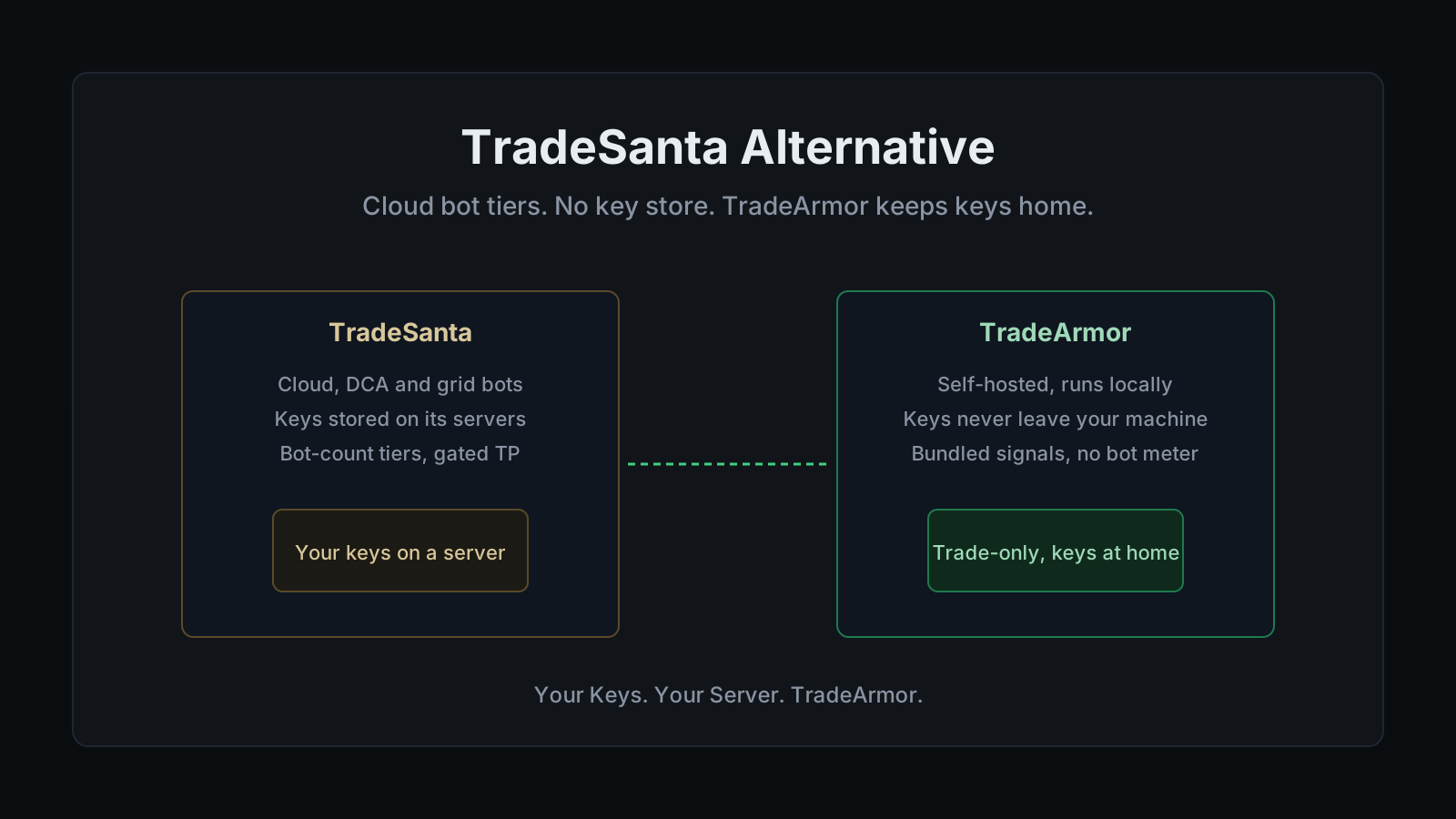
TradeSanta Alternative: Self-Hosted, Keys Local
TradeSanta has been running DCA and grid bots in the cloud since 2018, and it built a real following doing one thing well: point it at Binance or Bybit or Kraken, pick a strategy, and let it average into a position or work a range while you are at your day job. That is the actual promise behind every DCA and grid bot, automation for someone who is not free to sit in front of a chart during business hours, and TradeSanta delivers it. The reason people go looking for a TradeSanta alternative almost never starts with the bots themselves. It starts the day someone notices that trailing take profit, a feature that should just be part of a DCA bot, does not exist on the plan they are paying for. It only shows up once you upgrade past Basic. "Every feature is behind another upgrade tier" is the sentence sitting under most of these searches, and TradeSanta's own pricing page confirms it in plain checkmarks and crosses.
There is a second, quieter reason, and it surfaces once someone has been running bots long enough to think about where the keys actually live. TradeSanta's bots execute from its own servers, which means TradeSanta holds your exchange API keys to run them. More on that below, because TradeSanta actually handles the permission model correctly, but "I don't want to give my API keys to a third party" is a line I hear constantly, and it is the exact problem a self-hosted bot exists to solve.
The self-hosted option here is TradeArmor, which I build, so read the rest with that in mind. This is not a hit piece. TradeArmor is a self-hosted crypto trading platform with built-in BTC/USDC signals carrying a 3+ year track record, 15 technical indicators, a plain-English AI strategy builder, DCA, grid, futures, copy trading, backtesting, paper trading, and tax exports, all running where your API keys never leave your machine. The same DCA and grid mechanics TradeSanta popularized, minus the cloud key store and minus the meter on which basic features you get to use.
Where the ceiling actually is
TradeSanta's own pricing page, checked as of this writing, lays the ceiling out feature by feature rather than hiding it in fine print. Basic runs $25 a month billed monthly, or $18 a month if you commit to a year, and it caps you at 49 bots. That plan gets you all strategies and the trading terminal, and nothing else. No trailing take profit. No TradingView Screener signals. No custom TradingView signals. No futures bots. Every one of those sits behind a cross-mark, not a checkmark.
Advanced moves the cap to 99 bots for $45 a month, or $32 annually, and this is where trailing take profit and TradingView Screener signals finally turn into checkmarks. Maximum removes the bot cap entirely, adds custom TradingView signals and futures bots, and costs $90 a month, or $45 annually. Read that progression with a trader's eye: the thing being metered is not your trade volume, it is whether the bot you already understand how to configure is allowed to trail your take profit or not.
That is a subscription model wearing the costume of a feature set. If you want the full frame on why this architecture exists at all, the self-hosted versus SaaS breakdown lays out the whole trade matrix, and you can see the entire TradeArmor feature set here.
Credit where it is due: TradeSanta does custody right on funds
I am a self-custody maximalist, and I will still say this plainly: TradeSanta handles the fund-custody question well. It never holds your coins. It connects through API keys configured with trade-only permission, so the bot can place and cancel orders but cannot withdraw or transfer anything off the exchange, and it backs the account itself with two-factor authentication. If a reader is choosing between TradeSanta and some anonymous Telegram bot asking for withdrawal access "to optimize returns," TradeSanta is the adult in the room, and it is not close.
So the honest wedge here is not "TradeSanta will steal your money." It will not, and pretending otherwise would fail the only test that matters, which is the truth. The wedge is narrower and structural. To run your bots from the cloud, TradeSanta has to store those trade-only keys on its own servers, indexed by account, permission-limited but present. That store is the thing a self-hosted bot does not have, because there is nothing to store when the key sits on your own machine.
The one difference that drives the rest: where your keys live
Every real difference between TradeSanta and a self-hosted TradeSanta alternative traces back to one architectural fork. A cloud bot runs on the vendor's servers, so your keys have to live there too. A self-hosted bot runs on your hardware, so the keys live in a local config file that is never transmitted anywhere.
TradeArmor takes the second road. You run the bot on a Mac mini, a Linux box, a Raspberry Pi, or a cheap VPS, and the API key sits in a file on that machine. There is no TradeArmor database holding customer keys, because the keys are on your side of the wire. The correct permission set is the same two scopes TradeSanta already gets right, read and trade, never the third one, withdraw. If you want the full mechanics of why two is the only right number, the API key security walkthrough covers it end to end.
A trade-only key is a good lock. Self-hosting removes the door it is locking. Both matter, and only one of them is available from a cloud platform.
Signals, not just DCA and grid presets
Here is the feature gap that catches people off guard. TradeSanta's automation runs on the DCA and grid rules you configure, plus Extra Orders for averaging into a position against the trend. That is a real, useful engine, and it explains the following the platform has built since 2018. But none of it is a live call on when to actually enter. TradingView Screener signals fix that gap, and TradeSanta gates the feature behind Advanced and Maximum, with custom TradingView webhook signals reserved for Maximum alone.
TradeArmor bundles something structurally different: a built-in BTC/USDC signal feed with a 3+ year live track record, running since 2022, included on the entry Starter tier rather than sold as a feature unlock. You still keep the DCA engine, the grid bot, fifteen indicators, and the rest. The signals are one more input you can route into your own rules or run on their own. Signals are algorithmic outputs, not personalized advice, and past performance never guarantees future results. But there is a meaningful difference between paying extra to plug in someone else's TradingView alerts and getting a signal feed with three years of live history on the plan you already bought.
What you give up, honestly
Switching to a self-hosted TradeSanta alternative is a real trade, not a free lunch, and pretending otherwise would be the cringe move.
You give up connection breadth. TradeSanta reaches a wide, if slightly moving, list of exchanges across its regional sites, including Binance, Bybit, OKX, Kraken, Coinbase, KuCoin, and HTX depending on your region. TradeArmor supports six exchanges out of the box, Binance US, Coinbase, Bybit, OKX, Bitget, and KuCoin, with more available on request through the CCXT framework. If your trading depends on a venue outside that list, check the supported set before you switch.
You also give up the fully-managed experience. TradeSanta maintains the uptime for you, and its mobile apps mean you can babysit a bot from your phone without owning any hardware. Self-hosting means you own your own uptime instead, and a laptop that sleeps when you close the lid is not a trading server. A Raspberry Pi in a drawer works. Ask me how I know. What you get back is custody, an uncapped feature set, and one price instead of a bot-count ladder.
Pricing, side by side
TradeArmor's Starter plan is $19.99 a month with a 30-day money-back guarantee, and it includes the bundled signals, the full DCA engine with trailing take profit, and all six exchanges, with no bot-count tier standing between you and any of it. TradeSanta's comparable entry point is Basic at $25 a month, or $18 annually, and Basic is explicitly the tier without trailing take profit or any signal feed. Matching TradeSanta's checkmarks means moving to Advanced at $45 a month, still without custom TradingView signals or futures, or all the way to Maximum at $90 a month for the full feature set.
TradeSanta's own 3-day free trial, no credit card required, is a fast way to see the interface, but three days is barely enough to run one DCA cycle end to end. TradeArmor's 30-day money-back guarantee gives you a full month against your own account. The comparison that matters is not the sticker price on Basic, it is what you actually get for it and where the number climbs from there. If you are pricing the rest of the field too, the Bitsgap alternative, 3Commas alternative, and Coinrule alternative breakdowns cover the other names on the shortlist.
Who should switch to a TradeSanta alternative
Stay with TradeSanta if the cloud DCA and grid experience is exactly what you want, 49 or 99 bots is genuinely more than you will ever run, and you would rather a company own the uptime and hand you a phone app than run your own box. That is a reasonable position and I am not going to talk you out of it.
Move to a self-hosted TradeSanta alternative if trailing take profit being locked behind a paywall is the moment that soured you, if the bot-count ladder is costing you more than your strategy is earning, or if the cloud key store is the thing you keep circling back to at 2 a.m. Self-hosting is the only answer that actually resolves that last one, because it removes the store instead of hardening it. If you are arriving from ProfitTrailer rather than TradeSanta, the path is even shorter: TradeArmor ships a one-click ProfitTrailer migration that imports your open positions and DCA legs and matches the EQPRICE buy-gate logic.
Frequently asked questions
Is TradeArmor a drop-in replacement for TradeSanta? Not a drop-in in the technical sense, because there is no config importer between a cloud DCA and grid platform and a self-hosted one. It is a replacement in the practical sense: it runs the same DCA and grid categories of automation, ships bundled signals TradeSanta does not, and never stores your keys on a server. Expect an afternoon of setup and a week of paper trading rather than a one-click import, unless you are coming from ProfitTrailer, which does have a one-click path.
Is TradeSanta safe to use? TradeSanta gets the fund-custody question right. It never holds your coins, it connects through API keys configured with trade-only permission so the bot can place and cancel orders but cannot withdraw, and it supports two-factor authentication on the account itself. The structural caveat is the one no setting removes: to run your bots from the cloud, TradeSanta has to store those trade-only keys on its own servers. A self-hosted alternative removes that store entirely, because the key sits in a config file on your own machine and is never transmitted anywhere.
Does TradeSanta have built-in trading signals like TradeArmor? No. TradeSanta's bots run on the DCA and grid rules you configure, plus TradingView Screener signals and custom TradingView webhook signals, and both of those are locked behind the Advanced and Maximum plans rather than included at the entry tier. TradeArmor bundles a built-in BTC/USDC signal feed with a 3+ year live track record on every plan, including the entry Starter tier, as one more input alongside your own indicators and formulas.
Does TradeSanta limit how many bots I can run? Yes, and this is the lever the pricing page leans on. The Basic plan caps you at 49 bots, Advanced raises that to 99, and only the Maximum plan removes the cap entirely, at $90 a month billed monthly or $45 a month billed annually. Trailing take profit is also gated out of Basic entirely and only unlocks on Advanced and Maximum. TradeArmor's DCA engine, trailing take profit included, ships on the $19.99 Starter plan with no bot-count meter.
What is the best self-hosted TradeSanta alternative? If what you like about TradeSanta is the DCA and grid bot mechanics, but what you do not like is that a cloud company stores your exchange API keys and meters basic features like trailing take profit behind a bot-count ladder, the closest match is a self-hosted bot that keeps the same core automation. TradeArmor fits that: it runs on your own hardware with trade-only API keys that never leave your machine, and it ships built-in BTC/USDC signals with a 3+ year track record, 15 technical indicators, a plain-English AI strategy builder, DCA, grid, futures, copy trading, backtesting, paper trading, and tax exports, all on one price.
Why self-host instead of using a cloud bot like TradeSanta? The one-line answer is custody plus control. A cloud bot runs your DCA and grid rules on its servers and needs your exchange API keys stored there to do it, and it can gate core features like trailing take profit behind how many bots you are willing to pay for. A self-hosted bot runs the same automation on your own machine, so the keys stay local, there is no vendor database holding them, and there is no bot-count ladder standing between you and the feature you already paid for. You take on your own uptime in exchange, which for most people is a Raspberry Pi or a Mac mini left running. It reduces operational risk. It does not remove market risk, and trading still carries the full risk of loss.
Bottom line
TradeSanta and a self-hosted bot agree on the thing that matters most for beginners: your keys should be trade-only and your funds should stay on the exchange. TradeSanta earns real credit there. They part ways on two structural points. TradeSanta stores those keys on its own servers to run cloud bots, and it gates a feature as basic as trailing take profit behind a bot-count tier you have to buy your way into. A self-hosted TradeSanta alternative like TradeArmor keeps the DCA and grid mechanics and adds bundled BTC/USDC signals with a 3+ year track record, plus futures, copy trading, indicators, backtesting, paper trading, and tax exports, while your API keys never leave your machine and nothing gates trailing take profit behind a tier. You give up connection breadth and a phone app that requires no hardware of your own, and you take on your own uptime. You get custody, an uncapped feature set, and one subscription instead of a ladder.
If that trade sounds right, the broadest case lives in the best self-hosted crypto trading bot guide, and the cleanest next step is to see the plans and start.
Past performance is not indicative of future results. Signals are algorithmic outputs, not personalized investment advice. Trading cryptocurrency carries substantial risk including the total loss of capital.
Ed Cava