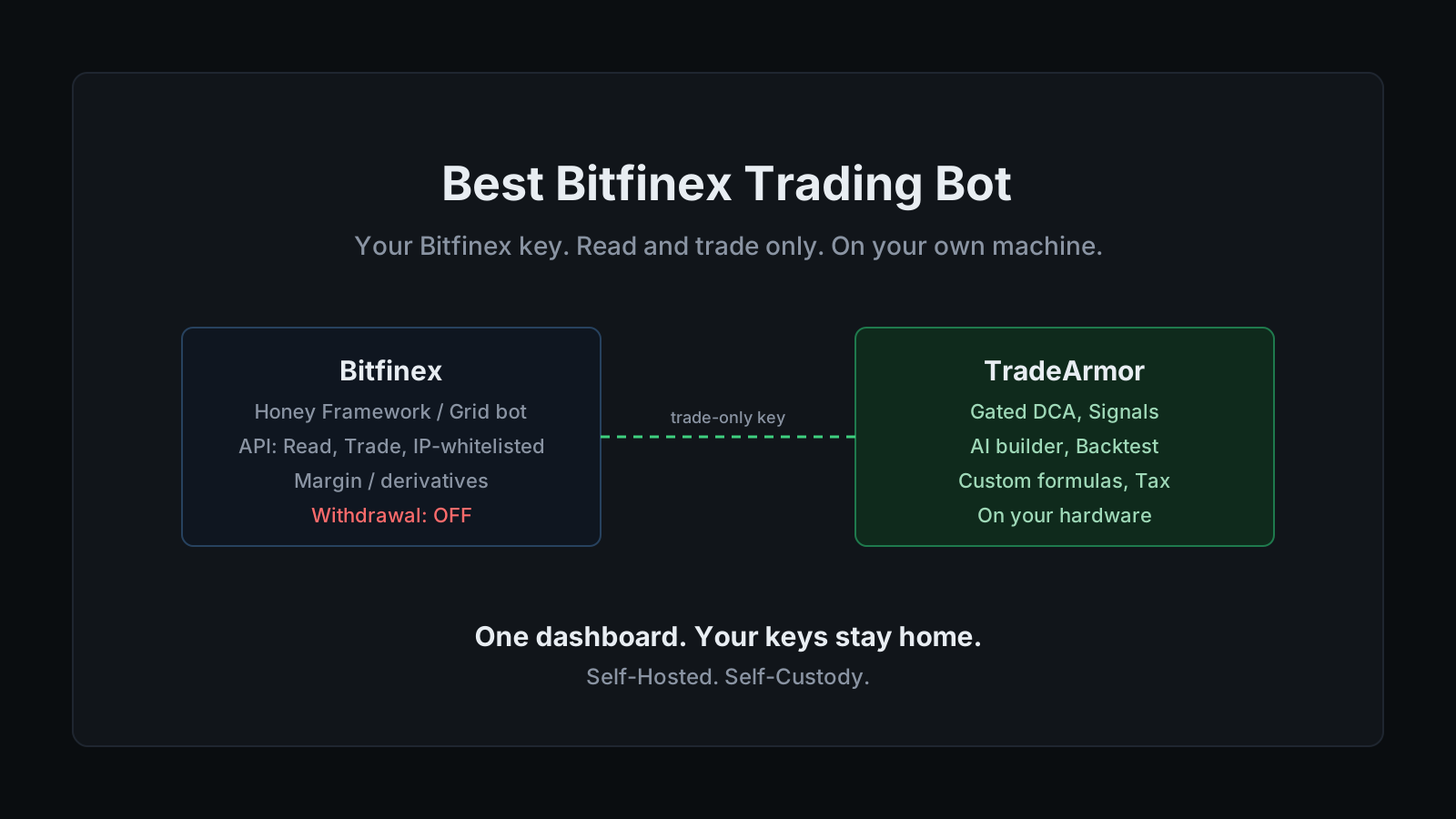
Anyone shopping for a Bitfinex trading bot has usually already said two things out loud to somebody. Not wanting a company they've never audited holding their exchange keys is the first, because Bitfinex traders tend to be the ones who read the fine print. The second follows close behind: TradingView, a signal service, and a bot are three separate bills to automate one exchange account that already charges a taker fee on every trade. Both complaints have the same root cause. A SaaS bot puts your Bitfinex key on a server you don't control, then charges you monthly for the privilege.
TradeArmor is built for the other way to run it: a self-hosted crypto trading platform that turns exchange accounts into fully automated trading operations, built-in BTC/USDC signals with a multi-year live track record, 15 real-time technical indicators, a plain-English AI strategy builder, DCA, grid, futures, copy trading, backtesting, paper trading, and tax reporting, all running on your own hardware where your API keys never leave the machine. One thing to confirm before you connect anything: Bitfinex is not one of the eight exchanges wired into the setup wizard by default (Binance US, Binance Global, Coinbase, Bybit, OKX, Bitget, KuCoin, and Hyperliquid). TradeArmor connects Bitfinex and other CCXT-supported venues on request. CCXT is the open-source library that gives a self-hosted bot a common language across dozens of exchange APIs, and Bitfinex has been a supported venue in it for years, so the connection itself is routine. Verify it before you subscribe, not after.
One more thing worth stating plainly, because getting it wrong wastes everyone's time: Bitfinex has not served US residents since 2017. The exchange announced a 90-day account wind-down that year, citing the cost of US banking relationships and federal compliance, and chose to exit the market rather than register with the SEC and CFTC. That restriction is still in force. If you're reading this from the US hoping to open a fresh Bitfinex account, you can't, and no bot changes that. If you already hold an eligible non-US account, or you're one of the traders this exchange has always served, everything below is for you.
What Bitfinex's own tools do, and where they stop
Bitfinex is a professional-leaning exchange, and its native automation reflects that. The Honey Framework ships a handful of built-in algorithmic orders, Iceberg to hide a large order's true size, TWAP to spread execution evenly across a time window, Accumulate/Distribute to build or unwind a position gradually, Ping/Pong to work both sides of a spread, plus a JavaScript environment for writing custom algo orders from scratch if the built-ins don't fit. There's also a grid bot for range-bound markets, buy low and sell high inside a fixed band, and trailing stop orders to protect a position without babysitting a chart.
That's a genuinely deep execution toolkit, more than most exchanges bother to build. It's also all execution. Every one of those tools acts on an order you already decided to place, or a range you already decided to trade. None of them read RSI, none of them combine two indicators into a rule, none of them take a signal from an outside source, and none of them run a dollar-cost-average schedule with per-level cooldowns and a floor tied to your actual cost basis. Bitfinex will slice, time, and repeat an order beautifully. It won't decide when to place the next one.
See the strategy engine, signals, and DCA logic that fill that gap: see all features.
Bitfinex's 2016 hack, and why it's a different risk than your bot key
The other thing everyone brings up about Bitfinex, right after the fee structure, is the 2016 hack. In August 2016, an attacker drained roughly 120,000 bitcoin from Bitfinex, worth about $70 million at the time. The exchange survived it, controversially, by socializing the loss across all customer balances rather than closing.
The stolen coins sat mostly untouched for years. In February 2022, the US government seized a portion of the haul then worth $3.6 billion after investigators decrypted a file belonging to Ilya Lichtenstein that held the private keys. Lichtenstein and his wife, Heather Morgan, pled guilty to money laundering conspiracy in 2023 and were sentenced in November 2024, five years for him, eighteen months for her, for laundering funds that had by then appreciated to roughly $10.5 billion.
That's an exchange-side custody failure from nearly a decade ago. It says nothing about whether your API key is safe once you hand it to a bot vendor today. A SaaS bot's own infrastructure can be breached independent of anything the exchange does with its hot wallet, the way 3Commas leaked user keys in 2022. Whether Bitfinex secured its cold storage in 2016 and whether your bot vendor secures your key now are unrelated questions. Self-hosting only answers the second one, because there's no TradeArmor server holding your key for anyone to breach in the first place.
What Bitfinex traders actually want from an external bot
Past the algo-order menu, the requests sound the same as they do on every other exchange, phrased by traders who already know exactly what they mean.
They want an entry rule they actually wrote, not a preset. "Buy when RSI drops under 35 and Supertrend just flipped bullish" is the kind of thing Bitfinex's Honey Framework was never built to evaluate on its own. TradeArmor's AI strategy assistant takes a plain-English description like that and translates it into the boolean formula the bot runs, or you write the formula directly, RSI_BUY && SUPERTREND_BUY, with no Python and no JavaScript.
They want DCA with an actual floor, not a grid that pretends to be one. Bitfinex's grid bot rebuys inside a fixed price band with no concept of an unsold cost basis to protect. TradeArmor's DCA engine runs unlimited levels with configurable per-level spacing and cooldowns, plus an EQ-price gate that holds the next buy until price clears the lowest unsold leg. That gate is the entire difference between averaging down on purpose and just buying every dip because the bot doesn't know any better.
They want the leverage Bitfinex offers through margin and its derivatives arm handled with real stops. Leverage amplifies losses exactly as fast as gains, no leverage level here is a recommendation, and a stop-loss belongs on the bot rather than on a browser tab you're not watching at 2am. The mechanics are in the futures trading guide.
How a self-hosted Bitfinex trading bot runs
The setup stays deliberately unglamorous. Generate an API key on Bitfinex scoped to read and orders write only, paste it into the setup wizard at localhost:8080/setup, pick a strategy mode, and the bot works Bitfinex's order book against your rules around the clock. The key sits in local config on hardware you own. There's no TradeArmor account holding it, and no TradeArmor server anywhere between you and the exchange.
Once connected, Bitfinex gets the same feature set as any other exchange in the wizard: gated DCA, partial sells that trim exposure without losing the cost-basis anchor, take-profit with a trailing option, and exits triggered by indicators or by signal. The built-in BTC/USDC signals, live for over three years, run the same on Bitfinex as anywhere else, and can be filtered through your own indicators in hybrid mode or skipped entirely for a fully custom strategy. Past performance is not indicative of future results, and every signal is an algorithmic output, never a personalized recommendation.
Trading Groups lets one bot run gated DCA on Bitfinex, a custom RSI formula on Bybit, and a different strategy entirely on a third exchange, all from a single dashboard with independent settings per group. Bitfinex's Honey Framework has never heard of another exchange. It doesn't need to; it wasn't built to coordinate across one.
Locking down your Bitfinex API key
This is where the actual protection lives, not in a decade-old headline.
Bitfinex separates permissions into read and write scopes across account, history, orders, positions, funding, and wallets, plus a dedicated withdrawal scope. A bot needs the read scopes and the orders write scope. It never needs the withdrawal scope. Leave it unchecked, and a leaked key can place an unwanted trade but cannot move a single coin off the exchange. The general version of this pattern across every exchange lives in the API key security guide, and the direct answer to whether a bot can withdraw your funds is: not without a permission you control and never have to grant.
Whitelist the key to an IP address too. Bitfinex lets you restrict a key to up to twenty specific addresses or ranges, and once that's set, connections from anywhere else are refused outright, no password or 2FA code required to get in. Pin it to your bot's address and a leaked key stops working the moment someone tries it from anywhere else. The per-exchange rundown of this trap across every supported venue lives in the exchange API permissions guide.
Setting it up, start to finish
- Confirm Bitfinex is connected for your account. It runs through CCXT on request, not the default eight, so verify with support before you subscribe.
- Confirm eligibility. Bitfinex has not accepted US residents since 2017. If that's you, this exchange isn't an option regardless of the bot.
- Create the API key on Bitfinex. Grant read access and the orders write scope. Leave withdrawal unchecked.
- Whitelist your bot's IP address. Up to twenty addresses per key. Store the secret, which Bitfinex shows once.
- Install TradeArmor. Download the ZIP, run
pip install -r requirements.txt, thenpython main.py. About 512 MB of RAM and 100 MB of disk covers a Raspberry Pi in a drawer or a machine that's already on all day anyway. - Run the setup wizard. Open
localhost:8080/setup, select Bitfinex, and paste the key and secret. Choose a strategy mode: built-in signals, hybrid with your own indicator filters, or fully custom. - Paper trade first. Run the strategy against live Bitfinex data on a simulated balance before a single real order fires. Flip one setting to go live once it behaves the way you expect.
Most people who land on this page came from Bitfinex's Honey Framework, hit the wall where execution tooling stops and strategy starts, and went looking for something that actually evaluates a rule instead of just placing an order well. That's the exact gap TradeArmor fills, without asking you to hand a second company your key to close it.
TradeArmor turns a Bitfinex account into a fully automated trading operation you actually own: built-in signals with a multi-year track record, 15 indicators, a plain-English AI strategy builder, gated DCA, grid, futures with real stops, peer-to-peer copy trading, backtesting, paper trading, and one-click tax exports, all running on hardware where your keys never leave the machine. If that's the version of a Bitfinex trading bot you want, see the pricing and get started.