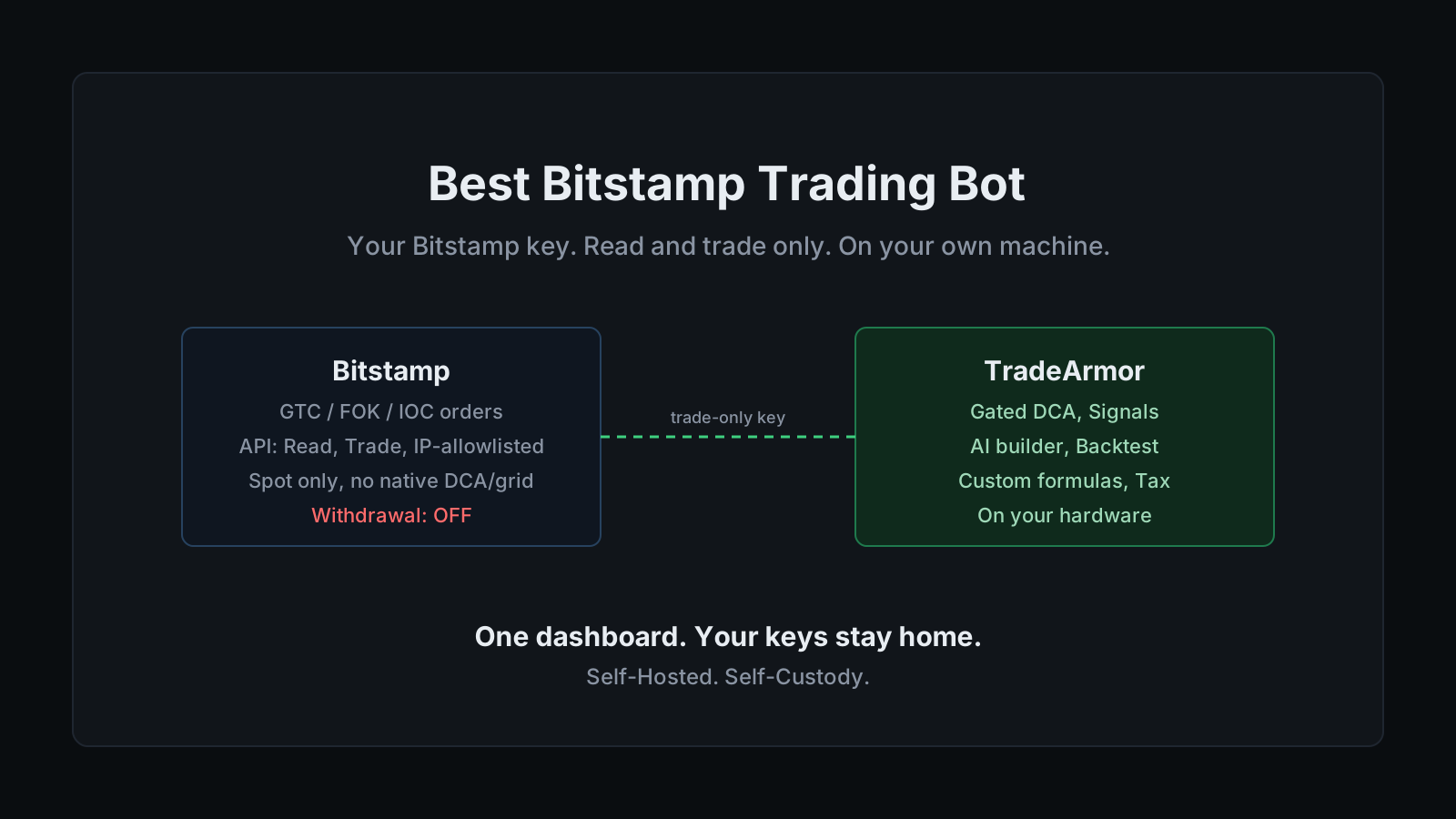
Anyone shopping for a Bitstamp trading bot has usually already stuck with the exchange for years, which means they trust it more than most. Bitstamp is the oldest crypto exchange still running, it survived its one bad week honestly, and it now sits inside Robinhood's regulated umbrella. That trust does not automatically extend to whatever bot you plug into it next. The instinct to keep a Bitstamp API key on your own machine instead of mailing it to a company you have never audited is a reasonable one. So is the annoyance of paying for TradingView, a separate signal feed, and a bot subscription just to automate one exchange account that already charges a taker fee on every fill.
TradeArmor is built for the trader who feels both of those things at once. It is a self-hosted crypto trading platform that turns exchange accounts into fully automated trading operations, from built-in BTC/USDC spot signals with a multi-year live track record, to 15 real-time technical indicators, to a plain-English AI strategy builder, to DCA, grid, futures, copy trading, backtesting, paper trading, and tax reporting, all running on your own hardware where the API key never leaves the machine. One honest note before you connect anything: Bitstamp is not one of the eight exchanges wired into the setup wizard by default (Binance US, Binance Global, Coinbase, Bybit, OKX, Bitget, KuCoin, and Hyperliquid). TradeArmor reaches Bitstamp and other CCXT-supported venues on request. CCXT is the open-source library that gives a self-hosted bot a common language across dozens of exchange APIs, and Bitstamp has been a stable, long-supported venue in it for years. Confirm the connection before you subscribe, not after.
What Bitstamp's own tools do, and where they stop
Bitstamp has never chased the algo-trading arms race the way some newer exchanges have. Pro-tier accounts get the order types that matter for execution: good-til-cancelled, fill-or-kill, immediate-or-cancel, on top of the standard limit, market, and stop orders. That covers how an order behaves once you place it. It does nothing about deciding when to place it.
There is no native grid bot on Bitstamp. No built-in DCA scheduler. No indicator engine that reads RSI or watches for a moving-average cross. Several third-party bot vendors already build grid and DCA products specifically for Bitstamp's API, which says plainly that Bitstamp's own roadmap never got there. If you want gated dollar-cost averaging, a formula that combines two indicators, or an exit that reacts to a signal instead of a static stop price, Bitstamp's interface was never going to be where you built it.
See the strategy engine, signals, and DCA logic that fill that gap: see all features.
The 2015 hack, the Robinhood deal, and what actually changed
Bitstamp's one real security incident happened in January 2015. An attacker drained roughly 19,000 bitcoin from an operational hot wallet, worth about $5 million at the time. Bitstamp suspended trading for close to a week, moved every remaining coin into new cold storage, and reimbursed every affected customer in full. It did not fold, and it did not socialize the loss onto customers the way some exchanges have handled worse breaches.
What happened after is the more interesting part. Bitstamp became one of the first exchanges to implement multisignature security on its hot wallet and built a dedicated cold-storage insurance fund to backstop customers if it ever happened again. A decade later, there has been no repeat. In June 2025, Robinhood closed a $200 million acquisition of Bitstamp, bringing more than fifty regulatory licenses under one roof and giving Robinhood its first real institutional crypto business. Bitstamp today is regulated in the EU under Luxembourg's CSSF with a MiCA license, and Bitstamp USA holds a New York BitLicense plus money transmitter registrations across most states.
None of that changes the math on your bot's API key. A regulated, audited, well-capitalized exchange can still sit behind a SaaS bot vendor whose own servers get breached independent of anything Bitstamp does, the way 3Commas leaked user keys in 2022 with zero fault attributable to the exchanges those users traded on. Exchange-side custody and bot-vendor custody are two separate questions. Self-hosting only answers the second one, because there is no TradeArmor server holding your key for anyone to breach in the first place.
What Bitstamp traders actually want from an external bot
Strip away the exchange-specific details and the requests sound identical to every other cluster of serious traders TradeArmor talks to.
They want a rule they wrote themselves running the entries, not a preset from a marketplace. "Buy when RSI drops under 35 and price closes above the 50 EMA" is a sentence Bitstamp's order book has no idea how to evaluate. TradeArmor's AI strategy assistant turns that plain-English description into the boolean formula the bot actually runs, or you write it directly: RSI_BUY && EMA_BUY, no Python, no external scripting environment.
They want DCA that respects a cost basis, not a bot that just rebuys on a timer. TradeArmor's DCA engine supports unlimited levels with configurable per-level spacing and cooldowns, plus an EQ-price gate that holds the next buy until price clears the lowest unsold leg. A timer-based bot cannot tell the difference between averaging into a dip on purpose and buying every red candle out of habit. The gate is the difference.
They want alerts that actually pull the trigger instead of pinging a phone at 3am. A signal that arrives and waits for a human to act on it is not automation, it is a notification with extra steps.
How a self-hosted Bitstamp trading bot runs
Setup is intentionally boring. Generate an API key on Bitstamp scoped to read and trading only, paste it into the setup wizard at localhost:8080/setup, pick a strategy mode, and the bot works your Bitstamp order book against your rules around the clock. The key lives in local config on hardware you own. There is no TradeArmor account holding it and no TradeArmor server sitting between you and the exchange.
Once connected, Bitstamp gets the same engine as every other supported exchange: gated DCA, partial sells that trim exposure without losing the cost-basis anchor, take-profit with an optional trailing setting, and exits triggered by an indicator or a signal. The built-in BTC/USDC signals, live for over three years, run the same on Bitstamp as anywhere else, filterable through your own indicators in hybrid mode or skipped entirely for a fully custom strategy. Past performance is not indicative of future results, and every signal is an algorithmic output, never a personalized recommendation.
Trading Groups lets one bot run gated DCA on Bitstamp, a custom formula on Coinbase, and something different again on a third exchange, all from one dashboard with independent settings per group. Bitstamp's own interface was built for one exchange. Coordinating a strategy across several was never the job.
Locking down your Bitstamp API key
This is where the real protection lives, not in a decade-old headline about a hack that has already been fixed.
Bitstamp splits API permissions into three scopes: read access to balances and transaction history, trading access to place and cancel orders, and withdrawal access, which sits off by default when you create a key. A bot needs the first two. It never needs the third. Leave withdrawal unchecked and a leaked key can place an unwanted trade but cannot move a single coin off the exchange. The general version of this rule across every supported venue lives in the API key security guide, and the direct answer to whether a bot can withdraw your funds is: not without a permission you control and never have to grant.
Bitstamp also supports IP allowlisting on each key, plus a kill switch that revokes every active key on the account at once if something ever looks wrong. Pin the key to your bot's address and a leaked credential stops working the moment anyone tries it from anywhere else. The per-exchange rundown of this pattern lives in the exchange API permissions guide.
Is Bitstamp available where you are?
Bitstamp USA holds a New York BitLicense, money transmitter licenses across most other states, and a FinCEN money services business registration. Practically, that means the exchange itself is available to residents of nearly every US state, with Hawaii and Nevada as the current exceptions, and derivatives products stay unavailable to US customers regardless of state. If you are outside the US, Bitstamp operates under its Luxembourg CSSF license with MiCA authorization across the EU. Confirm your own state or country against Bitstamp's current terms before you set anything up. A bot cannot fix an account you are not eligible to open.
Setting it up, start to finish
- Confirm Bitstamp is connected for your account. It runs through CCXT on request rather than the default eight, so verify with support before subscribing.
- Confirm eligibility. Check Bitstamp's current state and country list, since it changes as licenses are added or dropped.
- Create the API key on Bitstamp. Grant read and trading scopes. Leave withdrawal unchecked.
- Set an IP allowlist. Restrict the key to your bot's address so a leaked credential is useless from anywhere else.
- Install TradeArmor. Download the ZIP, run
pip install -r requirements.txt, thenpython main.py. About 512 MB of RAM and 100 MB of disk is enough for a Raspberry Pi in a drawer or a machine that already runs 24/7 for other reasons. - Run the setup wizard. Open
localhost:8080/setup, select Bitstamp, paste the key and secret, and choose a strategy mode: built-in signals, hybrid with your own indicator filters, or fully custom. - Paper trade first. Run the strategy against live Bitstamp data on a simulated balance before a single real order fires, then flip one setting to go live.
Most people who land here already know Bitstamp's Pro order types top out at execution, not strategy. That gap between a well-timed order and an actual decision engine is exactly what TradeArmor fills, without asking anyone to hand a second company the key that opens the gap.
TradeArmor turns a Bitstamp account into a fully automated trading operation you actually own: built-in signals with a multi-year track record, 15 indicators, a plain-English AI strategy builder, gated DCA, grid, futures with real stops on exchanges that support it, peer-to-peer copy trading, backtesting, paper trading, and one-click tax exports, all running on hardware where the keys never leave the machine. If that is the version of a Bitstamp trading bot worth running, see the pricing and get started.