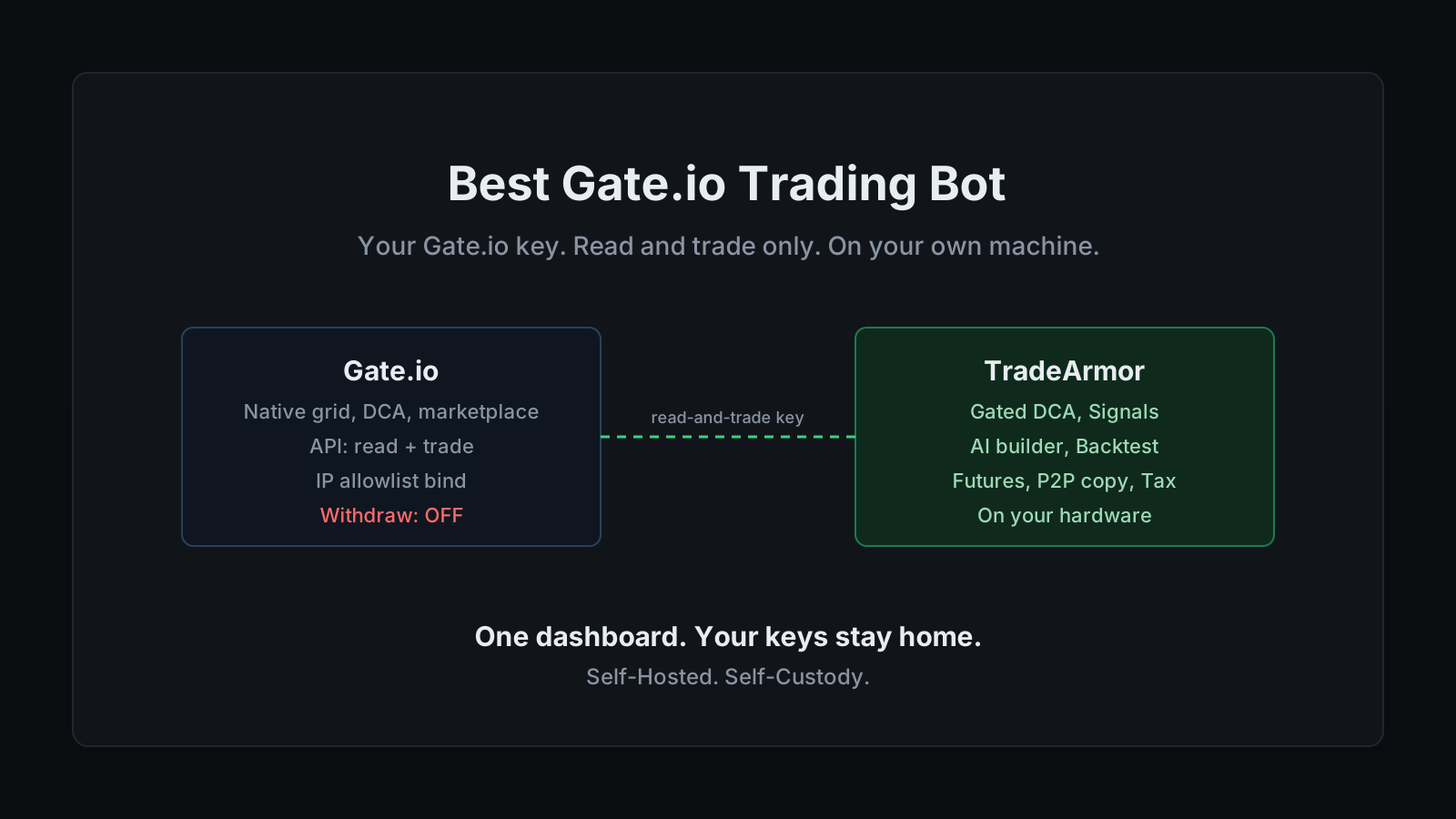
Gate.io hands you a bot marketplace. You can browse grid strategies other traders have shared, sort them by past return, and clone one onto your own account with a couple of taps. Then you find the strategy that is almost what you want, except it buys on a fixed price ladder and you want it to buy when RSI is oversold and the trend just turned, and there is no field for that. Or you want the same rule running on Gate and a second exchange from one screen. That is the ceiling of a hosted marketplace, and it is usually the moment people go hunting for a real gate.io trading bot. The first polished third-party option then asks you to paste your Gate API key onto its servers, which is where a lot of traders stop cold. "I don't want to give my API keys to a third party" is a reasonable line to hold. So is the arithmetic: a charts subscription, a signal service, and a bot on top is three bills to do one job.
The wall is structural, not bad luck, and it pays to see it before you connect a single key. A native Gate.io bot runs inside the same company that custodies your coins. A SaaS bot runs on a server you do not control and stores your key there. Both leave the automation, and the credentials, somewhere other than your own hands. The one arrangement that avoids both is a bot that runs on hardware you own and reaches into Gate.io across the API, where the key never leaves the machine.
That is the job a real gate.io trading bot is built for. TradeArmor is a self-hosted crypto trading platform: built-in BTC/USDC signals with a multi-year live track record, 15 real-time technical indicators, a plain-English AI strategy builder, plus DCA, grid, futures, copy trading, backtesting, paper trading, and tax reporting, all running on your own hardware where your API keys never leave your machine. One honest note up front, because it adds a setup step. Gate.io is not one of the eight exchanges wired into the setup wizard by default. Those eight are Binance US, Binance Global, Coinbase, Bybit, OKX, Bitget, KuCoin, and Hyperliquid, and TradeArmor connects other CCXT-supported venues like Gate.io on request. Gate is a well-supported CCXT exchange, so the connection is routine, but confirm it is enabled for your account before you subscribe rather than after.
What Gate.io's native bots do, and where they stop
Give the native menu its due. Gate.io ships one of the deeper automation shelves on any exchange: spot and futures grid bots, a DCA bot, a spot Martingale bot, rebalancing bots, a spot-futures arbitrage bot, and the strategy marketplace where you can clone another trader's setup or follow a copy-trading provider. None of it costs a subscription beyond ordinary trading fees. For a grid in a range-bound market, that shelf does honest work, and if a preset grid is the whole of what you need, you can probably close this tab.
The presets are a fixed menu, though, and fixed is where they run out. A native bot will not run a boolean rule you wrote against every candidate trade. It will not take a TradingView alert or a signal you generated somewhere else as its trigger. And it cannot run the identical strategy on Gate.io and Coinbase at the same time, because a native bot only knows the exchange it lives inside. The marketplace widens the menu but not the ceiling: cloning a stranger's grid is still a grid, tuned by someone whose risk tolerance is not yours.
That last point is the quiet one, and it carries the most weight. When the same company both runs your automation and holds your coins, self-custody was never on the table, because none of it is self-hosted. It is the identical trade-off you weigh with any SaaS bot versus a self-hosted one, only here it wears the exchange's own badge instead of a third party's.
Want to see the dashboard, the signals, and the strategy engine a self-hosted setup gives you? See all features.
The US question, answered straight
Worth stating plainly, because it decides whether this is even a live option for you. As of 2026, Gate.io does not serve US residents. The United States sits on Gate's restricted-jurisdictions list in Section 2.5 of its User Agreement, alongside thirty-plus other territories, and the company holds no US licensing that would let a resident trade there. Gate has announced a US-compliant platform, Gate US, but it has not launched. Routing around the block with a VPN runs into mandatory KYC that ties the account to a government ID and a declared address, and a location mismatch can freeze the account. None of this is legal advice, just the state of play.
This is exactly where self-hosting quietly earns its keep. Your strategy, your positions, your signal history, and your API keys all live on your own machine, not inside any one exchange. If Gate.io is off the table where you are, pointing the same bot at a venue you can legally use, like Bybit or OKX, is a dropdown change in the wizard, not a rebuild. You own the strategy layer. The exchange is only a connection.
What Gate.io traders actually want from an external bot
Strip out the marketing and the asks are short and consistent. People who go past the native menu want four things.
They want their own entry logic. Not a preset grid but a rule, buy when RSI is oversold and Supertrend flips bullish, written once and run automatically on every candidate. TradeArmor's formula engine takes exactly that, in plain language through the AI strategy builder or as a boolean formula directly, with no Python required.
They want DCA with brakes. Averaging into a spot position is bread-and-butter on a Gate account, and most simple DCA tools keep buying straight into a crash with nothing to halt them. TradeArmor's DCA engine runs unlimited levels with cooldown gates and an EQ-price buy gate that holds the next buy until price clears the lowest unsold leg. That is the difference between averaging down on purpose and paying more for every step of a falling knife.
They want copy trading that does not surrender custody. Gate's marketplace, like every exchange marketplace, keeps the funds and the whole arrangement inside the exchange. TradeArmor's copy trading is peer-to-peer through your own proxy, where provider keys and follower keys both stay local, with no custodial middleman skimming a performance fee off the result.
They want futures with real stops, where they can access them. Gate runs a large perpetual-futures venue, and TradeArmor's futures mode ships stop-loss and trailing take-profit so leverage arrives with brakes attached rather than bolted on afterward. Leverage amplifies losses as fast as gains, so treat that capability with the caution it deserves.
How a self-hosted Gate.io trading bot runs
The mechanics are deliberately dull. You create a read-and-trade API key on Gate.io, bind it to your bot's IP, paste the key and secret into the setup wizard at localhost:8080/setup, choose a strategy mode, and the bot connects over the Gate API and runs your rules around the clock. The key sits in local config on your own machine. There is no TradeArmor account holding it, because there is no TradeArmor server anywhere in the path.
Because Gate.io connects through CCXT rather than the default eight, the one extra step is confirming the connection for your account first. After that it behaves like any exchange in the wizard. You get the full position engine: gated DCA, partial sells that trim exposure without losing the cost-basis anchor, take-profit and trailing take-profit, and indicator-based or signal-based exits. The built-in BTC/USDC signals, live for over three years, behave the same on Gate as anywhere else, and you can filter them through your own indicators, run them straight, or ignore them and run a fully custom strategy. Past performance is not indicative of future results, and signals are algorithmic outputs, not personalized advice.
You also get to run Gate.io next to your other venues on one instance. Trading Groups lets a single bot run gated DCA on Gate spot, a custom formula on OKX, and something else on Coinbase, each with its own rules, all on one dashboard. That is the piece an exchange-locked native bot structurally cannot do.
Locking down your Gate.io API key
This is the part that actually protects your money, so it gets the detail.
A Gate.io API key lets you toggle spot and wallet access on or off, set it to read-only or read-and-write, and separately grant withdrawal. A trading bot needs a precise subset. Grant read-and-write on trading so it can see balances and place and cancel orders. Leave withdrawal switched off. Withdrawal is the only permission that moves funds off the exchange, and automation has no use for it. The worst a leaked read-and-trade key can do is place trades inside the account you did not want, never move coins out of it. The mechanics of why that holds on every exchange are in the API key security guide, and the short version of whether a bot can drain your funds is: not without a permission you control and never have to grant.
Gate adds one specific worth knowing, and it bites people who skip it. When you create the key, you can attach an IP allowlist of up to twenty addresses, or leave it unbound. Leave it unbound and Gate expires the key automatically after ninety days, and an unbound key is also usable from any address if it leaks. Bind the key to the address your bot runs from and you fix both problems at once: the key stops working from anywhere else, and the ninety-day clock is removed. The per-exchange version of all of this, across Gate and every other venue, is in the exchange API permissions guide.
Setting it up, start to finish
The whole path, in order:
- Confirm Gate.io is connected for your account. It runs through CCXT on request rather than the default eight, so verify the connection before you subscribe, not after.
- Create the API key on Gate.io. Enable trading with read-and-write, and leave withdrawal off.
- Bind an IP allowlist. Pin the key to the address your bot runs from. This blocks a leaked key from other machines and removes Gate's ninety-day expiry on unbound keys. Store the secret, which Gate shows once.
- Install TradeArmor. Download the ZIP, run
pip install -r requirements.txt, thenpython main.py. Around 512 MB of RAM and 100 MB of disk is enough, which is why a Raspberry Pi in a drawer or an always-on Mac mini makes a fine host. - Run the setup wizard. Open
localhost:8080/setup, pick Gate.io, and paste the key and secret. Choose a strategy mode: built-in signals, hybrid with your own indicator filters, or fully custom. - Paper trade first. Run the strategy against live Gate data with a simulated balance before a single real order fires. When it behaves, flip one setting to go live.
Most people start on spot with gated DCA and the built-in signals, then grow into custom formulas once they trust the engine. The product is built to grow with you rather than force a switch to a different bot when you outgrow the starter setup, which is the trap the native presets eventually spring.
TradeArmor turns a Gate.io account into a fully automated trading operation you actually own: built-in signals with a multi-year track record, 15 indicators, a plain-English AI strategy builder, gated DCA, grid, futures with real stops, peer-to-peer copy trading, backtesting, paper trading, and one-click tax exports, all running on your hardware where your keys never leave the machine. If that is the version of a gate.io trading bot you want, see the pricing and get started.