You have a full time job and you cannot watch charts all day. You wanted something closer to savings-account safety with day-trader yields, so you set up a dollar cost averaging plan, picked a weekly buy, and walked away. Then the market fell 30 percent in a week and your tidy little plan kept buying at almost the same price the whole way down, ran out of cash near the top of the fall, and had nothing left when the real bottom showed up two weeks later.
That is the gap between what most people call a crypto DCA strategy and what a DCA strategy is supposed to do. A calendar is not a strategy, even though most apps sell it as one. Buying every Friday is a habit. A real crypto DCA strategy is a rules engine: it decides not just how often to buy, but whether the next buy actually improves your position, how much dry powder to keep in reserve, and when to take some of the gain back off the table.
TradeArmor exists to run that engine on your own hardware. It is a self-hosted crypto trading bot that bundles built-in BTC/USDC spot signals with a multi-year track record, 15 real-time indicators, a plain-English strategy builder, and DCA, grid, futures, copy trading, backtesting, paper trading, and tax reporting, all on a machine where your API keys never leave your control. This guide is about one slice of that platform: how the DCA engine actually decides when to buy, because that is the part people set up wrong, and the part that quietly decides whether averaging down builds wealth or bleeds your account.
Crypto DCA explained: two strategies wearing the same name
The word DCA hides two completely different jobs, and confusing them is the root of most bad setups.
The first job is accumulation. You believe in an asset over a five-year horizon, you put a fixed dollar amount in on a schedule, and you never sell. This is the version your brokerage means when it advertises dollar cost averaging. It works because it removes the timing decision and because, in a volatile market, the strategy you can actually hold through a 70 percent drawdown beats the one that is mathematically optimal but that you abandon in a panic. Most studies that find DCA "wins" in crypto are measuring this behavioral edge, not a pricing miracle. You can read a neutral definition of the concept at Investopedia's dollar-cost averaging entry if you want the textbook framing.
The second job is position management. You open a trade, the price moves against you, and you buy more at lower prices to pull your average cost down so you can exit profitably on a smaller bounce. This is averaging down inside a live position with a finite budget. It is what a trading bot does thousands of times a year, and it has nothing in common with the set-it-on-a-calendar version except the three letters.
The danger is using the first mindset to run the second job. Accumulation has an infinite time horizon and no budget ceiling, so spacing and reserves do not matter much. Position management has a hard budget and a falling price, so spacing and reserves are the entire game. Averaging down without a budget is just buying the dip until you cannot.
When a crypto DCA strategy works and when it quietly fails
DCA earns its reputation in choppy, sideways, and falling-then-recovering markets. When price chops around a range, spacing your buys across that range gives you a better average than a single entry at a random point inside it. When price falls and later recovers, a budgeted average-down can turn a position that was 30 percent underwater into a green exit on a 12 percent bounce, because your cost basis moved down with the market instead of staying anchored to your first buy.
It fails in two specific ways, and both are avoidable.
The first failure is the clustered buy. Simple percentage-dip DCA without a gate will fire several buys inside a narrow band near the top of a drop, because each small wiggle down trips the trigger. You spend most of your budget in the first 10 percent of a 50 percent fall. By the time the asset is genuinely cheap, your account is empty. Your average cost barely moved because every buy landed close to the last one.
The second failure is the runaway buy on a one-way trend. If an asset is in a real structural decline, not a dip, averaging down just feeds more capital into a falling knife. No DCA rule fixes a broken asset. This is why the engine you run matters less than the asset you point it at, and why DCA belongs on assets you would be comfortable holding through a cycle, not on the week's hot microcap.
A good crypto DCA strategy cannot tell the difference between a dip and a decline in advance, because nobody can. What it can do is ration your capital so that if it is a dip, you still have ammunition for the bottom, and if it is a decline, you did not empty the magazine in the first week. That rationing is the job of gates and reserves, which is where the mechanics get specific.
See the rest of the platform before you tune one engine. The DCA engine is one mode among several, and most users run it alongside signals and indicator rules rather than alone. See how the full feature set fits together so you are tuning a strategy, not just a buy timer.
Simple DCA vs gated DCA: the math that matters
Here is the difference in one sentence. Simple DCA asks "has the price dropped enough since the last buy." Gated DCA asks "will this buy actually lower my average cost, and can I afford it." Those are not the same question, and the second one is the one worth answering.
A gate is a precondition that has to clear before a buy fires. TradeArmor's DCA engine runs three of them, and they stack.
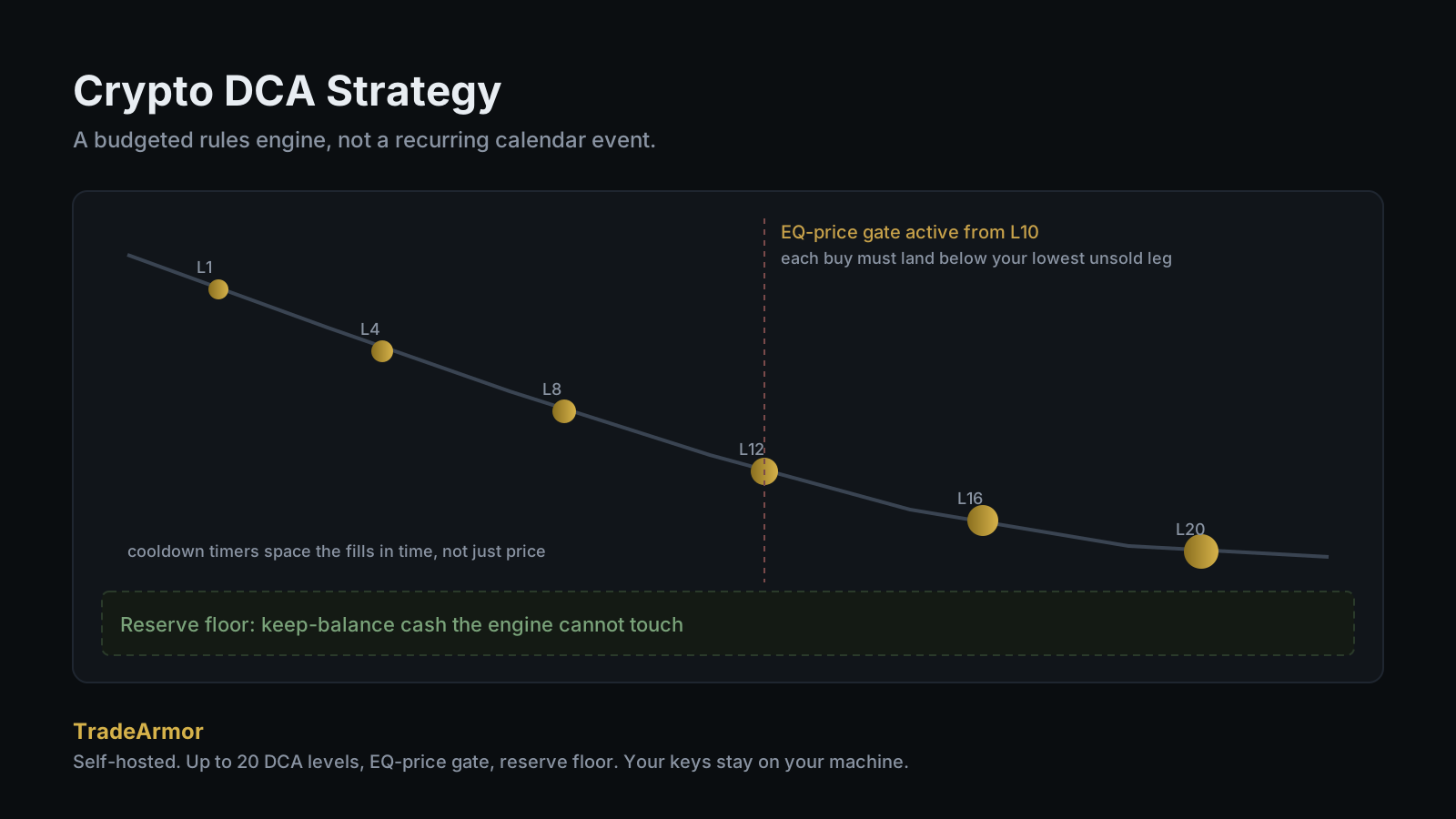
The first gate is price position. Past a configurable DCA level, the default being level 10, the next buy is blocked until the market price sits below your lowest unsold leg times 0.999. This is the EQ-price gate, and it is the one feature most worth understanding. It guarantees that a deep DCA buy lands below the cheapest price you already own, which means the buy genuinely pulls your average down instead of stacking near a level you are already holding. ProfitTrailer users will recognize this as EQPRICE logic, and TradeArmor matches it on purpose, so migrating from ProfitTrailer leaves your DCA behavior unchanged.
The second gate is the cooldown. Each level carries a configurable timer, so the bot cannot stack five buys in ten minutes during a flash crash. The cooldown spaces your fills out in time as well as in price, which stops a single violent candle from spending three levels of budget at once.
The third gate is the reserve. The keep-balance rule reserves a percentage of your total portfolio value as untouchable cash, where portfolio value is your available balance plus the current market value of your open positions. The bot is not allowed to dip below that floor, no matter how good the next buy looks. Reserve cash is boring right up until the day it is the only thing standing between you and a forced exit at the worst possible price.
Put the three together and the behavior changes completely. Instead of clustering buys near the top of a drop, the engine spaces them down the move, waits out each cooldown, refuses any buy that would not improve the average, and stops before it touches your reserve. The same budget gets spread across a far wider price range, and your average cost ends up meaningfully lower at the bottom. There is a deeper numerical walkthrough in the breakdown of gated DCA versus simple DCA, including why the gated version usually wins into a deep drop.
Level spacing, sizing, and cooldowns: how to actually configure it
The engine supports unlimited DCA levels per position, with per-level spacing, size multipliers, and cooldowns. That is a lot of knobs, so here is the reasoning behind each one.
Spacing is how far the price has to fall between levels. Tight spacing near the top and wide spacing as you go deeper is a sane default, because early in a drop you do not yet know if it is a dip or the start of something worse, so you commit lightly. Wider spacing later means you only deploy serious capital once the asset is genuinely cheaper. The EQ-price gate enforces the floor on this, but your spacing settings decide the shape above it.
Sizing is how much each level buys. Flat sizing buys the same amount at every level. Multiplied sizing buys more at deeper levels, which pulls your average down faster but burns the budget quicker and concentrates your risk at the bottom of the range. There is no free lunch here. Bigger deep buys mean a lower average if the asset recovers and a larger loss if it does not. Pick the multiplier whose worst case you can actually look at without flinching.
Cooldowns are the time gates between buys. Short cooldowns react fast but risk over-buying a volatile candle. Long cooldowns are patient but can miss a quick wick. For most spot DCA, a cooldown measured in hours rather than minutes keeps the engine from getting twitchy.
You should not pick these numbers by vibe, and you do not have to. The free DCA backtester runs any configuration against five years of real BTC, ETH, and SOL daily data in your browser, with no signup, and shows you the equity curve, the maximum drawdown, the realized and unrealized split, and exactly where each buy fired. Tune the spacing, the sizing, the EQ-price gate, and the take-profit, then watch the drawdown move. It is the cheapest way to find out that your "aggressive" multiplier produces a drawdown you cannot stomach, before a cent of real money is involved.
The sell side: where most DCA guides go quiet
Buying is half a strategy. A DCA engine that only knows how to buy is just a way to accumulate bags. The exit rules are what turn a lower average cost into realized profit, and TradeArmor's position engine handles the sell side with the same rule-based approach as the buy side.
Take-profit is the baseline. You set a percentage above your average cost, and when the market clears it, the position sells. Because gated DCA pulled your average down during the drop, your take-profit target sits closer to the current price than it would have under a single top-anchored entry, so you exit on a smaller bounce.
Trailing take-profit goes one step further. Instead of selling the instant you hit the target, the bot follows the price up and only sells when it pulls back by a set amount, so a strong move keeps running instead of getting cut off at the first green number. The bot rode the move up while I was asleep and locked it in on the pullback. That was the entire feature request.
Partial sells let you take risk off without a full exit. You can sell a slice at one level and let the rest run, and the unsold legs keep tracking for the buy-gate logic, so your cost-basis anchor stays intact. Add indicator-based and signal-based exits on top, and the sell side becomes as expressive as the buy side, rather than a single dumb take-profit number.
This is also where the anti-narrowing point lands. DCA is not the product. It is one engine inside a platform that also runs grid bots for range-bound markets, futures with stop-losses and trailing exits, copy trading through a peer-to-peer proxy where both sets of keys stay local, and a tax export that does not choke on a few thousand trades. The DCA engine is the one most people meet first, but a serious operator runs it as one layer in a stack, not as the whole strategy.
A worked example, in plain numbers
Say you allocate 1,000 USDC to a BTC position with a 20 percent keep-balance reserve, so 800 is actually deployable. You set 10 levels, spacing that widens with depth, a modest size multiplier, and the EQ-price gate active from level 10.
BTC drops. The first few levels fire a few percent apart, committing small amounts, because early buys are cheap insurance, not conviction. As the drop deepens, spacing widens, sizes grow, and every buy past level 10 has to clear the EQ-price gate, so each one lands below your lowest existing leg and genuinely drags the average down. Cooldowns keep the fills spaced in time, so a single 15 percent candle does not spend three levels at once. The reserve never gets touched, so even at the bottom you are not fully committed and you have not risked a margin event.
When BTC bounces, your average sits well below where a calendar-buyer's would, because their buys clustered near the top of the fall and ran dry. Your take-profit clears on a smaller recovery. You bank the trade, the unsold legs reset, and the engine waits for the next setup.
None of that requires you to watch a chart. It requires you to define the rules once, backtest them honestly, and let the bot enforce discipline you would not enforce manually at 3 a.m. with your own money on the line. That is the actual promise of automation: not magic returns, but consistent execution of a plan you already validated.
Conclusion: a strategy, not a schedule
A crypto DCA strategy worth running is a budgeted rules engine, not a recurring calendar event. It spaces buys so they land where they help, gates each buy so it only fires when it lowers your average, reserves cash so a deep drop never empties the account, and sells on rules instead of nerves. TradeArmor runs that engine, plus signals, indicators, grid, futures, copy trading, backtesting, and tax exports, on your own hardware where your keys never leave your machine. Prove your configuration on the free backtester first, and when the numbers hold up, see how the tiers line up on the pricing page and run it on a machine you control.
Frequently asked questions
What is a crypto DCA strategy? A crypto DCA strategy is a plan for buying an asset in pieces over time instead of all at once, so your entry price is an average rather than a single timing bet. Time-based DCA buys a fixed amount on a schedule for long accumulation you never sell. Gated DCA averages down inside an open position with a finite budget, and only buys when the price is below your lowest unsold leg, a cooldown has expired, and you still have reserve cash. The second version is what a bot runs.
Does dollar cost averaging work for crypto? It works mostly because it solves a behavioral problem. In a volatile market the plan you can stick with through a bear market beats the theoretically optimal one you abandon in a panic. Buying in pieces spreads your entry across a range of prices, which lowers the chance your whole position is anchored to a local top. It does not predict the bottom and does not remove market risk.
What is the difference between simple DCA and gated DCA? Simple DCA buys on a fixed trigger and keeps buying regardless of where your position sits. Gated DCA only buys when the gates clear: price below your lowest unsold leg by a real margin, cooldown expired, reserve intact. The gates stop a falling market from emptying your account in a tight band.
What is the EQ-price gate? Past a configurable level, it blocks the next buy until the market price is below your lowest unsold leg times 0.999, so a deep buy genuinely lowers your average instead of stacking near a price you already hold. It matches ProfitTrailer's EQPRICE logic.
How many levels and what spacing should I use? It depends on the asset's volatility and your budget. Wider spacing as you go deeper, with each buy a little larger, is a common starting point. The honest method is to backtest a few configurations on real data for your pair, watch the drawdown and fill count, and pick the worst case you can stomach.
TradeArmor is self-hosted trading software, not a financial adviser. Built-in signals are algorithmic outputs, not investment advice. Automation reduces operational risk such as missed or emotional buys; it does not reduce market risk or guarantee any return. Past performance does not predict future results.
Is crypto DCA safer than lump-sum buying? Safer is the wrong word. DCA reduces the operational risk of mistiming a single entry and the emotional risk of going all-in at the top, but it does not reduce market risk, and if the asset rises steadily from your start date a lump-sum entry would have done better. DCA reduces the regret tied to timing, not the volatility of the asset. A bot reduces missed buys, emotional buys, and the risk of handing your keys to a server you do not control. It does not promise a return.