There is a specific kind of trader who shows up looking for a crypto futures bot, and they tend to say two things in the same breath. The first is "I want leverage but I want stops to actually work." The second is "trailing TP on a bot, not manual," because they have already learned the expensive way that a trailing take-profit you manage by hand gets managed late, usually right after the candle that would have paid you. They are not looking for a money printer. They are looking for an execution layer that will hold the stop they set and trail the profit they earned without them sitting at the screen.
Leverage is a tool, not a strategy, and a crypto futures bot is the part of the toolbox that decides whether the tool builds something or removes a finger. The bot does not make leverage safe. It makes leverage consistent, which is a different and more useful thing. It places the stop, it sizes the position, and it takes the exit on rules instead of feelings. What follows is how the mechanics actually work, where the liquidation math bites, and how to run a futures bot without the outcome the marketing copy never mentions.
TradeArmor is a self-hosted crypto trading bot you run on your own hardware, with built-in BTC/USDC spot signals carrying a three-year track record, 15 real-time indicators, a plain-English AI strategy builder, and DCA, grid, copy trading, backtesting, paper trading, and tax reporting on one engine. Futures with leverage is one mode inside that platform. This guide is about that mode: how it differs from spot, the leverage and liquidation math you have to respect, and how the stop-loss and trailing take-profit keep a leveraged position from turning into a liquidation notice.
How Futures Differ From Spot
On spot, you own the coin. If you buy BTC and it drops 40 percent, you are down 40 percent on paper and you can wait, because nothing forces you to sell. The position cannot go to zero unless the asset does.
Futures change the rules. You are trading a contract with borrowed size, so the exchange has a hard interest in not letting your losses exceed the margin you posted. Cross past a certain loss and the exchange liquidates you: it force-closes the position to protect the funds you borrowed against. That is the line that does not exist on spot, and it is the line a futures bot exists to keep you away from.
Two settings define the shape of the risk. The first is margin mode. Isolated margin walls off a fixed amount of collateral to a single position, so the most you can lose on that trade is the margin you assigned to it, and a liquidation there does not reach into the rest of your account. Cross margin shares your whole balance as collateral, which delays liquidation but puts more of the account on the line if the trade goes wrong. The second setting is leverage, which sets how much size you control per dollar of margin and, as a direct consequence, how close your liquidation price sits to your entry. Most disciplined futures operators run isolated margin precisely so a single bad trade has a known, bounded cost.
The Leverage Math Nobody Puts in the Ad
Here is the part the "up to 100x" banners leave out. Leverage does not change how much you can win on a given move. A 2 percent move is a 2 percent move. Leverage changes how much of that move you control and how little room you have before the exchange closes you out.
For an isolated-margin position, the rough distance to liquidation is about one divided by your leverage, minus the exchange's maintenance margin rate. Drop the maintenance margin for a second and the shape is clear:
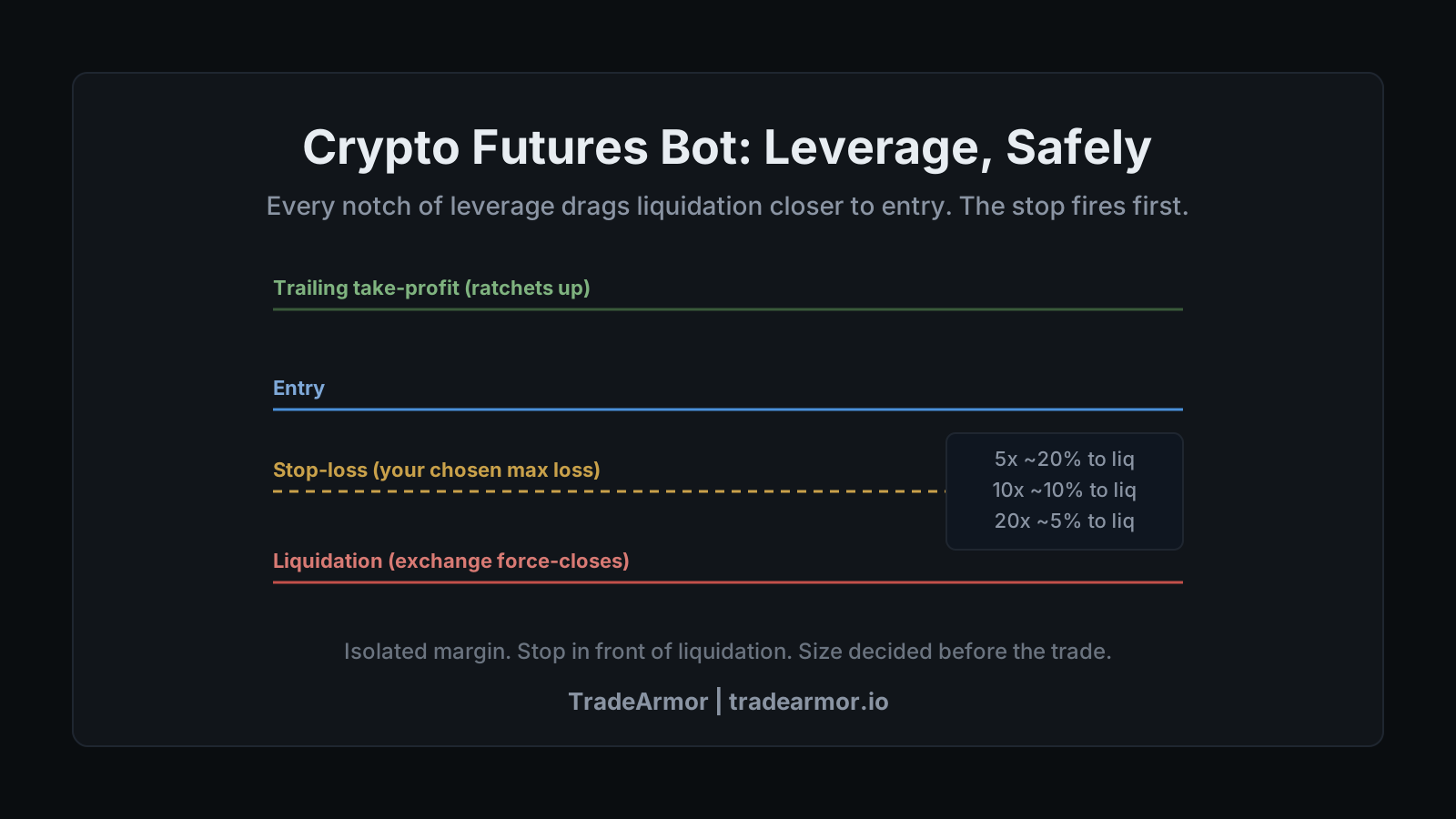
- At 5x, roughly a 20 percent adverse move is near liquidation.
- At 10x, roughly 10 percent.
- At 20x, roughly 5 percent.
- At 50x, roughly 2 percent, which in crypto is a quiet Tuesday.
Those are approximations. The exact liquidation price depends on the exchange's maintenance margin rate, your entry, and fees, and every major venue publishes its own formula. But the relationship is not an approximation: every notch of leverage you add drags your liquidation price closer to your entry. At high enough leverage, ordinary noise that you would not even notice on spot is enough to end the trade. The bot cannot repeal this. What the bot can do is put a stop-loss in front of the liquidation price so your own risk rule fires first, on your terms, for a loss you chose in advance.
This is also why "more leverage to make more money" is backwards. More leverage mostly buys you a faster liquidation. The size of your win comes from the move and your position size, not from how tight you set the dial.
See how TradeArmor's full platform fits together
Stops That Actually Fire: Stop-Loss and Trailing Take-Profit
The reason traders want a bot for futures specifically is that futures punish hesitation, and hesitation is the one thing software does not do. TradeArmor's futures mode runs two exit mechanics that matter most under leverage.
The stop-loss is your floor. You set the price or the percentage where the position closes, and the bot closes it, full stop. The discipline is in the not-moving. The classic way to turn a 2 percent planned loss into a liquidation is to widen the stop "just this once" because the chart looks like it is about to turn. The bot does not have a feeling about whether it is about to turn. It has a number, and it uses the number. On a leveraged position, that indifference is the feature you are paying for.
The trailing take-profit is your ratchet. On a long in profit, it follows price up and moves your exit up with it, then closes the position when price retraces by the percentage you set. You capture more of a trend than a fixed target would, and you do not have to watch it to do so. This is the crypto futures bot trailing stop behavior most people attempt manually and execute a candle too late. Set the trail wide enough that normal volatility does not shake you out of a winner, narrow enough that it locks in the gain when the move is actually done. The bot trails on every tick, identically, without getting greedy near the highs.
Used together, the two exits define a leveraged trade end to end before it opens: a known maximum loss on one side, a trend-following exit on the other. That is the whole pitch for automating futures. Not bigger wins. Defined ones.
Position Sizing Is the Real Risk Control
Leverage gets the attention. Sizing does the work. You can run a futures bot at modest leverage and still wreck an account by putting too much margin into one position, and you can run higher leverage safely if your size and your stop are set so the worst case is a loss you can absorb.
Work it backwards, the way a desk would. Decide the maximum dollars you are willing to lose on a single trade first. Set your stop-loss distance based on the chart and the strategy, not on what fits your desired size. Then let those two numbers determine your position size and your margin. Leverage is the last input, not the first, and most blowups come from people who pick the leverage first and reverse-engineer a story for the size afterward.
A useful habit: size so that a stop-out is annoying, not structural. If a single stopped trade meaningfully changes how you think about the rest of your account, the position was too big, regardless of what the leverage number said. The bot will execute whatever size you give it with the same calm either way, which is exactly why the number you give it has to be one you decided when you were not in the trade.
Running a Crypto Futures Bot on TradeArmor
In practice, setting up a crypto futures bot on TradeArmor is a configuration step, not a separate product to learn. You connect a futures-capable exchange, and the engine supports futures on Bybit, OKX, Bitget, and KuCoin. You choose your margin mode and leverage per the math above. You set the entry logic, whether that is an indicator condition, a signal, or a plain-English rule from the strategy builder, and you set the stop-loss and trailing take-profit that govern the exit. Long and short are both supported, so the same framework that rides an uptrend can position for a downtrend.
The signal-to-order path is the same one the rest of the platform uses, and if you want the full version of how an entry condition becomes a placed order, the how crypto trading bots work guide walks it. The futures-specific part is that the order carries leverage and a margin mode, and that the bot is now managing a liquidation price as well as a stop. If you trade on Bybit, the best Bybit trading bot guide covers that venue's spot and futures setup in more depth.
The custody posture does not change because the leverage went up. Your exchange API key stays in a local config on your machine, the same as it does for spot, which is the entire reason a bot that never needs withdrawal permission is the only kind worth handing a leveraged account. A futures key needs trade permission, not the keys to the vault. The bot opens positions. It does not need to move your coins to do it.
What Not To Do
A short list, because the failure modes are boringly consistent.
Do not run leverage you cannot explain. If you cannot say roughly where your liquidation price is, the leverage is set too high for your understanding of it, which is a worse problem than it being set too high for your account.
Do not trade futures without a stop-loss because "I will watch it." Under leverage, the gap between watching it and being liquidated is sometimes one fast candle. The bot exists so you do not have to win a reaction-time contest against a liquidation engine.
Do not put your whole account in cross margin behind one aggressive position. Isolated margin exists so a single mistake costs a single position. Use it.
Do not learn futures with real leverage on day one. Paper trading runs the identical engine with no capital at risk, so the sane order of operations is to test your leverage, stop, and trail settings on paper, watch where the simulated liquidation price lands, then go live small. The exchange charges tuition either way. Paper trading lets you take the class for free.
The Short Version
A crypto futures bot does not make leverage safe. It makes your risk rules non-negotiable, which is the closest thing to safe that leverage offers. The leverage math is fixed: every notch tightens the distance to liquidation, and high leverage turns ordinary volatility into a closing price. The defense is mechanical and unglamorous. A stop-loss in front of liquidation, a trailing take-profit to bank a trend, isolated margin to bound the damage, and a position size you decided before you were in the trade. The bot's contribution is that it does all four the same way every time, without the hesitation that costs leveraged traders the most.
TradeArmor runs that futures engine as one mode inside a self-hosted platform that also gives you built-in signals, 15 indicators, the AI strategy builder, DCA, grid, copy trading, backtesting, paper trading, and tax reporting, all on hardware you control where your keys never leave your machine. If you want to trade leverage with stops that actually fire and a trail that does not need babysitting, that is the setup.