You have a full time job and you cannot watch charts all day. You have heard that a bot can trade for you while you are in meetings, and you have also heard that bots are a black box that quietly empties accounts. Both stories float around the same forums, and neither one tells you how crypto trading bots work in the gap between the moment a price moves and the moment an order lands on your exchange.
That gap is the whole problem. People either treat a trading bot like a money printer or like a scam, because almost nobody explains the four boring stages in the middle. So this is a guide to how crypto trading bots work, mechanism by mechanism, with no hype and no hand-waving. By the end you will be able to look at any bot, including the one you might run, and say exactly where the signal comes from, how the decision gets made, how the order reaches the exchange, and where your API keys are sitting while all of that happens.
TradeArmor is the bot I build and trade with, so I will use it for concrete examples, but the mechanics here apply to any of them. It is a self-hosted crypto trading bot that bundles built-in BTC/USDC spot signals with a multi-year track record, 15 real-time indicators, a plain-English AI strategy builder, and DCA, grid, futures, copy trading, backtesting, paper trading, and tax reporting, all running on hardware you own. I am not going to pretend the only thing a bot does is buy dips. The point of understanding the full machine is that you stop being impressed by the parts that do not matter and start asking about the parts that do.
What is a crypto trading bot, really
A crypto trading bot is software that connects to your exchange account and places orders automatically according to rules you set in advance. That is the entire definition. It is not artificial intelligence dreaming up trades, and it is not a crystal ball. It is a rules engine that never sleeps.
The mental model that gets people in trouble is the casino model, where the bot is a slot machine that pays out if you feed it enough coins. The accurate model is duller. A bot is closer to a thermostat. A thermostat does not predict the weather. It watches the temperature, compares it to the number you set, and switches the heat on or off. A trading bot watches price and indicators, compares them to the rules you set, and switches buys and sells on or off. The intelligence is in the rules you wrote, not in the machine that runs them.
Once you accept that, the marketing falls away fast. A product promising effortless riches is selling the casino model to people who have not yet learned the thermostat one. The crypto bot space has a reliable tell: the more a landing page promises that you can set it and forget it, the less it wants you to ask where your keys are stored.
See the full machine before you judge one part. A bot is more than a buy timer. See how signals, indicators, DCA, grid, futures, and tax export fit together so you are evaluating a platform, not a single feature.
How crypto trading bots work: the four stages
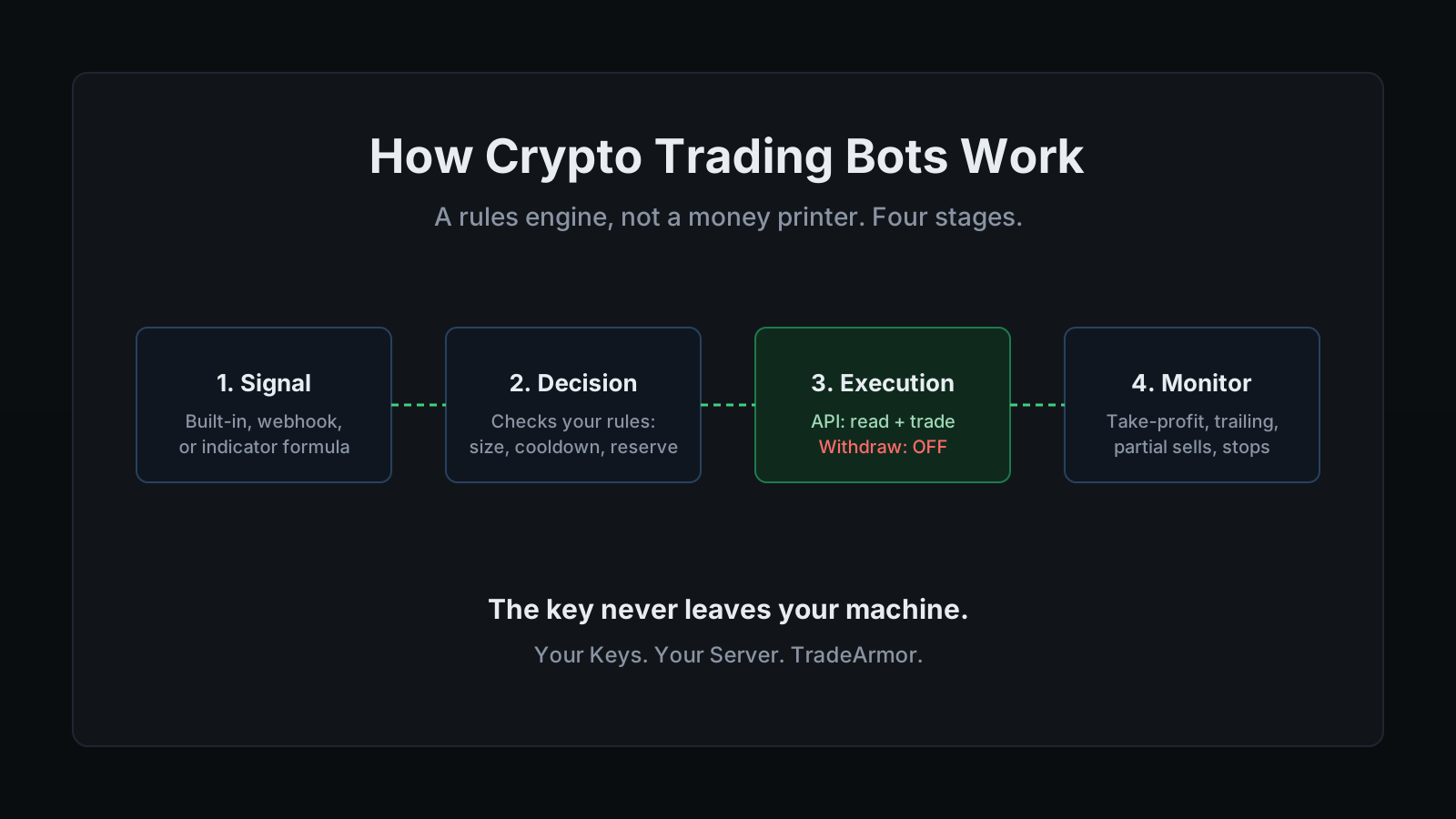
Strip away the branding and every crypto trading bot is the same four blocks in a row. Understand these four and you understand the category, because this is how crypto trading bots work underneath the marketing, every one of them.
The first block is the signal source. Something has to decide that a trade is worth considering. That trigger comes from somewhere: a built-in signal feed, a TradingView alert, or an indicator formula evaluating live candles.
The second block is the decision engine. A raw signal is not a trade. The engine takes the signal and runs it against your rules. Do you have budget left? Is this within your position limit? Has the cooldown expired? Would this buy actually improve your average cost? The engine answers those questions before anything reaches your exchange.
The third block is the execution engine. Once the decision clears, the bot turns it into a real order and sends it to the exchange through an API key. This is where software meets money. It is also where permissions matter, which I will come back to, because it is the single most important security decision you will make.
The fourth block is the monitoring layer. After a position is open, the bot tracks it and applies your exit rules: take-profit, trailing take-profit, partial sells, stop-losses on futures. A good monitoring layer also shows you the rules in plain sight, so you can see why the bot bought instead of trusting a black box. TradeArmor's Positions page expands each open trade into its live rule set, with a red or green dot on every condition, which is the difference between automation you can audit and automation you have to pray to.
Where the signal comes from
Most arguments about bots are really arguments about the signal source, so it is worth slowing down here. There are three common ways a bot decides something should happen, and serious platforms support more than one.
The first is built-in signals. The bot ships with its own signal feed, generated by the vendor's engine, and trades it for you. TradeArmor's cava-signals are BTC/USDC spot entries and exits that have run live for three years, included on every tier, with no TradingView subscription and no separate signal service to pay for. The advantage is that a beginner can run a proven strategy on day one without designing anything. The catch is that you are trusting someone else's logic, so a track record you can actually inspect matters more than a confident sentence on a homepage.
The second is external webhook signals. Many traders already have a TradingView setup that fires alerts, and a bot can receive those alerts through a webhook and execute them. The alert is just a trigger. The real work, position sizing, take-profit logic, account routing, and a record of what happened, all happens after the alert fires. A signal that only pings your phone is not automation. It is a more stressful notification.
The third is an indicator formula you build yourself. The bot computes indicators locally in real time, RSI, MACD, Bollinger Bands, Supertrend, VWAP, Stochastic, and more, and you combine their buy and sell states into a boolean rule. Something like RSI_BUY && (MACD_BUY || SUPERTREND_BUY). No data vendor, no external dependency, just math running on your machine against live candles. If writing boolean logic is not your idea of fun, the plain-English AI strategy builder translates a sentence into that formula, and because it is bring-your-own-key, you plug in your own AI provider and pay zero AI markup on top of the subscription.
How the execution engine turns a signal into a trade
This is the stage people skip, and it is the stage that actually moves money. A signal says "consider buying BTC." The execution engine has to turn that intention into a specific order on a specific exchange, then confirm it filled.
It connects to the exchange through an API, an interface most exchanges expose so software can place orders on your behalf. You generate an API key in your exchange account and hand it to the bot. The key carries permissions, and this is the part to read twice. An exchange API key can grant read access, trade access, and withdrawal access. A trading bot needs the first two. It never needs the third.
Read permission lets the bot see your balances and open orders. Trade permission lets it place and cancel orders. Withdrawal permission lets whoever holds the key move funds off the exchange entirely, and a bot has no reason to do that. If a setup guide tells you to enable withdrawal "to be safe," it has the word safe pointed in exactly the wrong direction. There is a full walkthrough in the API key security guide, and the short version is in the post on running a bot without giving away dangerous API permissions.
Once the order is sent, the execution engine listens for the fill, records it, updates the position, and hands control to the monitoring layer. The whole round trip happens in well under a second on a healthy connection, which is the one genuine speed advantage a bot has over a human. It is not that the bot is smarter at 3 a.m. It is that it is awake at 3 a.m. and you are not.
DCA, grid, signal, custom: the strategy modes
"How does the bot decide what to do" depends on which strategy mode it is running. There are four common ones, and they answer different questions. A capable platform runs several so you grow into it instead of switching tools.
Signal mode is the simplest. The bot trades entries and exits from a signal feed, built-in or external, with little configuration beyond the setup wizard. Best for hands-off traders who want a proven strategy without tuning.
DCA mode manages a single position by averaging down. When price moves against an open trade, the bot buys more at lower prices to pull the average cost down, so the position can exit profitably on a smaller bounce. The danger is buying the dip until you run out of cash, which is why a real DCA engine uses gates: a price gate so each deep buy genuinely lowers your average, a cooldown so a flash crash does not spend your whole budget in ten minutes, and a reserve so the bot never goes all in. The full mechanics live in the crypto DCA strategy guide, and the math behind gating is broken down in gated DCA versus simple DCA.
Grid mode profits from chop. The bot places a ladder of buy and sell orders across a price range and earns the spread as price oscillates inside it. It shines in sideways markets and struggles when price breaks out of the range and keeps going. Grids are the strategy most often oversold as a free lunch, and they are not. They are a range bet with a clean payoff and an ugly tail.
Custom mode is fully autonomous indicator logic, the boolean formulas from earlier, running with no signal feed at all. Best for traders who know exactly what they want and want the bot to enforce it without writing Python.
The point of listing all four is the anti-narrowing one. A bot is not "a DCA bot" or "a grid bot." Those are modes on one engine, and most operators run more than one at a time across different coin groups: signals on majors, a custom formula on a chosen alt, a grid on a range-bound pair. Reduce the whole category to one mode and you will buy the wrong tool.
The custody question: where do your keys live
Here is the part the glossy comparison tables skip, and it is the part that decides whether a quiet year stays quiet. Two bots can run the identical four-stage machine and identical strategies, and still be worlds apart on the one question that matters when something goes wrong: where is your API key physically stored.
A SaaS bot runs on the vendor's servers. That is convenient, and it means your exchange API key is sitting in the vendor's database. A self-hosted bot runs on your own hardware, a Mac mini, a Raspberry Pi, a small VPS, a Docker container, and the key stays in a local config file that never leaves the machine. Same trade-only permission, very different blast radius.
The blast radius shows up during a breach. In December 2022 the SaaS bot platform 3Commas had its database leaked, with roughly 10,000 user API keys posted publicly and an estimated $20 million drained from connected exchange accounts, an incident later picked up by the FBI (Halborn's breach writeup has the detail). The keys that leaked were the ones living on the vendor's side. A self-hosted bot has no central database to dump, because there is no vendor holding everyone's keys in one place. Your attack surface is your own machine, which is a target of one rather than a target of ten thousand.
This is the line I will not both-sides, because the mechanism is not ambiguous. If your key never leaves hardware you control, no vendor breach can expose it. That is the entire reason I run my own. There is a fuller comparison in self-hosted versus SaaS crypto bots, including the trade-off you do take on, which is that you handle your own uptime. A Pi in a drawer works. A laptop that sleeps when you close the lid does not.
The risks and the realistic expectations
A bot reduces operational risk. It does not touch market risk, and any product that blurs that line is selling something. Let me be specific about what automation actually buys you and what it does not.
It removes missed entries, because it is watching when you are asleep. It removes the fat-finger order and the panic sell, because it follows the rule instead of the adrenaline. It removes the slow tax of forgetting to take profit on a green day. Over a year, that consistency is worth real money, and it is the honest pitch for automation.
What it does not do is predict the market. If you point a flawless execution engine at a broken strategy, it will execute the broken strategy flawlessly, which is a faster way to lose money than doing it by hand. A bot is a force multiplier on whatever plan you give it, including a bad one. That is why the workflow that separates serious operators from gamblers is always the same: backtest the strategy against real historical data, paper trade it on live prices with no money at risk, then run it small before you scale. TradeArmor ships backtesting and paper trading as first-class features for exactly this reason, not as add-ons.
And leverage deserves its own warning. Futures and high leverage amplify both directions. A bot with a stop-loss helps you respect a plan, but it cannot repeal the fact that 20x magnifies a small move into a liquidation. Use leverage only with capital you can afford to lose entirely, and treat the futures mode as the sharpest tool in the box, not the default one.
Putting the machine together
So, how crypto trading bots work, in one breath: a signal source proposes, a decision engine checks it against your rules, an execution engine sends a trade-only order to your exchange, and a monitoring layer manages the exit, while your API key sits exactly where you decide it sits. Every bot is that machine. The differences that matter are the quality of the signal you can inspect, the honesty of the decision rules, and whether your keys live on your hardware or someone else's server.
TradeArmor is that machine built for the self-custody answer: built-in signals with a multi-year track record, 15 indicators, an AI strategy builder, DCA, grid, futures, copy trading, backtesting, paper trading, and tax exports, all on a machine where your keys never leave your control, for one subscription instead of a stack of them. If you came from ProfitTrailer, it is also where your positions and DCA logic land intact, covered in the ProfitTrailer alternative guide. Understand the four stages first, prove your strategy on the backtester and paper trading, and when the plan holds up, see how the plans line up on the pricing page and run it on hardware you own.
Frequently asked questions
How do crypto trading bots work? A crypto trading bot works in four stages. A signal source decides a trade is worth considering, whether that is a built-in signal, a TradingView webhook, or an indicator formula on live price. A decision engine checks that signal against your rules, like position size, cooldowns, reserve cash, and whether a buy would improve your average. An execution engine sends the order to your exchange through an API key that should carry trade permission only. A monitoring layer then tracks the open position and applies your exit rules. The bot runs those four stages continuously. It is a rules engine, not a predictor.
What is a crypto trading bot? A crypto trading bot is software that connects to your exchange through an API key and places buy and sell orders automatically based on rules you define in advance. It does not forecast the market and it does not create wealth on its own. It enforces a plan without sleeping, without missing an alert, and without the emotional override that makes people sell the bottom. A good one shows you which rule fired and why, so it is not a black box.
Are crypto trading bots profitable? A bot is only as profitable as the strategy it runs and the market it runs in. Automation removes missed entries, fat-finger orders, and panic exits, and that consistency is worth real money over time. It does not remove market risk. A bad strategy loses money faster with a bot, because the bot executes it flawlessly. The honest workflow is backtest, paper trade, then run small before scaling. No bot guarantees a return.
Do crypto trading bots need my withdrawal permission? No. A bot needs read permission to see balances and trade permission to place orders. It never needs withdrawal or transfer permission. Most account-draining incidents trace back to keys that carried more permission than the job required, often stored on a third-party server. The safest setup is a trade-only key on a bot you run yourself.
What is the difference between a SaaS bot and a self-hosted bot? A SaaS bot runs on the vendor's servers, so your API key sits in their database. A self-hosted bot runs on your own hardware, so the key stays in a local config you control. The difference matters most during a breach. When the 3Commas database leaked in 2022, the exposed keys were the ones on the vendor's side. A self-hosted bot has no central database to dump.
Can a beginner use a crypto trading bot? Yes, if the bot ships with a setup wizard and a proven default rather than a blank config. Start in the simplest mode, usually a built-in signal strategy, run it on paper first, and move to custom formulas only once you understand each rule. The classic beginner mistake is reaching for maximum leverage and exotic strategies on day one. Start boring.
TradeArmor is self-hosted trading software, not a financial adviser. Built-in signals are algorithmic outputs, not investment advice. Automation reduces operational risk such as missed or emotional trades; it does not reduce market risk or guarantee any return. Leveraged trading can result in losses exceeding your initial margin. Past performance does not predict future results.