Is Bitsgap Safe? A Custody-First Answer
Type "is Bitsgap safe" into a search bar and you get two confident, opposite answers. Bitsgap's own security page says yes, with a list of layers to prove it. A burned SaaS refugee in a Reddit thread says no company should ever hold your keys, full stop, and cites the 3Commas breach as Exhibit A. Both of them are technically right. That is the annoying part, and it is why the question keeps getting typed instead of settled.
Here is the short version before the mechanics, because the mechanics are the part that actually decides your risk. Bitsgap encrypts stored API keys with RSA 2048-bit encryption, sits behind a firewall, and rejects any key that has withdrawal permission switched on before it will even connect. Follow its setup guidance and the platform cannot move your coins off the exchange, full stop, because the exchange itself enforces that limit at the API level. In that narrow, correct sense, yes, it is safe. The word "safe" is carrying more weight than one sentence can hold, though, so it is worth taking apart into the pieces people actually mean when they ask it.
I build the self-hosted side of this argument for a living. TradeArmor is a self-hosted crypto trading platform with built-in BTC/USDC signals carrying a 3+ year track record, 15 technical indicators, a plain-English AI strategy builder, DCA, grid, futures, copy trading, backtesting, paper trading, and tax exports, all running where your API keys never leave your machine. So no, I am not neutral on custody. This is not a hit piece though. Bitsgap has genuinely earned credit here, and I will hand it over before making the case for the alternative.
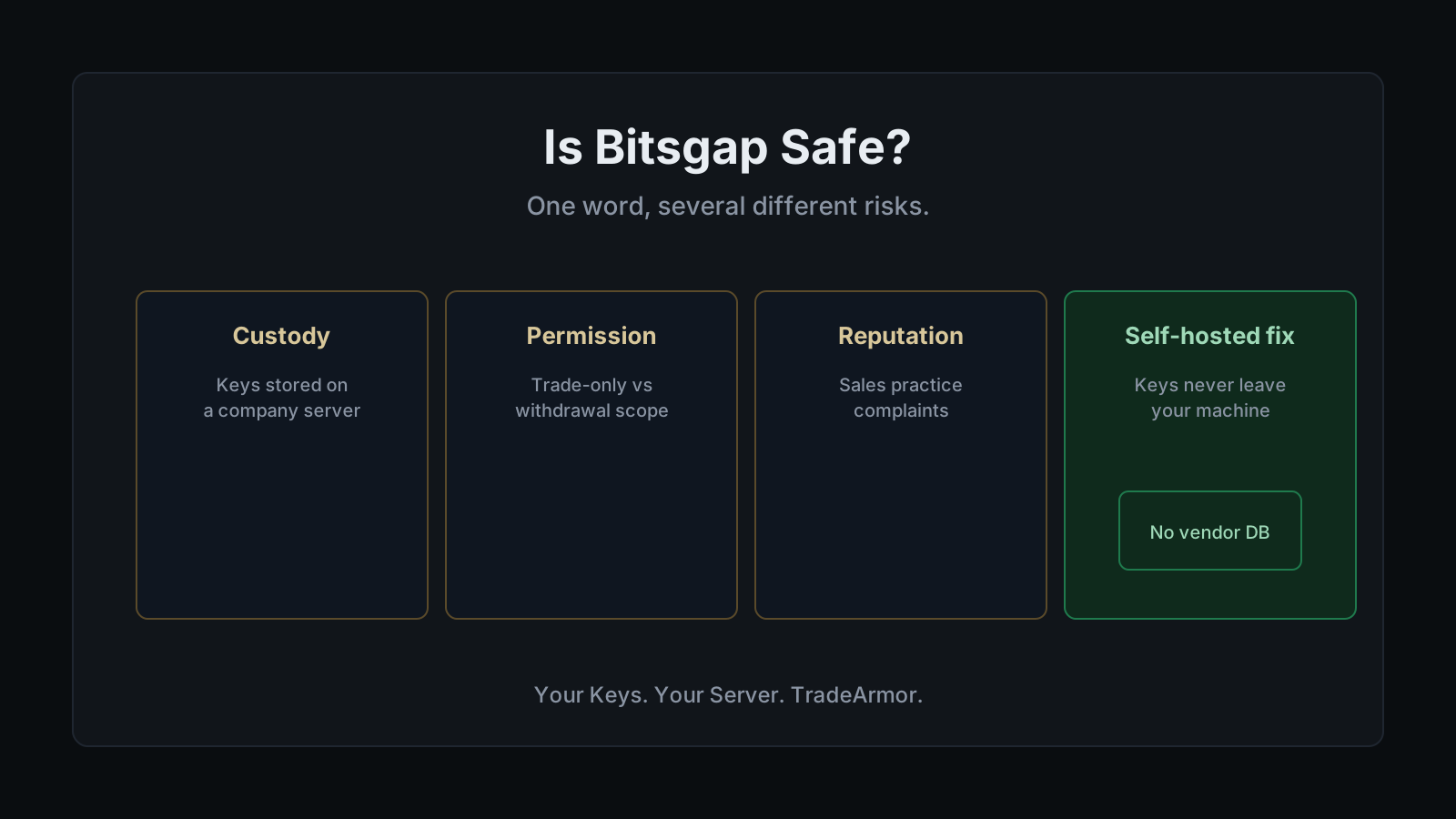
Risk one: custody, where the keys physically sit
Bitsgap is Software-as-a-Service. You connect an exchange API key, Bitsgap encrypts it and stores it on its own servers, and its cloud runs your grid or DCA bots against your account around the clock whether your laptop is open or in a drawer. That always-on convenience is the entire pitch. It is also the exact shape of the risk. For a cloud service to trade while you sleep, your key has to live somewhere the cloud can reach it, which means a database of trade-enabled keys sits on infrastructure you do not control and cannot inspect.
Encryption helps a lot here. RSA 2048-bit is a real, respected standard, and it is not window dressing. But encryption reduces the value of a breach; it does not make the store disappear. Bitsgap states it has never been breached since launching in 2018, and that track record is worth something. It is also a claim about the past, not a guarantee about tomorrow, and it is not a claim any SaaS bot, Bitsgap included, can make permanent. "I don't want to give my API keys to a third party" is not paranoia. It is a correct read of where the risk sits by design. The self-hosted versus SaaS breakdown walks the full matrix, but the short version is this: a SaaS bot asks you to trust an operator's security forever, and a self-hosted bot asks you to trust your own machine, which is at least a question you can personally answer.
Risk two: permission, what the key can actually do
This is the risk you control directly, and it is the one Bitsgap gets right by default rather than by asking nicely. An exchange API key carries separate, granular permissions. Read lets a bot see balances and price data. Trade lets it place and cancel orders. Withdraw lets it move coins off the exchange entirely. A trading bot needs exactly the first two.
Bitsgap does not just recommend disabling withdrawal. It rejects the key outright at connection time if that permission is enabled, which removes the "I forgot to uncheck a box" failure mode entirely. That is a better default than plenty of competitors ship, and it deserves to be said plainly instead of buried under a caveat. A key without withdrawal scope cannot send funds to an outside address even if the entire platform were compromised tomorrow, because the exchange, not Bitsgap, is the thing physically blocking the transfer.
The limit worth keeping in view: trade-only permission stops fund theft, not trade abuse. Someone with valid trade access can still place bad orders. Correct scoping shrinks the blast radius to something survivable. It does not erase the fact that a server somewhere holds a key that can trade on your account without you touching a keyboard. For the full scope-by-scope walkthrough, the API key security guide and the no-API-key-risk explainer both go deeper than one paragraph can. You can also see the full TradeArmor feature set here.
Risk three: reputation, the risk that has nothing to do with encryption
Here is where "is Bitsgap safe" quietly splits into a second question people rarely separate from the first. Search Bitsgap's Trustpilot page and the strongest complaints are not about a hack or a leaked key. They are about pushy renewal calls, aggressive upsell tactics, and sales agents some reviewers describe as making misleading claims about billing terms. That is a real risk category. It is not the same category as "can someone drain my exchange account," and treating the two as one blurred worry does Bitsgap's actual security posture a disservice.
A dry observation, since we're being honest about risk categories: a company can be cryptographically careful with your API key and still be a pain to get off the phone with, and both of those facts can be true on the same Tuesday.
Separate them cleanly when you evaluate any bot. Is my capital technically exposed, versus, do I trust this company's business practices. Bitsgap earns a strong grade on the first question and a mixed one on the second, and conflating them is how a platform with solid encryption ends up sounding shakier than the evidence supports.
Risk four: operational trust, the part no pricing page mentions
The last risk is structural, not a Bitsgap flaw specifically. On any SaaS bot, your automation depends on a chain you cannot inspect from the outside: the company staying solvent, its servers staying up, its staff not making a mistake, its encrypted key store staying encrypted. Most of the time, for most operators, that chain holds. You are trusting all of it permanently, though, and you only find out it failed at the worst possible moment.
Self-hosting swaps that chain for one you actually own. Your uptime becomes your responsibility, and a Raspberry Pi left running in a closet does not maintain itself. That is a real trade, not a free lunch. For a trader who already got burned once, trading a chain of trust for a chain of chores is usually the trade they came looking for. The broader case for making that swap lives in the best self-hosted crypto trading bot guide.
Ready to see what running your own key store actually looks like day to day? Start the 30-day trial and connect an exchange without handing a company your API key.
So is Bitsgap safe, or not?
Both answers hold, which is exactly why the question survives. Bitsgap is a legitimate, long-running platform that encrypts stored keys, rejects withdrawal-enabled connections by design, and states an unbroken security record since 2018. Set up correctly, it is not going to let a breach drain your exchange balance, because the withdrawal block sits at the API level, not at Bitsgap's discretion.
What no setting changes is the architecture underneath. To run bots from the cloud, Bitsgap has to hold a key that can trade your account, and that store is a standing fact, encrypted and locked down, but present. The wider framing from are crypto trading bots safe at all applies here directly: a bot is only as safe as where its keys live. Bitsgap keeps yours on its servers. A self-hosted bot keeps them on your machine, where there is no vendor database to breach in the first place because there is no vendor in the trade path. If you want the same category of grid and DCA automation without the hosted key store, the Bitsgap alternative comparison lays out that trade in full, including where Bitsgap still wins on breadth.
Frequently asked questions
Is Bitsgap legit or a scam? Legit. It is an established platform that has run since 2018, states it has never suffered a breach in that time, and publishes detailed security documentation. The complaints that surface most often on review sites are about pushy renewal calls and sales tactics, not the platform stealing funds or leaking keys. Treat that as a customer-experience flag, not a custody flag.
Can Bitsgap withdraw or steal my funds? Not through the API connection, if you follow its own setup rule. Bitsgap explicitly rejects any exchange API key with withdrawal permission enabled, so a correctly scoped key physically cannot move coins off the exchange, whether the request comes from Bitsgap, a hacker who breached Bitsgap, or anyone else. The exchange enforces that limit, not Bitsgap's goodwill.
Is it safe to give Bitsgap my exchange API keys? Safer than handing over a withdrawal-enabled key, and safer than most people assume, once you confirm the key is read and trade only. It is never as safe as a key that is never transmitted to a third party at all. That gap, transmitted-but-encrypted versus never-transmitted, is the entire difference between a SaaS bot and a self-hosted one.
Why do some reviews call Bitsgap unsafe if the security holds up? Because people use "unsafe" to mean two different things and rarely say which one. Some mean the technical kind, can someone drain my account, and Bitsgap answers that one well. Others mean the trust kind, do I believe this company's business practices, and that is where the aggressive sales complaints live. Conflating the two makes Bitsgap sound shakier on security than the evidence supports.
Does self-hosting actually make my trading safer? It reduces operational risk, the kind that comes from a company breach, an outage, or a server holding a key you cannot see. It does not touch market risk. The bot runs your rules, and the market does whatever it is going to do regardless of who holds the API key. Self-custody means you own every decision and every outcome, which is the actual trade.
Bottom line
"Is Bitsgap safe" is really three separate questions sharing one word: can it lose your funds, can it lose your trust, and are you comfortable with either answer permanently. On funds, Bitsgap's withdrawal-block design and encryption are genuinely solid. On trust, the sales-practice complaints are real and worth weighing on their own terms, separate from the security question entirely. On the third question, the honest answer is that a SaaS bot asks you to hold that comfort level forever, because the architecture cannot change without becoming a different product.
TradeArmor is the different product. Same categories of automation, bundled signals with a 3+ year track record instead of none, and an API key that never leaves your own hardware because there is no server in the trade path to hold it. You give up nothing on the security side by moving, and you stop needing to trust anyone's key store at all. If that is the trade you were weighing, see the plans and start.
Past performance is not indicative of future results. Signals are algorithmic outputs, not personalized investment advice. Trading cryptocurrency carries substantial risk including the total loss of capital.
Ed Cava