You are four legs deep on a coin that has not recovered, and the blended average price is the only number standing between the position and a realized loss. You have money sitting in open ProfitTrailer positions with no obvious place to move them, and of everything in that setup, the one piece you actually trust is ProfitTrailer EQPRICE. It is also the setting nobody ever explained to you properly. The wiki hands you a one-line definition and a formula, the forums argue about spacing, and you are left leaning on a rule you depend on without a clean picture of what it does. That is a rough way to trust real money.
So here is the clean picture, because the idea underneath EQPRICE outlives ProfitTrailer itself. ProfitTrailer EQPRICE is not complicated once you see what it is actually pointing at. This is the concept I still run today, on TradeArmor, a self-hosted crypto trading platform that lives on your own hardware where your API keys never leave your machine, with built-in BTC/USDC signals, 15 technical indicators, a plain-English strategy builder, DCA, grid, futures, copy trading, backtesting, paper trading, and tax exports on one engine. This post is about the mechanic, not the dashboard. EQPRICE is a DCA idea first, and understanding it is worth more than any product tour.
What ProfitTrailer EQPRICE actually is
Every time a DCA bot averages down, it opens a new leg, and it records the exact price that leg was bought at. A position four buys deep is not one blob of coins at one price. It is four separate purchases, each with its own cost. EQPRICE is simply how ProfitTrailer refers to the bought price of a single one of those legs, the specific leg its Equalize strategy is looking at right now, instead of the blended average of all four.
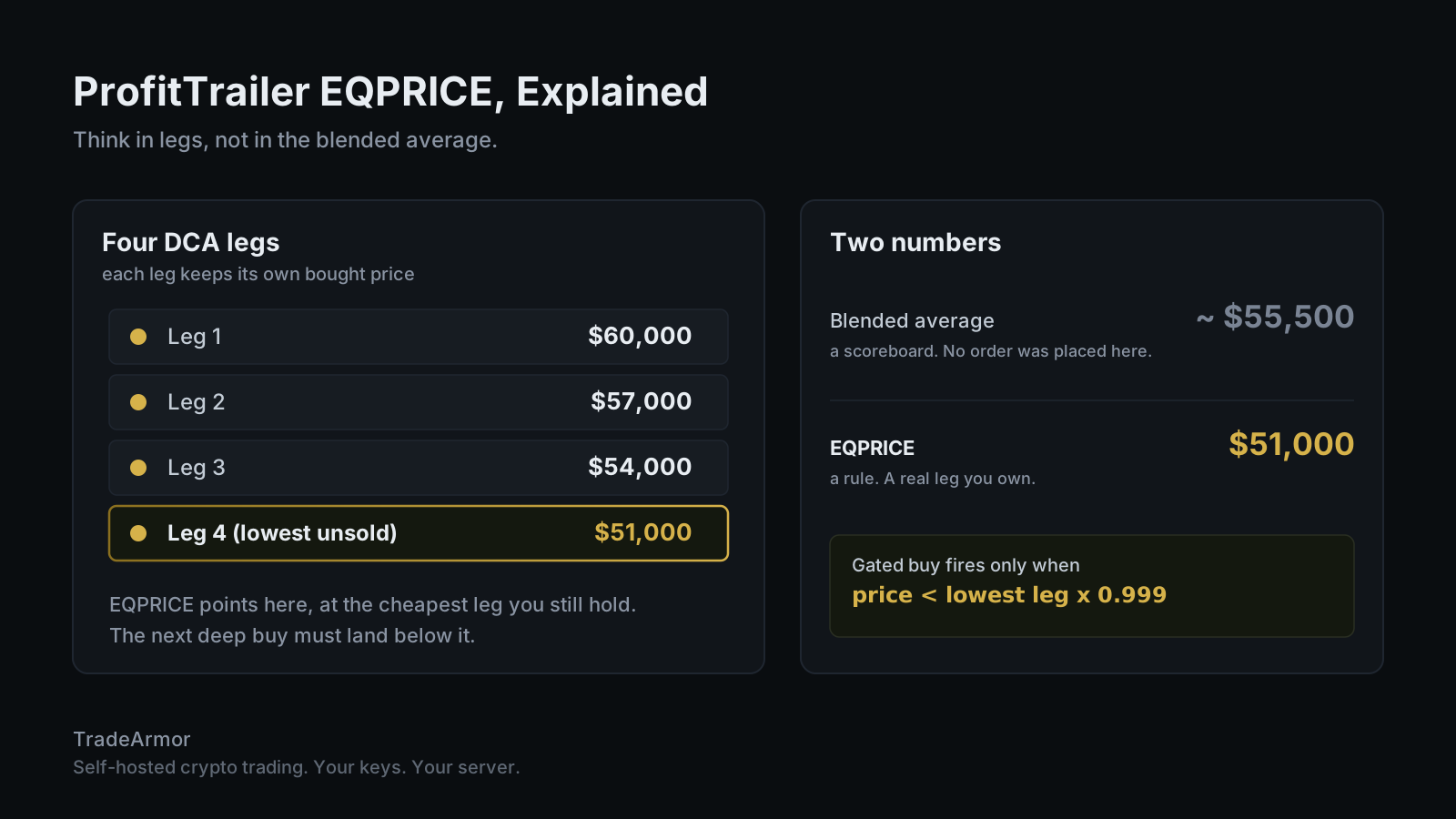
That distinction is the whole thing. Say your legs came in at $60,000, $57,000, $54,000, and $51,000. Your blended average is around $55,500. That average is what your P&L is measured against, and it is a useful summary. But it is a summary, not a real order. No single coin in that stack was bought at $55,500. The cheapest leg you are still holding was bought at $51,000, and EQPRICE is how the bot names that number so it can reason about legs one at a time.
Most bots only ever think in the blended average. EQPRICE is what lets a bot think in legs. That sounds like a small difference. It is the difference between a DCA engine that works into a crash and one that quietly runs out of money.
See how the full platform handles DCA and strategy modes, or keep reading for why the average is the wrong number to trigger on.
Why the blended average lies to a DCA bot
The blended average is honest about one thing and misleading about another. It tells you the truth about where the whole position breaks even. It tells you nothing useful about whether your next buy is a good one.
Picture the same four legs, average around $55,500, and the price drifts to $55,000. A bot that gates its next buy against the average sees $55,000 sitting just under $55,500 and fires. Congratulations, you just bought coins four thousand dollars above your cheapest existing leg. The average barely moved, you spent real capital, and you are now stacking purchases near a level you already own plenty of. Do that a few times in a shallow dip and your budget is gone before the market has actually gone anywhere.
Gate that same buy against EQPRICE, the lowest unsold leg at $51,000, and the bot refuses. It will not add until price drops below the cheapest thing you hold. That is the point. Averaging down only helps if every new buy lands below your average, and the only way to guarantee that mechanically is to require each deep buy to come in under your lowest leg, not under a blended number that no order was ever placed at. The average is a scoreboard. EQPRICE is a rule.
The two jobs EQPRICE does
Once a bot can name individual legs, it can do two things a blended-average bot cannot.
The first is on the sell side, which is where ProfitTrailer's Equalize strategy started. Because the bot knows each leg's own cost, you can tell it to sell a specific leg at EQPRICE * 1.01, one percent above what that leg cost, even while the whole position is underwater on the blended average. Your $51,000 leg can take a small profit and exit while your $60,000 leg keeps waiting. You peel gains off the cheap legs instead of holding the entire stack hostage to the expensive one. It is a genuinely clever piece of design, and it is why the Equalize crowd was so loyal to it.
The second job is on the buy side, and it is the one most people mean when they say they trust the EQPRICE logic. Here EQPRICE is the reference point for a buy gate: no deep DCA buy is allowed unless price is below the lowest unsold leg. Same variable, opposite end of the trade. One version decides when a leg may leave, the other decides whether a leg may join.
How gated DCA uses EQPRICE
This is where the idea carries forward cleanly, because it is not really a ProfitTrailer feature. It is a DCA principle that any serious engine should implement, and TradeArmor's gated DCA engine does.
The rule in plain terms: past a DCA level you configure, the default is 10, the next buy only fires when the market price is below the lowest unsold leg times 0.999. That 0.999 is a small margin so the buy has to be genuinely cheaper, not a rounding-error match. It is the same shape as ProfitTrailer EQPRICE gating, on purpose.
Walk it through. You are 11 legs deep, lowest unsold leg at $51,000. The gate will not let the bot buy until price prints below $50,949. Price wicks to $50,800, the gate clears, the buy fires, and now your cheapest leg is $50,800, so the gate re-arms one level lower. Every deep buy is forced to actually lower your cost basis. The bot cannot stack six orders inside a two percent band near the top and then sit flat and broke while the market falls another twenty. You can prove any spacing and level count out first on the free DCA backtester before a cent is at risk, and you can watch the gate arm and clear in the position rules inspector rather than guessing at it. Show me the rules the bot is following, not just the fill it printed. That is the whole reason EQPRICE-style gating exists.
For the deeper version of this same argument, with a worked six-buy example, the complete DCA strategy guide runs the numbers.
What happens to EQPRICE when you migrate
Here is the part that matters if you have an open book. The EQ-price gate depends entirely on leg history. It has to know each individual leg's bought price, because the lowest unsold one is the reference. A migration that copies over only your blended average throws that away and leaves the gate with nothing to point at. That is not a migration. It is a reset with extra steps.
TradeArmor's ProfitTrailer migration tool reads your database and rebuilds every leg with its own bought price, along with your trade and signal history, so the EQ-price buy gate behaves the way you tuned it the day you left. The legs come across intact, which means the one piece of logic you trusted keeps working on the coins you already hold.
And the respectful part, because it is true. ProfitTrailer taught a generation of traders how to run a DCA bot, and EQPRICE was a real part of that curriculum. The leg-level thinking, the patience, the refusal to let a blended average trigger a bad buy, that was the lesson. ProfitTrailer stopped shipping. The work did not have to stop with it, and the good ideas were worth continuing rather than reinventing.
Closing
EQPRICE is one honest idea wearing a technical name: reason about your DCA position one leg at a time instead of hiding behind a blended average, so every deep buy has to be genuinely cheaper than anything you already hold. TradeArmor carries that idea forward on a self-hosted platform that runs on your own hardware, keys never leaving your machine, with the gated DCA engine, backtesting, signals, and the full strategy stack on one bot. If EQPRICE was the logic you trusted, you can keep it and bring your positions with it. See how the tiers line up on the pricing page.
Frequently asked questions
What is ProfitTrailer EQPRICE? ProfitTrailer EQPRICE returns the bought price of the individual DCA leg its Equalize strategy is currently looking at, rather than the blended average of the whole position. It lets the bot reason about each leg on its own cost. On the sell side you can exit a leg at a small profit above its own price, and on the buy side you can gate deep buys against the lowest unsold leg so each new buy actually lowers your average.
Is EQPRICE the same as the average price? No, and that is the point. The average price is the blended cost of every coin in the position, useful for measuring P&L. EQPRICE is the cost of one specific leg. Gating a DCA buy against the average lets the bot buy above legs you already hold, while gating against the lowest unsold leg forces every deep buy to come in cheaper than anything in the stack.
Does TradeArmor support EQPRICE logic? Yes. TradeArmor's EQ-price buy gate matches the behavior: past a configurable DCA level, default 10, the next buy only fires when price is below the lowest unsold leg times 0.999. Same protection against stacking into a crash too fast, on a self-hosted engine where your keys stay on your machine.
What is the ProfitTrailer Equalize strategy? The Equalize strategy is the system that made per-leg thinking possible in ProfitTrailer. It exposes each leg's bought price as a variable, EQPRICE among them, so the bot can sell individual DCA levels independently instead of treating the position as one combined blob. That is how you sell a cheap leg for a small gain while an expensive leg keeps waiting.
Will migrating from ProfitTrailer keep my EQPRICE behavior? It will if the migration preserves your legs, not just your average. The gate needs each leg's individual bought price to know which one is lowest. TradeArmor's migration tool rebuilds the full leg history, so the EQ-price gate on a migrated position behaves the way you had it tuned.
Ed Cava builds TradeArmor and trades with it. He ran ProfitTrailer for years before building the self-hosted platform he wanted, and he still runs the gated DCA engine on his own machine.