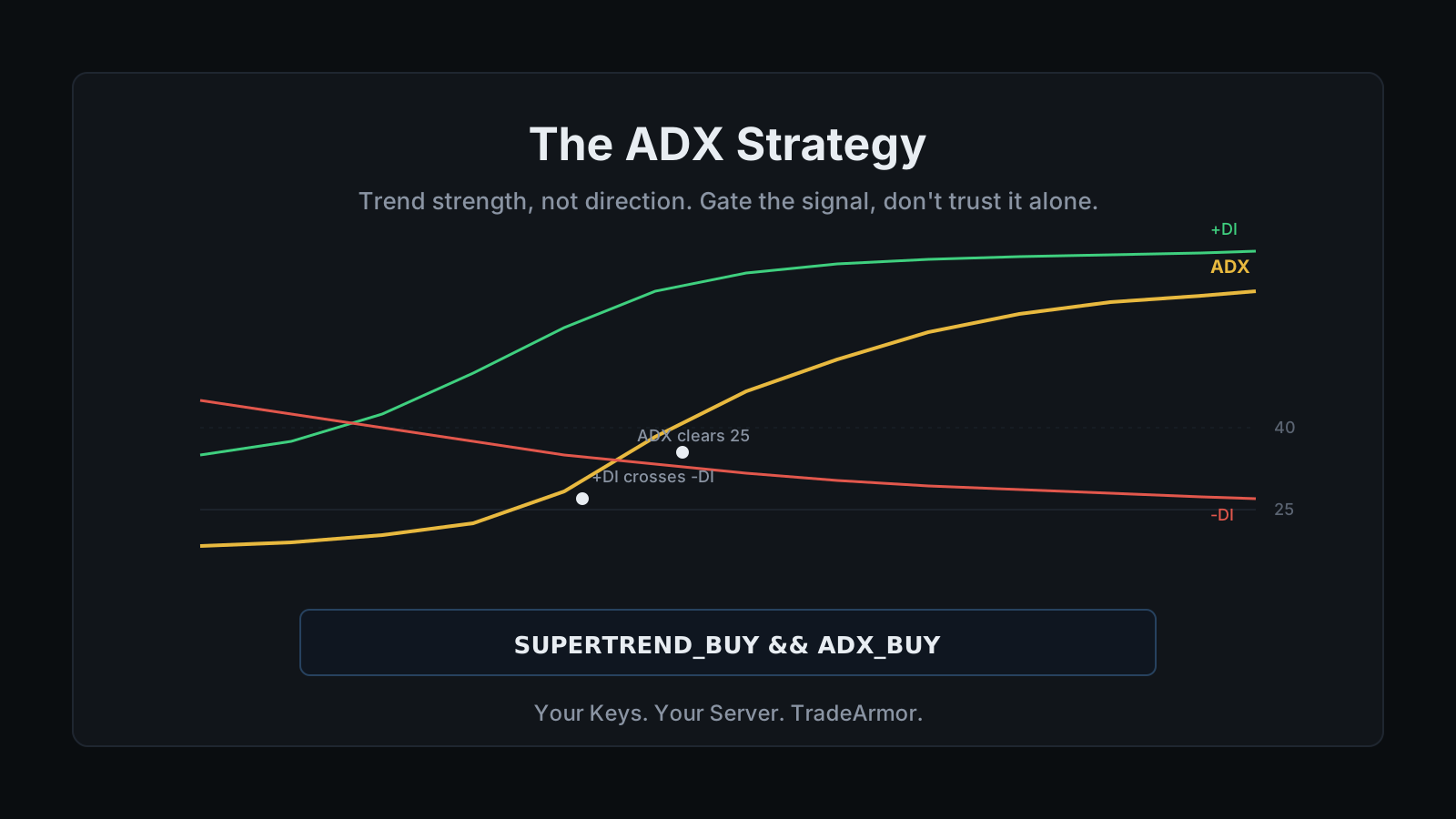
Run an ADX strategy on a Bitcoin four-hour chart during a choppy, directionless week and watch the ADX line sit under 20 for days, refusing to climb no matter which way price twitches. That flat line is doing its job. It is telling you, correctly, that nothing worth trading is happening, and a range chews through trend-following entries one at a time regardless of who is feeding it.
I build and trade with TradeArmor, a self-hosted crypto trading bot that runs on hardware you own, with built-in BTC/USDC signals carrying a three-year track record, 15 real-time technical indicators, a plain-English AI strategy builder, and DCA, grid, futures, copy trading, backtesting, paper trading, and tax reporting on one engine. This is a guide to what ADX actually calculates, the threshold levels that separate a real trend from noise, and how to gate an ADX strategy into a rule the bot runs without you watching a chart.
Most people come to ADX wanting the same thing they want from every indicator: something that just runs, and rules they can see, not a Python script they'd have to write themselves to get the same answer. That instinct is correct, and it's also why ADX gets misused constantly. It's the one indicator in the entire toolkit that was never designed to answer the question people keep asking it.
What an ADX Strategy Is Actually Measuring
J. Welles Wilder introduced ADX in the same 1978 book that gave the world RSI and ATR, "New Concepts in Technical Trading Systems," as part of what he called the Directional Movement System. Three lines come out of that system, not one. +DI tracks how much of each candle's range happened to the upside. -DI tracks how much happened to the downside. ADX takes the gap between those two lines, smooths it over a period, 14 candles by default, and reports the result on a scale of 0 to 100.
Here is the part that trips people up: ADX has no idea which way the market is going. It only measures conviction. An ADX reading of 45 during a brutal downtrend looks identical, on the ADX line alone, to an ADX reading of 45 during a screaming rally. Direction lives entirely in +DI and -DI. Strength lives entirely in ADX. Confusing the two is how a trend-strength filter ends up mistaken for a trend-direction signal, and it's the single most common misread of the entire Directional Movement System.
The Threshold Levels an ADX Strategy Crypto Traders Actually Use
Four bands do most of the work. Below 20, the market lacks conviction in either direction, and price is more likely chopping sideways than trending. Above 25, a trend has enough behind it to be worth trading. The 25 to 40 range is where most trend-following systems find their best win rates. Above 50, the trend is running unusually hot, historically the zone right before a sharp mean reversion snaps it back, not a green light to add size.
Those bands were tuned on markets that close on weekends and trade at a fraction of crypto's volatility. Bitcoin and Ethereum don't take weekends off, and they carry more leverage and thinner order books than most of the markets Wilder was staring at in 1978. ADX on a crypto pair tends to spike into the 40s and 50s faster than it would on a forex chart, then unwind just as fast once the move exhausts itself. Traders who ran a strict ADX above 25 filter in 2026 reported roughly 37 percent higher profitability than traders who skipped the threshold entirely, alongside a 40 percent higher failure rate on trades entered while ADX sat under 25. Treat 25 as a starting point you validate on your own pair, not a number to inherit blind.
One indicator is still just one input. ADX, the other 14 built-in indicators, cava-signals, DCA, grid, and futures all run on the same engine. See how the full platform fits together before you size a position off one system alone.
Why ADX Never Fires a Trade by Itself
This is the mistake that actually costs money. ADX cannot generate a buy or a sell, full stop, because it is non-directional by design. A reading of 45 confirms a trend is strong. It says nothing about whether that trend is up or down. The only directional read inside the same system is the +DI and -DI crossover, +DI crossing above -DI for a bullish signal, -DI crossing above +DI for a bearish one, and that crossover alone is noisy enough to whipsaw through a range just like any other single-line signal.
The correct division of labor is to let something else call direction and let ADX act as the gate that decides whether the call is worth acting on. Supertrend, an EMA crossover, or the DI crossover itself can supply direction. ADX above 25 confirms there's real conviction behind it before the bot risks anything. Every backtest showing an ADX filter improving win rate is really showing something simpler: rejecting weak-trend entries beats accepting every directional signal a chart throws at you, which is a fancy way of saying that not trading is sometimes the whole edge.
Building an ADX Strategy Into a Bot Rule
TradeArmor computes ADX as one of its 15 built-in indicators, locally, in real time, and every indicator exposes a boolean buy and sell state that Custom mode formulas can combine with &&, ||, and parentheses. A trend-confirmed Supertrend entry looks like this:
SUPERTREND_BUY && ADX_BUY
That formula only fires when Supertrend has already flagged a directional flip and ADX confirms the trend behind it clears the strength threshold, the same fix traders reach for when a bare Parabolic SAR strategy whipsaws through a range. Hybrid mode runs the identical logic on top of the built-in cava-signals instead of an indicator: only buy when a cava-signal fires and ADX confirms real trend strength behind it, which turns a proven signal source into one that skips its own weakest setups. None of this requires writing Python, and none of it asks you to trust an answer you can't inspect. The Activity and Trades pages show exactly which condition was true, and which wasn't, the moment a rule fires, so an ADX strategy crypto traders run automatically stays a rule they can audit, not an output they just have to take on faith.
What ADX Doesn't Do
An ADX gate tells the bot whether to trust a directional signal. It says nothing about how much capital goes into the trade, whether the entry scales in with DCA legs instead of firing all at once, or where the stop sits once you're in. Trend-strength filters get all the attention in guides like this one because the math is interesting. Position sizing quietly decides whether a good filter actually protects the account or just delays the same mistake at a slightly better entry price.
None of that changes where the exchange API key running any of it should live. A trend-strength gate, a directional crossover, or a hand-tuned webhook rule all execute the same way whether the key sits in a vendor's cloud or a config file on hardware you control. Only one of those arrangements keeps the bot restricted to trade permission, never withdrawal, and entirely outside anyone else's reach.
The Honest Summary
ADX measures conviction, not direction, and the moment you ask it to do both jobs it stops being useful. Pair it with a directional indicator like Supertrend or an EMA crossover, gate the entry above 25, and you get a system that skips the chop instead of trading through it. That's the whole trick behind a working ADX strategy: one line confirms strength, a second line confirms direction, and the bot only acts when both agree. TradeArmor runs that gate, the signal generation, the sizing, and the exits on one self-hosted subscription instead of a chart tool, a signal service, and a SaaS bot stacked on top of each other, with your API keys never leaving your machine. See the plans and get started.
Frequently Asked Questions
What does ADX actually measure, and how is it different from +DI and -DI?
ADX, +DI, and -DI come from the same calculation, J. Welles Wilder's Directional Movement System from his 1978 book New Concepts in Technical Trading Systems, but they answer two different questions. +DI and -DI measure direction: +DI rises when price is making higher highs, -DI rises when price is making lower lows, and whichever line sits on top tells you who is in control, buyers or sellers. ADX measures something else entirely, the strength of whichever direction is winning, on a 0 to 100 scale, and it does that by smoothing the gap between +DI and -DI over a period, 14 candles by default. A rising ADX means the trend, up or down, is getting stronger. A falling ADX means it's losing conviction, even if price is still grinding in the same direction. That's why ADX alone never tells you which way to trade. It only tells you how much to trust the direction some other indicator already gave you.
What ADX threshold should I use for an ADX strategy crypto traders can actually run?
25 is the standard trend-confirmation line, below 20 the market is usually ranging and not worth a trend-following entry, 25 to 40 is where most trend-following systems do their best work, and above 50 the trend is unusually strong and historically prone to a sharp mean reversion once it peaks. Those bands were built on markets that close for the weekend. Crypto doesn't, and it trades on more leverage and less liquidity depth than most traditional markets, so ADX on Bitcoin or Ethereum tends to spike into the 40s and 50s faster than it would on a currency pair, then unwind just as fast. Traders who backtested a strict ADX above 25 entry filter in 2026 reported roughly 37 percent higher profitability than traders who ignored the threshold, alongside a 40 percent higher failure rate on trades entered while ADX sat below 25. Treat 25 as the starting point, not gospel, and confirm it on your own pair and timeframe before sizing anything off it.
Can ADX generate buy and sell signals on its own?
No, and this is the mistake that costs people money. ADX is non-directional by design. A reading of 40 tells you a trend is strong. It says nothing about whether that trend is up or down, which means an ADX line by itself can never fire a buy or a sell. The only way to get direction out of the Directional Movement System is the +DI and -DI crossover, +DI crossing above -DI for a bullish signal, -DI crossing above +DI for a bearish one, and even that crossover is noisy and prone to whipsaw on its own. ADX's real job is downstream of the direction call: confirm that the trend a directional indicator just flagged is actually strong enough to trade, and reject the ones that aren't.
Why does an ADX strategy crypto bots run still need a separate directional indicator paired with it?
Because ADX was built to answer one question, is a trend strong, and a trading rule needs the answer to two questions, is a trend strong and which way is it pointed. Pair ADX with something that already answers direction, Supertrend, EMA crossover, or the DI crossover itself, and let ADX act purely as a gate: only take the directional signal when ADX confirms real conviction behind it. That division of labor is the entire point of Wilder's design. He built three lines because one line can't do two jobs, and every backtest showing ADX filters improving win rate is really showing that rejecting weak-trend entries beats accepting every directional signal a chart throws at you.
Can a self-hosted crypto trading bot run an ADX strategy automatically?
Yes. TradeArmor computes ADX as one of its 15 built-in indicators locally, in real time, alongside RSI, MACD, Supertrend, Bollinger Bands, EMA, and the rest, and every indicator exposes a boolean buy and sell state that formulas can combine. A rule like SUPERTREND_BUY && ADX_BUY only takes the Supertrend entry when the engine's trend-strength gate also confirms conviction, and the reverse pairing works the same way for exits. Hybrid mode runs the identical logic on top of the built-in cava-signals, gating a signal instead of an indicator. None of it requires writing Python, and none of it requires trusting a result you can't inspect, because the Activity and Trades pages show exactly which condition was true when a rule fired. The bot runs on your own hardware, and the exchange API key it uses never leaves that machine.