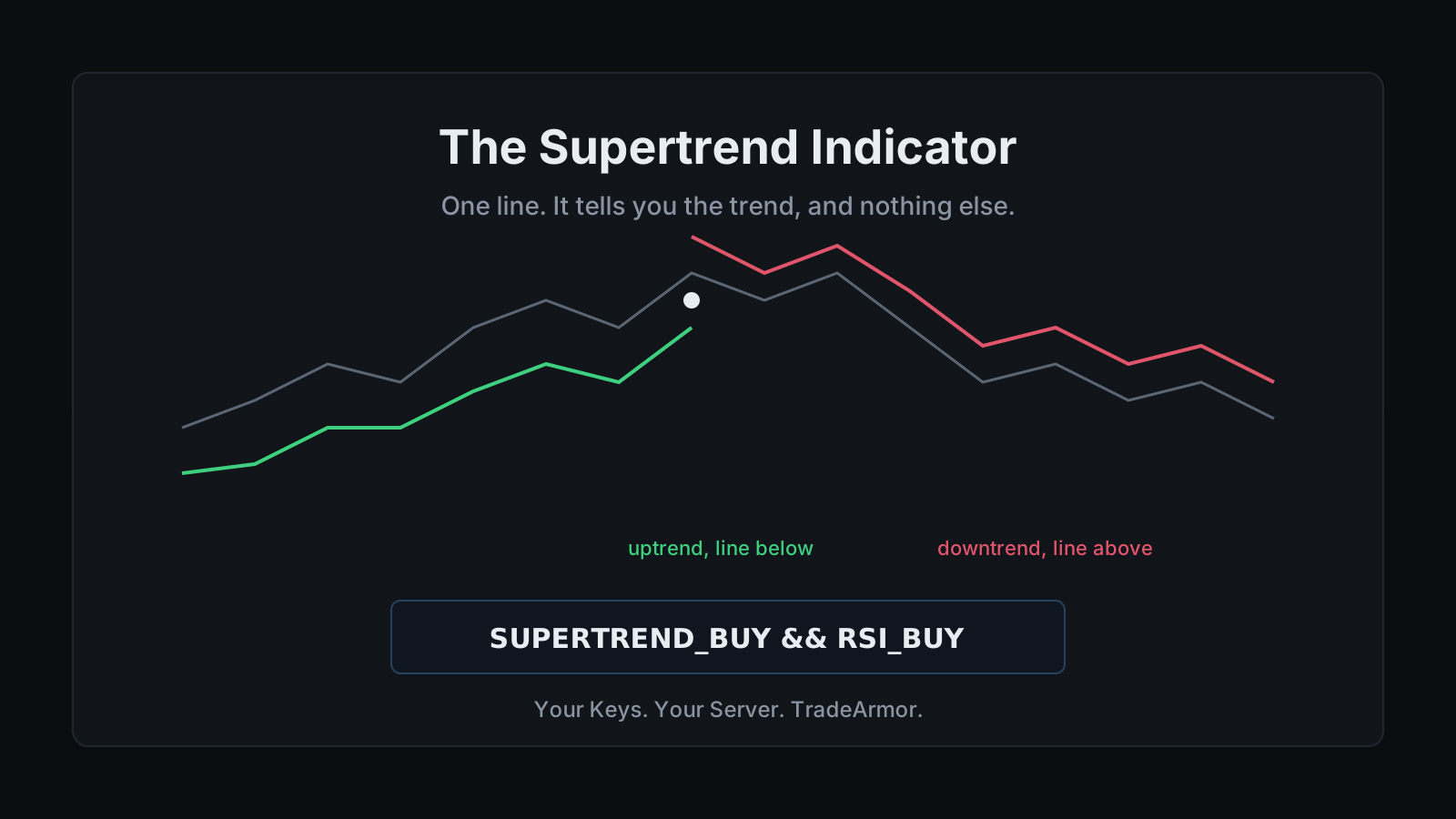
A trend line that flips green and sits under price the whole way up looks like the easiest setup in technical analysis. You backtest the Supertrend indicator on a chart of last year's bull run, watch it catch the whole move, and decide you have found the one. Then you run it live through a flat, choppy three weeks, and it flips you in and out at every wiggle, bleeding fees and patience. The indicator did not lie to you. You just tested it where it works and ran it where it does not.
That gap, between how an indicator looks on a clean chart and how it behaves in a real market, is where most automated strategies quietly die. I build and trade with TradeArmor, a self-hosted crypto trading bot that runs on hardware you own, with built-in BTC/USDC signals carrying a three-year track record, 15 real-time indicators, a plain-English AI strategy builder, and DCA, grid, futures, copy trading, backtesting, paper trading, and tax reporting on one engine. Supertrend is one of those 15 indicators. This is a guide to what it actually measures, where it earns its keep, where it whipsaws, and how to turn it into a rule a bot follows instead of a line you stare at.
I am writing the mechanics rather than a pitch for a reason. Most people who want to automate an indicator are after two things they rarely get together. They don't want to write Python strategies, and they don't trust a black box to trade their money. Supertrend, run correctly, can give you both. But if you do not understand when Supertrend is wrong, no amount of software will save the strategy. The bot is the easy part.
What the Supertrend Indicator Actually Is
Supertrend is a trend-following indicator built by Olivier Seban. It plots a single line that sits either below price or above it, and the side it sits on is the whole signal. When the line is below price and colored bullish, the trend is up. When price closes through it and the line flips above, the trend has turned down.
That is the entire reading. No oscillator to interpret, no divergence to squint at, no overbought zone to second-guess. It is the most legible indicator on the chart, which is exactly why beginners reach for it and why they get burned by it. Legible is not the same as reliable.
The reason the line flips when it does comes down to volatility, and that is the part worth understanding before you let anything trade on it.
How Supertrend Reads Volatility
Supertrend is built on the Average True Range, or ATR, a measure of how much an asset typically moves over a set window. ATR does not care about direction. It only answers one question: how wide is the range right now. A calm market has a low ATR. A market dropping 8 percent a day has a high one.
Supertrend takes that volatility reading and builds a buffer around price. The calculation is straightforward:
Upper band = (high + low) / 2 + (multiplier x ATR)
Lower band = (high + low) / 2 - (multiplier x ATR)
The line you see is whichever band is currently active. Price has to close past the opposite band by the full ATR-scaled buffer before the trend flips. The two knobs are the ATR period, which sets how many candles of volatility you average, and the multiplier, which sets how wide the buffer sits. The standard settings are an ATR period of 10 and a multiplier of 3.
Here is why the buffer matters. By scaling the flip distance to current volatility, Supertrend tries to ignore noise that is normal for the asset and only react to moves big enough to mean something. In a volatile market the bands widen, so it takes a larger move to flip. In a quiet market they tighten. The indicator is, in effect, grading every move against how jumpy the asset has been lately.
Where Supertrend Breaks
Now the honest part. Supertrend is a trend-following tool, and trend-following tools have one congenital weakness: they have no idea what to do in a range.
When price chops sideways without committing to a direction, it pokes through the band, flips the line, drifts back, pokes through the other side, and flips it again. Each flip is a buy or a sell. In a tight range you can collect five or six flips in a week, every one of them a fee and most of them a small loss. Traders call this getting whipsawed, and it is not a bug you can tune away. It is the cost of an indicator that assumes a trend exists and acts on that assumption even when one does not.
The multiplier is the only real defense, and it is a trade-off, not a fix. Widen it and the line sits farther from price, so you get fewer flips and fewer false ones, at the cost of a wider stop and later entries. Tighten it and you react faster, at the cost of more whipsaw. There is no setting that catches trends early and ignores ranges. Anyone selling you one is selling you the chart, not the market behind it.
This is the single most useful thing to internalize about Supertrend. It is a filter for whether you are in a trend, used best alongside something that tells you the trend is real. On its own, it is a coin flip with a confident-looking line.
Best Supertrend Settings for Crypto
Crypto never closes, and the standard 10 and 3 were not chosen with a 24/7 asset on a 15-minute chart in mind. They are a reasonable starting point, not gospel. The right numbers depend on your timeframe and how much noise you are willing to eat for earlier entries.
For faster intraday work, operators often shorten the buffer toward a multiplier of 2 or even 1.5 with an ATR period around 10, accepting more signals and more false ones in exchange for catching moves sooner. For swing setups on higher timeframes, the opposite: an ATR period in the 10 to 20 range with a multiplier closer to 5, which cuts the flip count hard and rides longer trends while sitting through more of each pullback.
Notice that none of those numbers is a recommendation, because the correct setting is a question you answer with data, not opinion. You backtest the Supertrend indicator across a few setting pairs on real historical candles, look at the equity curve and the drawdown rather than the win count alone, then paper trade the survivor on live data before a real dollar is at risk. A setting that looks brilliant on one year of trending price and falls apart on a year of chop has told you exactly what you needed to know. There is a free DCA backtester you can run in the browser right now to get a feel for how setting changes move an equity curve before you commit to anything.
One indicator is not a strategy, and a strategy is not the whole bot. Supertrend, the other 14 indicators, built-in signals, DCA, grid, and futures all run on the same engine. See how the full platform fits together before you bet an account on a single line.
Turning Supertrend Into a Bot Rule
You should not need to write Python to express "buy when Supertrend flips bullish." That is a sentence, and a bot should let you write it almost as plainly. This is where boolean formulas come in, and where the legibility of Supertrend actually pays off.
TradeArmor computes all 15 indicators locally in real time and exposes each one as a buy or sell state you combine with logical operators: && for and, || for or, ! for not, with parentheses for grouping. A Supertrend entry is one line:
SUPERTREND_BUY
SUPERTREND_BUY is true on the candle the line flips bullish. On its own that is the naive version that whipsaws, so you almost never run it alone. You gate it. Require a momentum tool to agree before you act on the trend flip:
SUPERTREND_BUY && RSI_BUY
Now the bot only buys when Supertrend has turned up and RSI confirms momentum is behind the move, which strips out a chunk of the range-bound false flips. If you want the deeper version of pairing a trend read with a momentum read, the RSI and MACD combined strategy covers the same logic in full. The point that carries across all of it is that the rule stays readable. You are looking at the exact condition the bot follows, not a hidden model.
That matters more than it sounds. The most common complaint I hear from traders coming off other tools is some version of "I don't trust a black box" and "I want to see exactly why the bot bought." A boolean formula answers both. The condition is right there in plain operators. When a trade goes wrong, you can read which gate fired and fix the rule, instead of shrugging at a result you cannot explain. And if writing the syntax still is not your idea of a good evening, the plain-English AI strategy builder turns "buy when Supertrend flips up and RSI confirms" into the formula for you. It is bring-your-own-key, so you plug in your own AI provider and pay no markup. The AI writes the rule. You still read it before it trades.
Where Supertrend Fits in the Bigger System
A trend filter decides whether to enter. It says nothing about how much to buy, when to take profit, or what to do when a position moves against you. Those are different jobs, and they are where accounts are actually won or lost.
The cleanest way I run a trend signal is hybrid: let a proven signal feed propose the trade, then use Supertrend as a gate that only lets it through when the trend agrees. Whatever fires the entry, position management decides whether you keep the gains, which is where the DCA engine and its gating logic come in. Entry timing gets all the attention in indicator guides. Sizing and exits quietly decide the result.
One thing no indicator setting can do, no matter how well tuned, is protect your keys. A Supertrend strategy runs the same on any platform. What changes is whether your exchange API key is sitting on a third-party server while it runs. On a self-hosted bot the key stays in a local config on your own machine, carrying trade permission only, never withdrawal. The strategy is yours either way. The custody should be too.
The Honest Summary
The Supertrend indicator is a volatility-scaled trend filter: one legible line that flips with price and tells you whether a trend exists, nothing more. It shines in clean trends and whipsaws in ranges, and the multiplier trades one weakness for the other rather than removing either. Run it as a gate alongside a momentum confirmation, write it as a boolean formula so you can read the exact rule, backtest it before you trust it, and run it inside a system that also handles sizing, exits, and key custody. TradeArmor is the self-hosted platform I built to do all of that on hardware you own, where your keys never leave your machine and one subscription replaces the stack of a chart tool, a signal service, and a SaaS bot. See the plans and get started.
Frequently Asked Questions
What is the Supertrend indicator in simple terms?
Supertrend is a trend-following indicator that plots a single line which sits below price during an uptrend and above price during a downtrend. When price closes through the line, the trend is considered to have flipped. It is built on the Average True Range, so the distance price must travel to flip the line scales with how volatile the asset has been recently. It answers one question, which direction is the trend, and it answers nothing about momentum, value, or how long the trend will last.
What are the best Supertrend settings for crypto?
The standard settings are an ATR period of 10 and a multiplier of 3, which is a reasonable starting point rather than a final answer. Faster intraday traders often shorten the multiplier toward 2 or 1.5 to catch moves sooner, accepting more false signals. Swing traders on higher timeframes often raise the multiplier toward 5 and the ATR period toward 20 to cut whipsaw and ride longer trends. There is no universally correct setting, which is why you decide it with a backtest and paper trading rather than opinion. Past performance does not guarantee future results.
Why does the Supertrend indicator give false signals?
Because it is a trend-following tool, and trend-following tools have no good answer in a sideways market. When price chops without committing to a direction, it repeatedly pokes through the band and flips the line, generating a string of buys and sells that go nowhere and cost fees. This whipsaw is inherent to the indicator, not a tuning error. Widening the multiplier reduces the flip count but widens your stop and delays entries. The standard fix is to pair Supertrend with a momentum filter such as RSI so a trend flip only triggers a trade when momentum confirms it.
How do you use Supertrend as a crypto trading bot rule?
In TradeArmor you combine indicator states with boolean operators. A bare entry is SUPERTREND_BUY, which fires on the candle the line flips bullish, and a gated entry like SUPERTREND_BUY && RSI_BUY only buys when the trend turns up and RSI confirms. The exit side uses SUPERTREND_SELL. Because the rule is written in plain operators, you can audit exactly why the bot bought instead of trusting a hidden model, and you do not have to write Python to express it.
Is Supertrend better than RSI or MACD for crypto?
Neither is better, because they measure different things. Supertrend reads trend direction, RSI reads momentum speed, and MACD reads momentum shifts through moving-average crossovers. They fail in different ways, which is the entire reason to combine them rather than pick one. A trend filter like Supertrend tells you the direction to lean, and a momentum tool times the entry. Signals are algorithmic outputs, not investment advice, so the only honest way to settle which combination works for your market is to backtest it and paper trade it before going live.