Most products that call themselves a crypto DCA bot are a recurring buy with a logo. You set a fixed amount, pick a day of the week, and the thing buys on schedule whether or not buying makes any sense for the position you already hold. That is fine for a five-year accumulation plan you never touch. It turns into a quiet disaster the week the market falls 30 percent, your bot keeps buying at nearly the same price the whole way down, empties its cash near the top of the fall, and has nothing left when the real bottom shows up two weeks later.
The people who get burned here usually started with the right instinct. They have a job that does not leave room to babysit charts, so they wanted something that just runs. They also did not trust a black box and wanted to see exactly why the bot bought. A calendar gives them neither. It buys on a date, not on a reason, and it shows you a fill log instead of a decision.
TradeArmor exists to run the reason, not the calendar, on hardware you own. It is a self-hosted crypto trading bot that bundles built-in BTC/USDC spot signals with a multi-year live track record, 15 real-time indicators, a plain-English AI strategy builder, plus DCA, grid, futures, copy trading, backtesting, paper trading, and tax exports, all on a machine where your API keys never leave your control. This guide is about one slice of that platform, the part most people set up wrong: how a real crypto DCA bot decides when to buy, and why that single decision separates averaging down that builds a position from averaging down that bleeds an account.
What a crypto DCA bot actually does
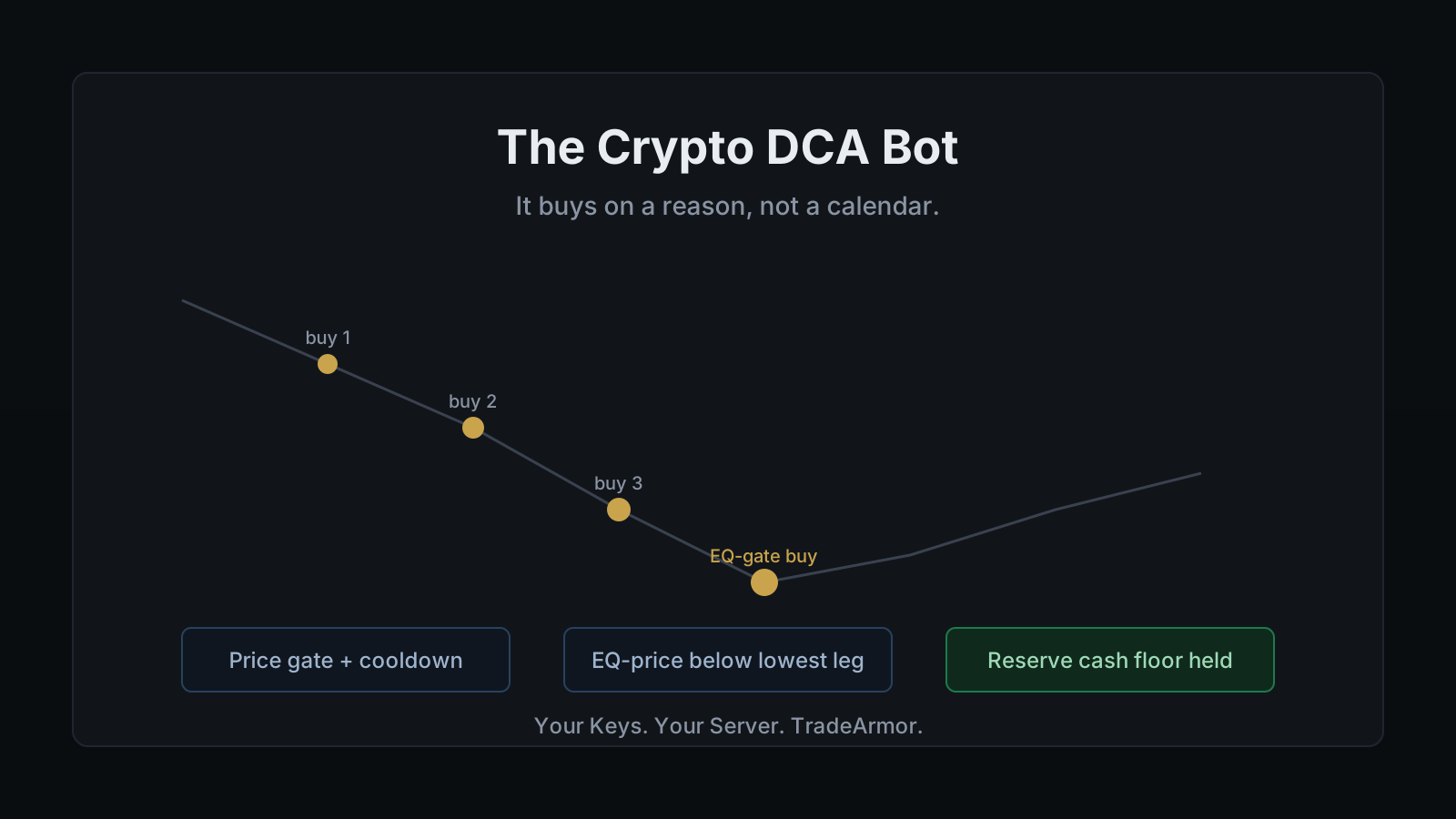
Strip the marketing off and a DCA bot has exactly one job: decide whether the next buy improves your position. A calendar cannot answer that question because a date is not a market condition. A real DCA engine answers it with three gates.
First, price. The next buy should land below your current average, or at least below your lowest unsold buy, so it genuinely pulls your cost basis down instead of stacking more coins at a price you already hold. Second, time. A cooldown between buys stops the bot from firing four levels in a single red candle and exhausting its budget in a ten-minute panic. Third, reserve. A cash floor keeps the bot from going all-in during a drawdown, because the buy you most want to make is usually the one at the bottom you can no longer afford.
Get those three right and DCA does what it is supposed to do. Get them wrong and you have built an automatic way to run out of money at the worst possible moment.
Want to see the dashboard, the signal engine, and the strategy modes a self-hosted setup gives you beyond DCA? See all features.
The averaging-down math, in one example
Here is why the gates matter, in numbers. Say you open a BTC position with $200 at $60,000. Price falls to $54,000, a 10 percent drop. A simple calendar bot might have already bought twice on the way down at $58,000 and $56,000, spending another $400 and leaving your average near $57,000 with a chunk of your budget gone inside a narrow band.
A gated bot waits. It buys at $54,000 only because the price cleared the gate below your lowest unsold leg, and it sizes that buy larger than the first, say $400. Now your average sits closer to $55,500 with more budget intact, and a recovery to $57,000 exits the whole position green on a 5 percent bounce instead of needing price to climb back to $60,000.
That is the entire edge: the same dollars, placed on a falling price by a rule instead of a date, move your break-even down faster and keep dry powder for the level that actually matters. The math is not exotic. It is just arithmetic that a calendar refuses to do. For the full treatment of when this works and when it quietly fails, the complete crypto DCA strategy guide walks the cases.
Simple DCA vs gated DCA: the EQ-price gate
The cleanest way to tell a real DCA bot from a recurring buy is to ask what it does on the deep levels. Most products average down happily for the first few buys and then keep going on the same trigger forever, which is how a position ends up with twelve legs clustered within a few percent of each other.
A gated engine changes the rule as it goes deeper. Past a configurable level, TradeArmor applies an EQ-price gate: the next buy is blocked until the market price is below the price of your lowest unsold leg, in our case below that leg times 0.999. The buy only fires when it provably reduces your average cost. This is the EQPRICE logic that ProfitTrailer users built their whole approach around, and matching it exactly is why a migrated position keeps behaving the way its owner expects.
If you want the mechanism pulled fully apart, with the failure modes of the simple version laid out beside it, that lives in gated DCA versus simple DCA. The short version: the gate is the difference between averaging down and just buying until you cannot.
What to look for in a crypto DCA bot
When you are evaluating any crypto DCA bot, custody and buy logic come before features, and features come before price. The checklist that matters:
Where do your API keys live. This is the first question, not the last. A bot only needs read and trade permission, never withdrawal. If the platform stores that key on its own servers, you are trusting a third party's security with trade access to your account. If it runs on your machine, the key never leaves it.
Does it gate the deep buys. Ask specifically about the price gate on later DCA levels. If the answer is "it buys every X percent," that is simple DCA, and you will want to understand how it avoids stacking near a single price.
Cooldowns and reserve. Confirm there is a per-level cooldown and a keep-balance rule. Without them, a fast crash drains the budget before the bot reaches a level worth buying.
Sell rules, not just buy rules. A DCA bot that cannot take partial profits or trail a take-profit is half a tool. Averaging in is easy. Getting back out on a bounce is the part that books the gain.
Can you see the reasoning. You should be able to open a position and read the exact conditions for the next buy and the next sell, with each one showing whether it has triggered. A fill log tells you what happened. A rules inspector tells you why.
Can you test it first. Backtesting and paper trading let you validate a configuration before risking capital. Any platform that wants you to learn its DCA behavior with live money is asking you to pay tuition.
Comparing crypto DCA bots in 2026
The category splits into three custody models, and the model decides more than any feature checkbox. The figures below are current as of June 2026; vendor pricing changes often, so confirm at the source before you decide.
SaaS platforms (3Commas, Bitsgap, TradeSanta). These give you a polished dashboard and hold your API keys on their servers. 3Commas runs a free tier plus paid plans around $29, $49, and $99 per month, with the number of active DCA bots gated by tier. Bitsgap starts near $29 and climbs to $69 and $149, allotting 10, 50, and 250 DCA bots respectively. TradeSanta sits lower at roughly $25, $45, and $90. All three are capable. All three also keep your keys in a vendor database, and the 2022 3Commas API key leak is the standing reminder of what that exposure costs when it goes wrong.
Exchange bots (Pionex). Pionex bundles free bots into the exchange itself at a flat 0.05 percent trading fee, which is genuinely cheap. The trade-off is custody by design: the same company holds your funds and runs the automation, so there is no separation between your exchange and your bot. Its standard DCA bot is closer to the calendar model, with a separate Martingale bot for averaging down. Convenient, custodial, and a single point of trust for both halves of the job.
Self-hosted (TradeArmor, ProfitTrailer). Here the bot runs on your hardware and the keys never leave it. ProfitTrailer pioneered gated DCA for this audience and then stopped shipping, which is the gap TradeArmor was built to fill. TradeArmor's Starter plan is $19.99 per month with the DCA engine included, the keys stay on your machine, and DCA levels are uncapped with per-level cooldowns, a keep-balance reserve, and the EQ-price gate. The honest cost of self-hosting is that uptime becomes your job. A Raspberry Pi in a drawer handles it.
The pattern across the table: SaaS sells convenience for the price of your keys, exchange bots fold both jobs into one custodian, and self-hosted asks you to run the thing yourself in exchange for never handing trade access to a stranger. We are not neutral on which trade we would make.
How TradeArmor's DCA engine works
The engine is built around the three gates, exposed where you can read them. Each DCA level has its own spacing from the level above, its own size multiplier, and its own cooldown, so you can set the early buys close and small and the deep buys far and large. The keep-balance rule reserves a percentage of total portfolio value, measured as available cash plus open positions at current market value, so the bot never spends the floor.
On the Positions page, every open position expands into a rules inspector with three sections: Next DCA Buy, EQ Sell, and Full Sell. Each condition shows a red or green dot, the rule, and the current value, so you can see at a glance that the next buy is waiting on, say, price below $54,180 and a cooldown with nine minutes left. Nothing about the decision is hidden, which is the answer to the "I don't trust a black box" objection that sends people looking for a new bot in the first place.
DCA is also one mode of three on the same engine. You can run it straight from the built-in signals, gate it behind your own indicators in hybrid mode, or write a custom boolean formula. And because TradeArmor uses trading groups, one instance can run a gated DCA strategy on a spot pair while running something entirely different on another, which is the kind of layering a single-purpose calendar bot cannot touch.
A worked example on BTC/USDC
Put it together on the default pair. You connect an exchange with a read-and-trade API key, withdrawal permission left off, pick Cava-signals mode, and let DCA handle the position management underneath the entries.
The bot opens on a signal. Price drifts down, and the first DCA buys fire at your configured spacing, each one larger than the last, each gated by its cooldown so a single fast candle cannot trigger three at once. Past your deep-level threshold the EQ-price gate engages, and now a buy only lands when it is below your lowest unsold leg, which means every deep buy is genuinely lowering your average rather than padding it. The keep-balance reserve sits untouched in the background as the floor. When price bounces, the sell rules take a partial off the table and trail the take-profit on the rest.
You did not watch any of it. You reviewed it afterward in the rules inspector and the trade log, which is the closest thing to hands-off that honest trading allows. Before you run a configuration with real money, the free DCA backtester lets you test the spacing and reserve against real historical data, and the backtesting guide covers how to read the equity curve and drawdown it hands back. If you are arriving from ProfitTrailer with open positions, the migration walkthrough brings the whole book across with the legs and history intact.
The bottom line
A crypto DCA bot is only as good as the rule behind its next buy. A calendar is not a rule. A real engine gates each buy on price, cooldown, and reserve, lets you read every condition before it fires, and keeps the key that places the trade on hardware you own. TradeArmor packages that engine inside a full self-hosted platform: built-in signals with a multi-year track record, 15 indicators, an AI strategy builder, grid, futures, copy trading, backtesting, paper trading, and tax exports, with your keys never leaving your machine. If that is the version of a DCA bot you want, see the pricing and get started.