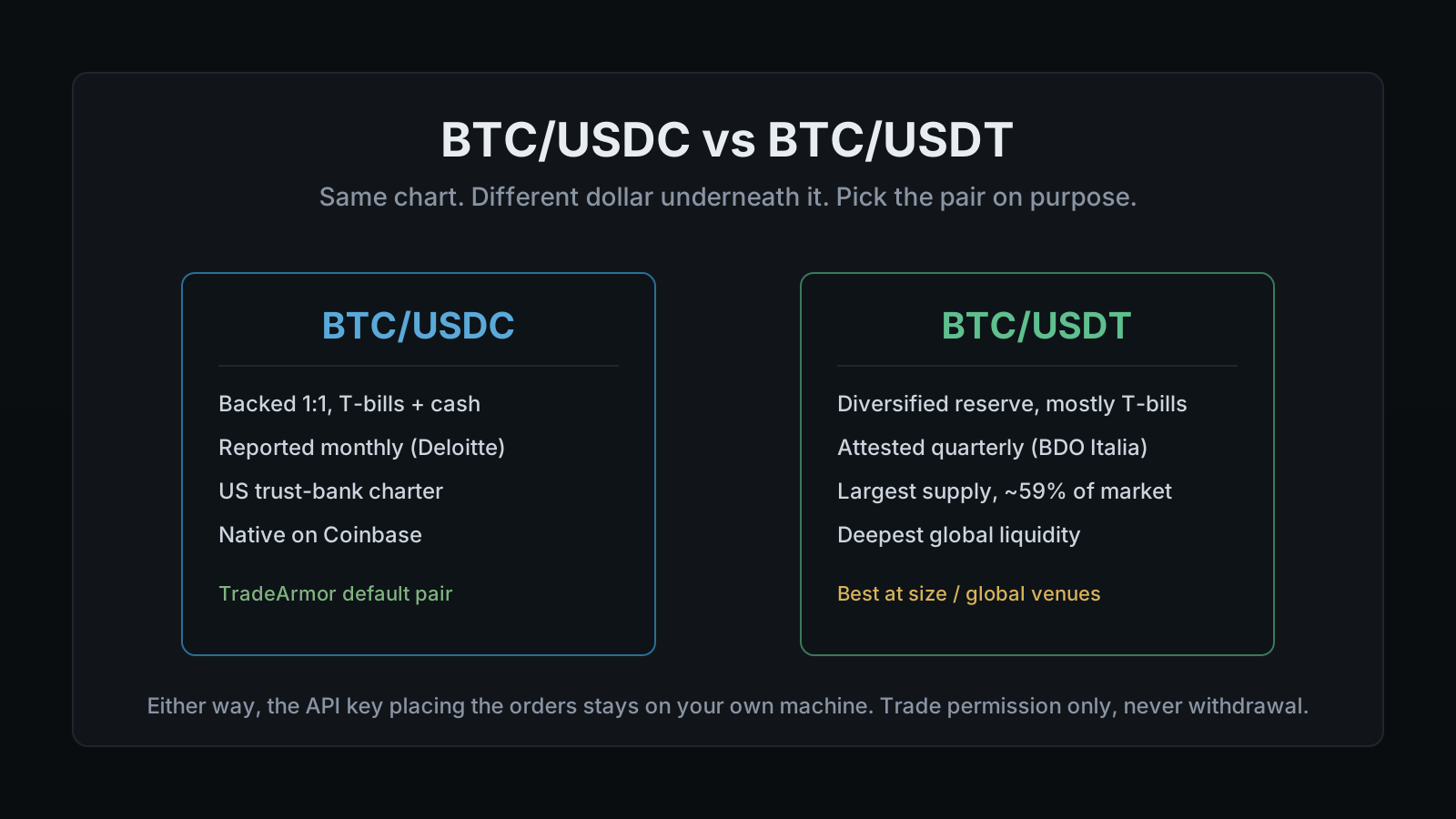
You are setting up a bot, you reach the screen that asks which pair to trade, and you pick BTC/USDT without thinking, because that is the chart you have always watched. BTC/USDC vs BTC/USDT is the most consequential stablecoin decision of your trading year, and most people make it on autopilot, in about two seconds, by habit. The quote currency on the other side of every buy and every sell is not a cosmetic detail. It is the dollar you are actually holding between trades, issued by a company, backed by a reserve you did not pick, and increasingly governed by a law that treats the two leading options very differently.
This is the BTC/USDC vs BTC/USDT decision for a trading bot, taken seriously: what the two stablecoins actually are, how their reserves and reporting differ, why a 2025 US law just turned regulation into a live variable, where the liquidity really sits, and which pair makes sense for an automated strategy. The price action is almost identical. Everything underneath it is not.
TradeArmor is a self-hosted crypto trading bot you run on your own hardware, with built-in BTC/USDC spot signals carrying a three-year track record, 15 real-time indicators, a plain-English AI strategy builder, and DCA, grid, futures, copy trading, backtesting, paper trading, and tax reporting on one engine where your API keys never leave your machine. It defaults to BTC/USDC, and the rest of this guide is the reasoning behind that default, plus the cases where BTC/USDT is the better call.
See how TradeArmor's full platform fits together
BTC/USDC vs BTC/USDT: What You Are Actually Choosing Between
A trading pair has two sides. With BTC/USDT, the dollar side is Tether's USDT, the oldest and largest stablecoin, with a circulating supply around $185 billion and roughly 59 percent of the entire stablecoin market. With BTC/USDC, the dollar side is Circle's USDC, the second largest, with a supply near $75 billion and roughly a quarter of the market. Together the two account for more than 80 percent of all stablecoin value, so for almost every bot operator this is a two-horse race.
The candles look the same because both coins track the dollar closely. What you are choosing is the counterparty. When your bot sells BTC, it is holding the issuer's promise to honor a dollar of redemption. When it buys back in, it is spending that promise. Picking the pair is picking whose balance sheet you trust to sit between your trades, sometimes for minutes, sometimes for weeks. That is a different question from "which chart looks better," and it is the one almost nobody asks at the setup screen.
Reserves and Transparency: The Part Under the Peg
USDC keeps its reserve story simple. Each token is backed one-to-one by short-dated US Treasury bills and cash held at regulated US banks, with the bulk sitting in the Circle Reserve Fund, a government money market fund managed by BlackRock and registered with the SEC. Circle publishes reserve composition monthly, attested by Deloitte. Boring, narrow, and easy to verify, which in a stablecoin reserve is the highest compliment available.
USDT runs a wider book. Tether's reserves are mostly US Treasuries, reported at roughly $135 billion, which is around three quarters of the total, plus reverse repurchase agreements, money market funds, secured loans, gold, and a bitcoin holding north of 96,000 coins. The yield on that pile is real, and so is the complexity. Tether attests quarterly through BDO Italia, an attestation rather than a full audit, on a slower cadence than USDC's monthly reporting. The reserve is larger and more diversified, which cuts both ways: more buffer, and more moving parts to track.
For a bot that parks in the stablecoin between cycles, this is the difference that matters most. A DCA strategy that averages into a long drawdown can leave you sitting in the quote asset for a while, and "a while" is exactly when reserve quality stops being trivia.
Regulation Just Became a Live Variable
For years the USDC vs USDT debate was a transparency argument among enthusiasts. A US law changed that. The GENIUS Act, signed in July 2025, is the first federal framework for payment stablecoins, setting rules for reserves, redemption, and supervision, and restricting issuance to permitted entities like federally chartered banks and OCC-supervised issuers. Its requirements are expected to bite in the first half of 2027 once the final rules are written. You can read Circle's own summary of the law and the bill text on Congress.gov if you want the primary sources.
The practical fallout is uneven. In December 2025 the OCC granted Circle a national trust bank charter, putting USDC on a clear path to being a fully regulated US stablecoin. Tether, by contrast, would need a US banking license or partnership to issue USDT to American users under the new regime, a step it has not completed, even as USDT keeps dominating globally. None of this makes USDT vanish from your screen tomorrow. It does mean that for a US-based operator, the regulatory wind is at USDC's back, and the stablecoin your domestic exchange chooses to support over the next two years may not be a neutral decision. Regulators have a way of making "we will sort it out later" into a deadline.
Liquidity and Exchange Availability
Now the case for the other side. USDT is the deeper market by a wide margin. Its daily trading volume runs in the tens of billions of dollars, roughly ten times USDC's, and BTC/USDT order books are usually thicker across global venues. If you are placing large orders or chasing the tightest possible spread, that depth is a genuine edge.
The catch is that for most retail bots, the edge is theoretical. A modest DCA buy or a grid fill on a major exchange clears against both books without you ever noticing the spread difference. Liquidity becomes decisive at size, or on a thin exchange, not on a $200 spot order. Where the pair really diverges is by venue. On Coinbase, USDC is the native stablecoin, co-founded by Coinbase itself, so a Coinbase trading bot often runs cleanest on BTC/USDC. On Binance US and most global exchanges, BTC/USDT is typically the deepest and most universally listed book.
Both coins have also reminded everyone that "stable" is a goal, not a guarantee. USDC fell to about $0.87 in March 2023 after Circle disclosed roughly $3.3 billion of reserves trapped at the failing Silicon Valley Bank, around 8 percent of its backing, as CNBC reported at the time; it recovered once regulators backstopped the bank. USDT slipped to roughly $0.95 intraday during the Terra collapse in May 2022 and to about $0.97 during the FTX failure that November, recovering both times. Different failure modes, same lesson: the dollar side of your pair carries its own risk, separate from Bitcoin's.
Why TradeArmor Defaults to BTC/USDC
TradeArmor ships with built-in BTC/USDC spot signals that have run live for three years, so the default pair is BTC/USDC for a few concrete reasons. The signal engine was built and tracked against that pair. USDC's monthly reserve reporting and its clearer US regulatory standing fit a self-custody, do-not-surprise-me posture. And on Coinbase, the venue many US users start on, USDC is the native quote asset.
None of that locks you in. The engine trades whatever spot pairs your exchange lists, so running DCA on BTC/USDT is a configuration choice, not a different product. The strategy logic is pair-agnostic: the DCA gating, the indicators, the grid, and the sell rules behave identically whether the quote asset is USDC or USDT. What changes is the issuer on the dollar side and the depth of the book, which are exactly the two things this guide has been about.
The custody posture does not change with the pair either. Whether your bot quotes in USDC or USDT, the exchange API key that places the orders lives in a local config on your own hardware, and the bot needs trade permission only, never withdrawal. A key that cannot move your funds is the only kind worth handing to any bot. A SaaS bot needs that same key sitting on its server to function, which makes the choice of stablecoin almost academic next to the choice of who holds your keys.
How to Actually Choose for Your Bot
Strip away the noise and the decision is short. Trade where your exchange is deepest and your issuer comfort sits highest.
If you are on Coinbase, or you want the regulated, monthly-reported stablecoin and you are based in the US, BTC/USDC is the clean default, and it is what TradeArmor's signals are tuned for. If you are on a global exchange where USDT is the deepest listed book and you want maximum liquidity at size, BTC/USDT is a perfectly reasonable call. If you genuinely cannot decide, run the strategy in paper trading on each pair and watch how the fills behave on your exchange before committing real capital. The market will price the difference for you, eventually, but paper trading lets you see it for free.
The Short Version
The BTC/USDC vs BTC/USDT choice is not about the chart, which is nearly identical, but about the dollar underneath it: USDC is the smaller, regulated, monthly-reported token now on a US trust-bank path, while USDT is the larger, deeper-liquidity, quarterly-attested incumbent that still rules global volume. USDC suits a US, Coinbase-first, transparency-forward operator. USDT suits maximum liquidity on global venues. Both have held their peg through real stress and both have wobbled, so the dollar side carries risk either way.
TradeArmor runs either pair as a configuration inside a self-hosted platform that also gives you built-in signals, 15 indicators, the AI strategy builder, DCA, grid, futures, copy trading, backtesting, paper trading, and tax reporting, all on hardware you control where your keys never leave your machine. Pick the stablecoin that fits your exchange and your risk read, and let the bot run the pair while your keys stay home.