You can be right about the trade and still lose the trade. You buy well, price runs, and then you sell at plus four percent because plus four felt like enough, and you spend the next week watching it go to plus forty without you. Or the mirror image: you hold for the top, ride a clean winner all the way back to your entry, and hand the whole gain back. The entry was fine. The exit is what got you, and a take profit strategy is the part you were missing.
Selling is the half of trading nobody markets to you, because "buy the dip" fits on a hat and "have a pre-planned laddered exit you will not override at plus fifteen percent" does not. But a take profit strategy is the rule that decides when a position turns unrealized green into money in the account, and most traders run without one. They improvise the exit live, under the exact emotional pressure the exit exists to remove.
TradeArmor is a self-hosted crypto trading bot you run on your own hardware, with built-in BTC/USDC spot signals carrying a three-year track record, 15 real-time indicators, a plain-English AI strategy builder, and DCA, grid, futures, copy trading, backtesting, paper trading, and tax reporting on one engine. Take profit is one family of its sell rules. This guide is about that family: the three exit shapes that cover almost every trade, what each one costs you, and how to turn the one you pick into a rule the bot runs so you are not the one clicking sell at the worst possible moment.
See how TradeArmor's full platform fits together
Why Taking Profit Is the Hard Half
Buying is a decision you make when you are calm and curious. Selling a winner is a decision the market forces on you when you are neither. The position is up, greed says hold for more, fear says lock it in now, and both are loud. Whatever you decide in that state is not a strategy, it is a mood.
A rule fixes this by moving the decision earlier, to the moment before the trade opens, when the money is still hypothetical and your judgment still works. "I will scale out a third at plus twenty and trail the rest" is a sentence you can write clearly on a Sunday. It is a sentence you cannot write at plus twenty on a Wednesday, because at plus twenty on a Wednesday you are busy negotiating with yourself. A bot does not negotiate. It has the level you gave it, and it uses the level.
That indifference is the entire value. The point of automating the exit is not that the bot is smarter than you about where the top is. Nobody knows where the top is, and any product that implies otherwise is selling you a feeling. The point is that the bot will actually execute the plan you already agreed was good, at the price you set, while you are asleep or at work or simply too attached to the trade to press the button.
Fixed Take Profit: A Target You Set Once
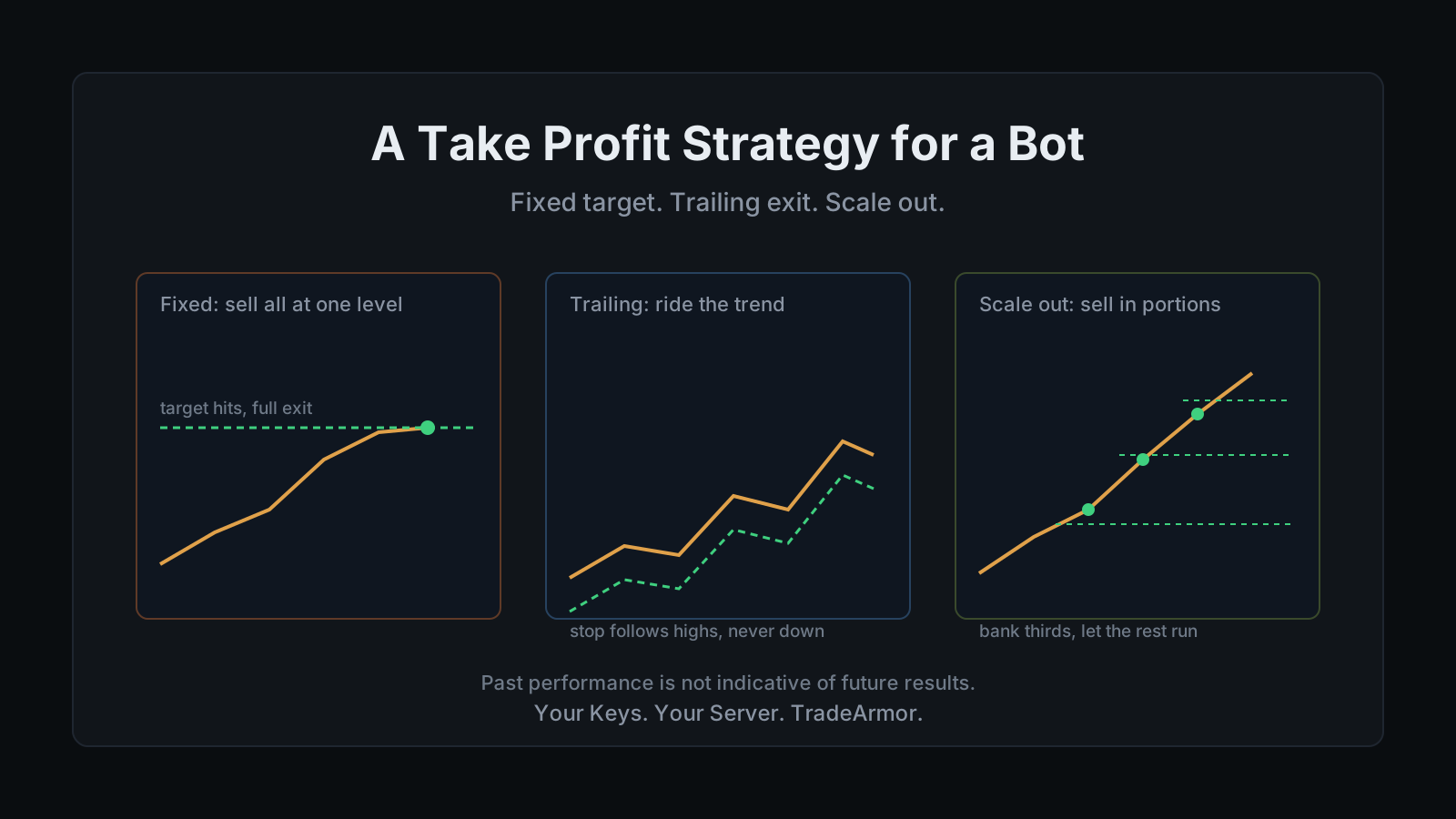
The simplest exit is a fixed take profit. You pick a percentage above your entry, say plus fifteen, and the bot sells the position when price touches it. That is the whole rule. It fires, the trade closes, the gain is realized, and you move on.
The strength of a fixed target is that you know exactly what you are getting. There is no ambiguity, no trailing math, no "should I hold." You defined success as plus fifteen percent when you were thinking clearly, and the bot delivers plus fifteen percent when it arrives. For a range-bound market or a trade you do not expect to trend hard, that certainty is worth more than the upside you might be capping.
The weakness is the mirror of the strength. A fixed target has no idea whether it just sold the bottom of a much larger move. Set it at plus fifteen and price runs to plus eighty, and you banked fifteen while the trend kept the rest. That is not a bug. It is the deal you signed. If capping your upside to guarantee your outcome bothers you more than round-tripping a winner does, the fixed target is the wrong tool, and the next two are for you.
Trailing Take Profit: Let the Winner Run
A trailing take profit is built for the trade you think has legs. Instead of selling at a fixed number, it follows price up. You set a trail distance, a percentage or a fixed interval, and the exit keeps that distance below the highest price the position has reached. Price makes a new high, the trigger ratchets up behind it. Price falls back through the trail, the bot sells.
The trail is a one-way ratchet by design. It rises with new highs and never moves down. Buy at 100, set a 10 percent trail, and your exit starts at 90. Price climbs to 150, the exit ratchets to 135. Price then fades to 135, you are out with the bulk of a fifty percent move captured and only the last leg given back. The trailing exit is how you ride a trend without deciding in advance where it ends, which is useful, because you cannot decide that in advance and neither can anyone charging you a subscription to pretend they can.
The cost is baked in and worth saying plainly: a trailing take profit always sells below the top. The trail distance is the price of admission for staying in the trend. Set it too tight and normal volatility taps you out early, turning a trend-follower into an expensive market sell. Set it too wide and you give back a painful chunk before the exit fires. On TradeArmor this is the trailing take profit sell rule, and it behaves the same whether the trade came from a cava-signal, an indicator formula, or a plain-English strategy built in the AI assistant. If you want to see how an entry condition becomes a managed position in the first place, the how crypto trading bots work guide walks the full path.
Scaling Out: The Laddered Exit
The third shape refuses the all-or-nothing choice entirely. Scaling out sells the position in portions at successive levels instead of dumping it at one price. Sell a third at plus twenty, a third at plus fifty, and let the last third run behind a trailing exit. That is a laddered exit, and for most traders it is the most psychologically survivable of the three.
Here is why it works on the part of you that panics. Banking real profit early, even a slice, quiets the fear that makes people sell the whole position at the first green candle. You already took money off the table, so the remaining piece is house money and you can let it breathe. At the same time you keep exposure to the move you cannot predict, so a monster trend still pays you on the back third. You stop trying to be right about the exact top, which is good, because you were never going to be.
On a bot each rung is just a configured partial-sell level. The ladder executes on its own, in order, whether or not you are at the screen. Partial sells also pair naturally with the DCA engine on the entry side: you average into a position on the way down and scale out of it on the way up, both sides running as rules rather than reactions. The cost of scaling out is the same honest one as before. If price rips straight through every rung to the top, you sold some of it cheaper than you had to. That discount is what you pay for not needing to call the top.
Building a Take Profit Strategy on TradeArmor
On TradeArmor, all three exits are configuration, not separate products to buy. A single position can carry a fixed take profit target, a set of partial-sell rungs, and a trailing take profit at once, so the entire trade is defined end to end before it opens. Where you scale out, how much at each rung, how tight the trail runs on the remainder, all of it lives in the position rules, and all of it shows in the same dashboard view that shows you why the position is still open.
That visibility is the "show me the rules it's following, not just the result" half of what traders actually want. The exit is not a mystery that happens to your account overnight. It is a rules inspector you can read: the next sell level, the trail distance, the current high the ratchet is tracking. Because the platform is self-hosted, that logic runs on your machine, which is the honest tradeoff. You get full control and full custody, and in exchange you run the bot on hardware that stays on. The key needs trade permission to sell a position. It never needs withdrawal permission, and it never sits in a third-party database to do its job.
You can test the whole exit before a cent is at risk. Paper trading runs the identical engine on live prices with a simulated balance, so you can watch where your trail distance actually triggers on real volatility instead of guessing, and the free DCA backtester lets you pressure-test the entry side against historical data first. On the futures side, where leverage sharpens every one of these decisions, the same take profit rules apply alongside a liquidation price, and the crypto futures bot guide covers how exits behave once leverage is in the picture.
Common Mistakes
A short list, because the failure modes repeat.
Do not set a trailing take profit so tight it fires on noise. A trail has to survive normal volatility, or it is just a slow market sell that exits every good trade before lunch.
Do not move your take profit target higher because the trade is working. The number you set when you were calm is worth more than the number greed wants when you are up. Dragging the target is how a banked winner becomes a round trip.
Do not run a software-managed exit on hardware that sleeps. If the machine tracking each new high goes dark, the trailing rule that depends on it goes dark too. Run it on something that stays on, or rest a fixed limit sell on the exchange where the venue supports one. This is the same logic behind a fixed stop loss versus a trailing stop on the downside: where the rule lives decides whether it is working when you need it.
Do not confuse a target with a prediction. A take profit level is a decision about what you will accept, not a forecast of what the market will do. Set it to a number whose outcome you can live with, then leave it alone.
The Short Version
A fixed take profit sells the whole position at a level you set and hands you certainty at the cost of upside. A trailing take profit follows the highs and lets a trend run, banking most of a big move while always selling below the top. Scaling out sells in portions so you take real profit early and still ride the part you cannot predict. Most good exits combine them, and the point of putting them on a bot is not to outguess the top but to execute the plan you already agreed was sound, at the price you chose, without your Wednesday self overriding your Sunday self.
TradeArmor runs all three as sell rules inside a self-hosted platform that also gives you built-in signals, 15 indicators, the AI strategy builder, DCA, grid, futures, copy trading, backtesting, paper trading, and tax reporting, all on hardware you control where your keys never leave your machine. If you want a take profit strategy that fires on a rule instead of a feeling, that is the setup.