Sideways markets are where most trading strategies quietly go to die. Price spends weeks bouncing between the same two levels, the trend traders get chopped up buying breakouts that fail, and the buy-and-hold crowd watches a flat candle chart and wonders why they are still here. The honest reaction to a range-bound market is boredom. Crypto grid trading explained in one line is the profitable reaction instead: stop trying to predict the breakout and start harvesting the chop. That is the entire idea behind a grid bot, and it is the one strategy that treats a boring sideways market as the opportunity rather than the punishment.
This is crypto grid trading explained from the mechanics up: what a grid bot is actually doing when it places all those orders, why it wants a range and not a trend, how the range, step size, and order count decide whether it works, and the part the breathless guides skip, which is what happens when the range breaks. If you have ever thought "I want something that just runs" but also "I don't trust a black box," a grid is a good place to start, because the rules are simple enough to hold in your head and watch on the dashboard.
TradeArmor is a self-hosted crypto trading bot you run on your own hardware, with built-in BTC/USDC spot signals carrying a three-year track record, 15 real-time indicators, a plain-English AI strategy builder, and DCA, grid, futures, copy trading, backtesting, paper trading, and tax reporting on one engine where your API keys never leave your machine. The grid bot is one mode inside that platform. This guide is about that mode: how it works, how to set it, and when to turn it off.
Crypto Grid Trading Explained: What a Grid Bot Is Actually Doing
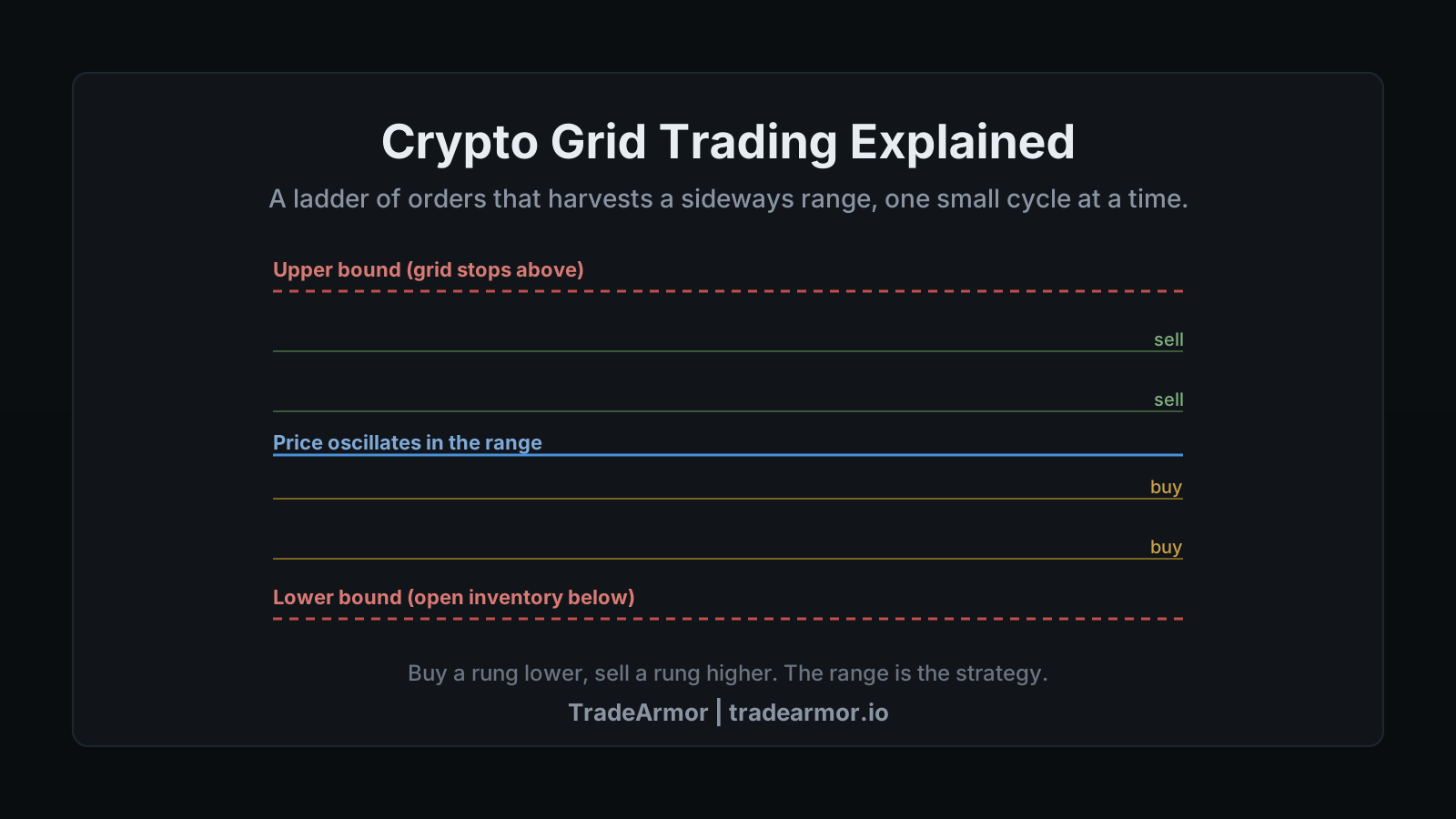
A grid bot divides a price range into evenly spaced levels and stations an order at each one. Below the current price it places buy orders. Above it, sell orders. The grid is just that ladder of resting orders, waiting.
When price drops to a buy level, the bot buys. The moment that buy fills, the bot places a sell order one level up. When price rises to that sell level, the bot sells the same amount for a small profit, then re-arms the buy order back at the lower level. Each completed loop, buy low and sell a notch higher, banks a small realized gain, and the bot immediately resets to do it again. Price oscillating inside the range is the bot completing cycle after cycle, each one small, each one real.
A concrete version makes it click. Say BTC is ranging between $50,000 and $55,000 and you set a grid of 10 lines. Each level sits roughly $500 apart. Price dips to $51,000, the bot buys; price ticks back to $51,500, the bot sells that lot and pockets the spread minus fees; price dips again, it buys again. You are not calling the top or the bottom. You drew a box and the bot works the inside of it, over and over, while you do something else. The grid does not have an opinion about where Bitcoin is going. It has a ladder, and it climbs up and down the rungs taking a small toll each time.
See how TradeArmor's full platform fits together
Why Range-Bound Markets Are the Whole Point
The grid's edge and the grid's weakness are the same fact: it profits from movement inside a range, not from direction. That makes a sideways, choppy market the ideal habitat. While a directional trader watches Bitcoin slap the same two levels for a fortnight and slowly loses patience, a grid bot is filling dozens of small cycles inside that exact channel, turning the chop everyone else hates into realized gains.
Volatility helps, as long as it stays inside the box. A range that is dead flat gives the grid nothing to do, because price never travels far enough to cross levels. A range that swings hard between its floor and ceiling crosses levels constantly, and every crossing is a fill. The counterintuitive bit is that a grid wants a nervous, jumpy market, just one that keeps coming back. It is the rare strategy that is happiest when the chart looks like it is going nowhere in particular, loudly.
What a grid does not want is a clean trend. A strong move in either direction is the one thing the ladder cannot harvest, and understanding why is the difference between running a grid on purpose and running one into a wall. That is the next section, because it is the part that actually costs people money.
When a Grid Breaks
Here is the honest accounting that the "profit in any market" headlines leave out. A grid works beautifully until price leaves the range, and then it does one of two things, neither of them good.
If price breaks out above the top of your range and keeps climbing, the grid has done its job all the way up, which means it has sold its entire inventory into the rally. Now it is sitting in cash, watching the asset run away above the highest sell line, booking nothing. Your realized profit is whatever the grid banked on the way up, and your opportunity cost is the entire rest of the move. A grid will reliably underperform simple buy-and-hold in a bull breakout. It was never built to ride a trend, and pretending otherwise is how range strategies disappoint people.
If price breaks down below the bottom of your range, the other failure mode shows up. On the way down, the grid bought at every level, exactly as designed, so now it is holding a stack of inventory purchased above the current price, with the unrealized loss sitting open below the lowest grid line. The bot is not broken. It did precisely what you told it to do, which was buy the dips inside a range you drew, and price simply went lower than the range allowed for. The position is real, the loss is open, and it stays open until price climbs back into the box or you decide to take it.
Both failures trace to one decision: the range. A grid is only as good as the boundaries you give it, which is why range selection is not a setting you skim past. It is the strategy.
Setting the Grid: Range, Step Size, and Order Count
Three parameters define a grid, and they trade off against each other.
The range is the upper and lower bound, the box itself. Anchor it to where the asset has actually been trading, not where you would like it to trade. A recent support floor and resistance ceiling that the chart clearly respects make honest boundaries. Set the box too wide and the grid is sluggish, with levels so far apart that price rarely crosses one. Set it too narrow and price escapes the moment the market does anything interesting. The goal is a range price keeps returning to.
The step size, or the number of grid lines inside the range, controls the resolution. More lines means tighter spacing, smaller profit per cycle, and more frequent fills, which suits a calmer pair. Fewer lines means wider spacing, larger profit per cycle, and fewer fills, which suits a pair that swings hard. There is no magic count. There is the count that matches how far this specific asset tends to move between reversals.
The order count and size decide how much capital sits at each rung, and this is where the breakdown risk gets managed in advance. Size each order so that the worst realistic case, price falling out the bottom and leaving you holding everything the grid bought on the way down, leaves you with an inventory you can actually sit with. If a full range-exit would put on a position that scares you, the orders are too big, full stop. A grid that you have to panic-close the first time the range fails was never sized correctly.
The way to find these numbers without paying tuition to the live market is to test them. Run the settings through backtesting on historical data first, so the equity curve and the worst drawdown are things you watched happen on a chart rather than things you are discovering with real money on a bad afternoon.
Grid vs DCA: Different Jobs, Not Rivals
People treat grid and DCA bots as competitors. They are closer to different tools in the same box, and the cleaner question is which job you are doing.
A grid harvests a range. It wants chop with no net direction, and it profits from the oscillation itself. A DCA bot, the dollar-cost-averaging kind, is built for a different shape entirely: it accumulates into a downtrend by adding at lower and lower prices to pull the average entry down, then exits the whole position once price recovers past that average. One works the sideways channel. The other averages into a dip and waits for the bounce. A grid wants the market to stay home; a DCA strategy is fine with it going lower for a while, as long as it comes back.
The reason this matters is that you do not have to choose globally. The mature setup runs both at once on different assets, a DCA engine on the coins you want to accumulate and a grid on the ones that keep chopping in a channel. TradeArmor's Trading Groups feature exists precisely for this: each coin group runs its own independent strategy, DCA settings, indicators, and sell rules, on the same instance. You can have BTC on signals, a stable-ish range pair on a grid, and an accumulation target on DCA, all on one dashboard, without three subscriptions and three places your keys could leak from.
Running a Grid Bot on TradeArmor
In practice, a grid on TradeArmor is a configuration, not a separate product to learn. You pick the pair, set the upper and lower bounds, choose the number of grid lines and the size per order, and the engine maintains the ladder from there, placing the paired sell on every filled buy and re-arming as cycles complete. It runs as its own mode, so it can operate on one coin group while DCA or signals run on others through Trading Groups.
The grid bot is part of TradeArmor's Enterprise tier, alongside futures and the multi-machine and Docker-plus-VPN setups, so it sits in the same plan as the rest of the heavier execution tooling. Wherever it runs, the custody posture does not change. Your exchange API key stays in a local config on your own hardware, and the grid needs trade permission only, never withdrawal. The bot places and cancels orders inside the range. It has no reason to touch your funds, and a bot that never needs withdrawal permission is the only kind worth handing an account to. A SaaS grid bot, by contrast, needs that same key sitting on its server to function, which quietly makes the vendor's security your problem.
Before any of it goes live, paper trading runs the identical grid engine on live prices with no capital at risk, which is the sane way to watch how your chosen range and step behave through a real session before committing to them. The market charges for the lesson either way. Paper trading lets you audit the answer for free.
The Short Version
Crypto grid trading is the strategy for the market everyone else finds boring. A grid bot lays a ladder of buy and sell orders across a range and harvests the back-and-forth, banking a small realized gain on every completed cycle, and it does that best when price is volatile but going nowhere. The catch is symmetrical and worth respecting: a grid gives back the trend when price breaks out above the range, and holds open inventory when price breaks down below it. The skill is not in running the bot. It is in choosing the range and sizing the orders so the worst case is one you can sit through.
TradeArmor runs that grid engine as one mode inside a self-hosted platform that also gives you built-in signals, 15 indicators, the AI strategy builder, DCA, futures, copy trading, backtesting, paper trading, and tax reporting, all on hardware you control where your keys never leave your machine. If you want to put a sideways market to work without handing your keys to a server you do not own, that is the setup.