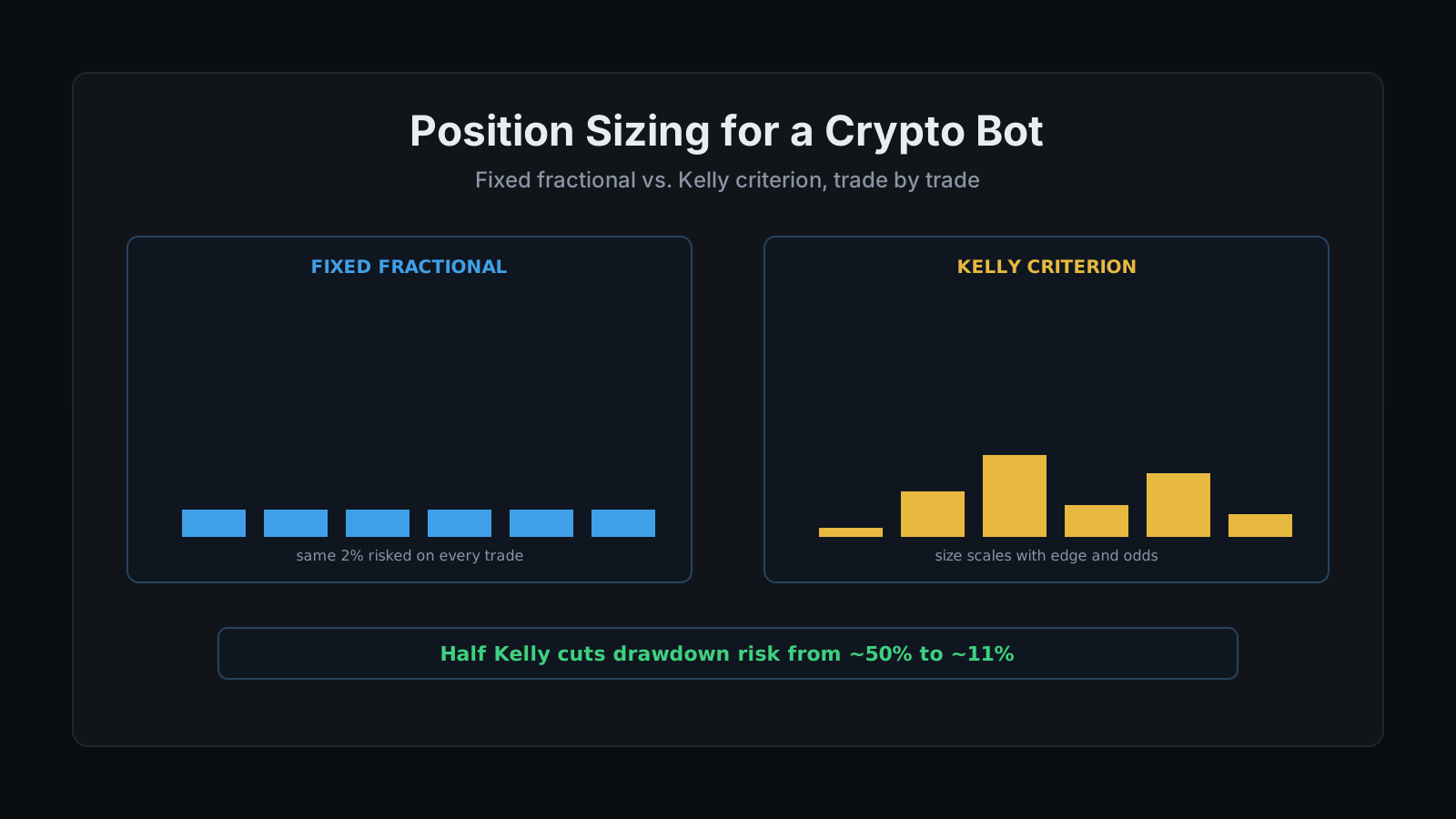
Why does a flat two percent risk rule feel disciplined and still wreck an account during a rough month? Because a fixed percentage treats every trade as equally likely to work, and most of them are not. Position sizing for a crypto bot is the setting that decides how much a strategy is allowed to bet on its own confidence, and getting it wrong quietly outweighs almost every other line in the dashboard.
Ask most traders how they size a position and you get a shrug: a round number, some multiple of the last trade, whatever felt right after a long night of forum arguments. That is not sizing, it is a guess with a percent sign attached to it. Traders who want leverage but want the stop behind it to actually hold, and who do not trust a black box spitting out a lot size with no math behind it, are really choosing between two disciplines: fixed fractional or the Kelly criterion. Both answer the same question, how much of the account should this one trade risk, and they answer it in very different ways.
I have been trading on TradeArmor for three years now, self-hosted end to end on hardware I control. Fifteen real-time indicators, a plain-English AI strategy builder, and DCA, grid, futures, copy trading, backtesting, paper trading, and tax exports all run on that same engine, off the same signal history this whole guide leans on. Every strategy mode on that list still needs an answer to the sizing question this guide is about, because a great signal paired with a reckless size is just a slower way to lose the account. See how the DCA engine's size multipliers work before you decide which sizing discipline fits your strategy.
Fixed Fractional Sizing: The Boring Rule That Works
Fixed fractional sizing risks the same percentage of account equity on every trade, no matter how good the setup looks. The formula is short: position size equals account size times risk percent, divided by the distance between entry and stop.
Take a ten-thousand-dollar account risking two percent per trade, entering BTC/USDC at $65,000 with a stop at $63,000, the kind of level our ATR-based stop placement guide walks through in more depth. That is $200 of risk divided by a $2,000 stop distance, which sizes the trade at 0.1 BTC, worth $6,500 at entry. Lose, and the account is down exactly $200. Win at a 2:1 reward, and it is up $400. Do that consistently and the math is unglamorous but survivable, because the position shrinks automatically as the account shrinks and grows as it grows.
The math is not exciting. Neither is a portfolio that is still solvent in March.
Fixed fractional's real strength is that it ignores how confident you feel. A setup you are sure about and a setup you are only half sure about get the same size, which sounds like a flaw until you remember that most traders are wrong about their own confidence more often than they think.
The Kelly Criterion: Sizing to Your Actual Edge
The Kelly criterion asks a sharper question: not how do I cap risk, but what fraction of the account maximizes long-run growth given a real, measured edge. The trading form of the formula is f equals the win-loss ratio plus one, times the win rate, minus one, all divided by the win-loss ratio.
Run the numbers on a strategy with a 55 percent win rate and an average win 1.5 times the average loss. That works out to (2.5 times 0.55 minus 1) divided by 1.5, which is 0.25, or 25 percent of account equity per trade. Compare that to a flat two percent fixed fractional rule and the difference is not subtle. Kelly does not treat every trade the same. It scales the bet to exactly how much edge the numbers say you have.
That is also where it gets dangerous.
Why Full Kelly Is a Bad Idea for a Live Crypto Bot
Kelly's math is only as good as the win rate and payoff ratio fed into it, and both numbers are estimates pulled from a limited trade history. Overestimate either one, even slightly, and the formula recommends a size that is too large. Betting roughly twice the correct Kelly fraction on a genuine edge produces a long-run expected growth rate of zero. Push past that and the growth rate turns negative. Every individual bet in that scenario still carries positive expected value. The bankroll does not care. That gap between "profitable on paper" and "losing money over time" is what risk of ruin actually looks like in practice.
Crypto makes the estimation problem worse, not better. Win rates measured over a few dozen trades in one volatility regime rarely hold up once BTC/USDC rotates from chop into a trend or a sharp drawdown, which is the same overfitting trap our walk-forward testing piece covers from the backtesting side. A full-Kelly bettor faces roughly a 50 percent chance of losing half the bankroll before doubling it. Cut to half Kelly and that chance drops to about 11 percent, for a modest sacrifice in growth. Almost nobody running real capital uses full Kelly. The standard move is half Kelly, or quarter Kelly, treated as a ceiling rather than a target.
Add leverage to a Kelly-sized position and the stakes climb again. Trading crypto futures and leveraged products carries the risk of rapid and total loss of capital, including losses beyond your initial deposit on some exchanges, and liquidations can happen with little or no warning. TradeArmor's futures mode supports leverage up to 20x with stop-loss and trailing take-profit rules, but the platform does not decide your leverage or your position fraction for you. If you do not understand how liquidation and position sizing interact on your exchange, that is not the place to test a full-Kelly bet.
Where This Actually Runs Inside TradeArmor
TradeArmor does not ship a single toggle that runs the Kelly formula and outputs a lot size. I would rather say that plainly than let a feature list imply otherwise. If you are still fuzzy on how the execution engine decides when a trade fires in the first place, how crypto trading bots work is the place to start before layering a sizing discipline on top. What TradeArmor does give you are the levers that make either discipline real instead of theoretical. The DCA engine takes configurable size multipliers per DCA level, so a fixed fractional rule, or a fraction of a Kelly-derived percentage, becomes the actual number typed into that setting rather than a note in a spreadsheet. Keep Balance reserves a percentage of total portfolio value as untouchable cash, which is fixed fractional discipline applied at the account level: the bot cannot go all-in during a drawdown even if every individual trade rule would allow it.
Turning a real, honest win rate into a Kelly fraction takes real, honest data, and that is where the backtester and paper trading earn their keep. Run a strategy through the backtester across enough history to get a win rate and win/loss ratio that means something, not the ten trades from a lucky week. Then paper trade it forward on live data with no capital at risk before trusting the number enough to size a live position around it. Skipping that step and guessing at a win rate is how a Kelly calculation turns into a very precise-looking way to overbet.
Position Sizing for a Crypto Bot: A Practical Routine
Start by backtesting the strategy across a real stretch of history, long enough to produce a win rate and win/loss ratio you would trust in front of your own money. Compute the Kelly fraction from those numbers by hand. Cut it to half or a quarter before you use it for anything. Compare that ceiling against a plain fixed fractional rule, one or two percent, and run whichever number is smaller through the DCA size multipliers and Keep Balance settings, not a mental note you will forget under pressure. Re-run the whole check periodically, the same way a walk-forward pass gets re-run, because an edge measured six months ago is not automatically the edge you are trading today.
Position sizing for a crypto bot is not the part of the system that decides whether you are right about a trade. It is the part that decides how much being wrong is allowed to cost, and how much being right is allowed to compound. TradeArmor runs the DCA engine, the backtester, and paper trading on hardware you own, so the sizing discipline you choose is backed by real numbers instead of a guess with a percent sign on it. See the plans and get started.