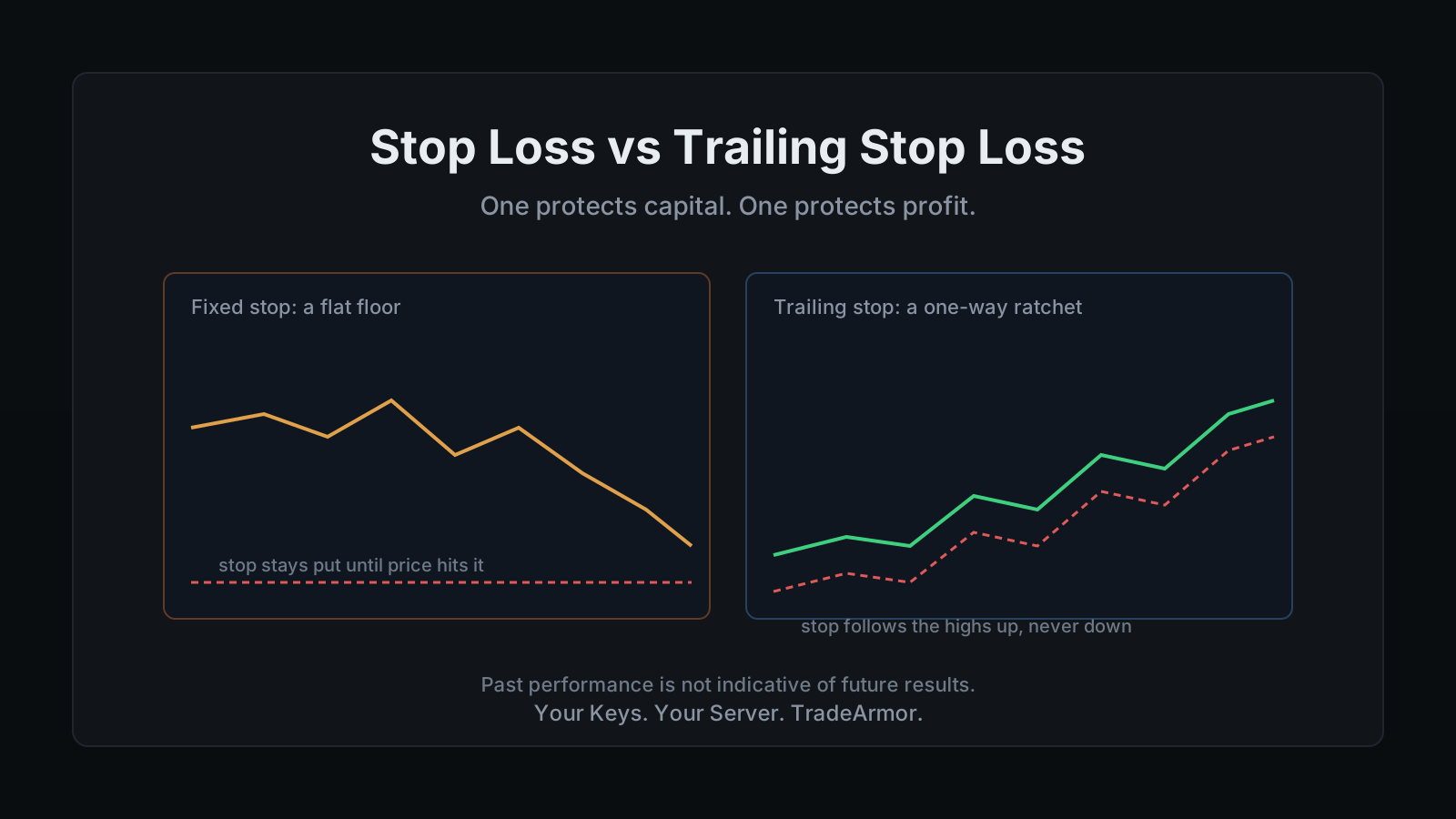
The hardest order to place is not the buy. It is the sell. Every trader who has ridden a winner all the way up and then all the way back down knows the specific ache of watching realized profit turn back into a chart. The usual fix is a stop, and this is where it gets confusing: a fixed stop loss and a crypto trailing stop loss share the word and do almost opposite jobs. One caps what a bad trade can cost you. The other protects what a good trade has already made. Selling is where discipline goes to die, and picking the wrong one of these two is how it dies quietly.
What most people actually want out of a sell rule is two things that sound contradictory. "Set and forget, but actually see what it's doing." And "show me the rules it's following, not just the result." A fixed stop loss and a crypto trailing stop loss are the two rules that deliver on exactly that, once you understand which one is protecting your capital and which one is protecting your profit. Confuse them, or set them wrong, and you get the worst of both: a stop that yanks you out of good trades and rides the bad ones down.
TradeArmor is a self-hosted crypto trading bot you run on your own hardware, with built-in BTC/USDC spot signals carrying a three-year track record, 15 real-time indicators, a plain-English AI strategy builder, and DCA, grid, futures, copy trading, backtesting, paper trading, and tax reporting on one engine. Stop-loss and trailing take-profit are two of the sell rules inside it. This guide is about those two: what each one actually does, the fill you get when it fires, where it should live so it keeps working, and how to decide which one belongs on a given trade.
What a Fixed Stop Loss Protects
A fixed stop loss is a resting order that says "if price falls to this level, close me." You set it once, below your entry, and it does not move. If the trade works, the stop never fires and you forget it was there. If the trade fails, it caps the damage at a number you chose while you were calm instead of a number the market chooses while you are not.
That is the whole point of a fixed stop: it converts an open-ended loss into a bounded one. On spot, nothing forces you to sell a position that is underwater, so without a stop the "plan" is often just hope with a chart attached. The stop replaces the hope with a rule. It answers, in advance, the one question traders are worst at answering live: how much is this idea allowed to cost me before I admit it was wrong.
The discipline lives in not touching it. The classic way to turn a 2 percent planned loss into a 10 percent real one is to drag the stop lower "just this once" because the setup still looks fine. A bot does not have a feeling about whether the setup still looks fine. It has the level you gave it, and it uses the level. That indifference is the feature.
What a Crypto Trailing Stop Loss Does Differently
A crypto trailing stop loss is not trying to protect your capital. It is trying to protect a gain you already have. Instead of resting at one price, it keeps a set distance behind the highest price the position has reached, and it moves that stop up every time a new high prints. It never moves down.
The mechanics are easier to see with numbers. Buy Bitcoin at 40,000 and set a 5 percent trailing stop loss. The stop starts at 38,000. Bitcoin runs to 42,000 and the stop ratchets up to 39,900, still 5 percent below the new high. Bitcoin runs to 45,000 and the stop follows to 42,750. Now price rolls over. The stop does not follow it down. It holds at 42,750 and closes the position when price touches it, banking most of the move instead of round-tripping it back to your entry.
That one-way ratchet is the entire idea. A fixed stop asks "how much can I lose." A trailing stop asks "how much of this win am I willing to give back before I take it." The trail distance is the answer to the second question, and it is where people get it wrong. Set the trail too tight, at 1 percent on a coin that moves 5 percent before breakfast, and you have not built a profit-protection rule. You have built an expensive way to sell at every dip. Set it too wide and you hand back more of the trend than you needed to. The right distance is wide enough that normal volatility does not knock you out of a good trade, and narrow enough that it actually locks the gain when the move is genuinely done.
On TradeArmor this behavior is the trailing take-profit sell rule, and it works the same way whether the underlying trade came from a signal, an indicator formula, or a plain-English strategy. If you want to see how an entry condition becomes a managed position in the first place, the how crypto trading bots work guide walks the full path.
See how TradeArmor's full platform fits together
Stop-Market or Stop-Limit: The Fill You Actually Get
A detail that decides whether your stop saves you or embarrasses you: what kind of order it becomes when it triggers. Both a fixed stop and a trailing stop rest as a trigger. When price hits the trigger, the order has to turn into something that actually executes, and there are two choices.
A stop-market order converts to a market order and takes the next available price. It prioritizes getting out over getting a good price, which means in a fast drop it can fill below your stop level. That gap is slippage, and it is the cost of certainty. A stop-limit order converts to a limit order at a price you set, so it will never fill worse than your limit. The catch is that if price gaps straight through your limit, the order sits there unfilled while the position keeps bleeding, which defeats the reason you set a stop at all.
For a stop loss, whose job is to remove you from a trade that already went wrong, most operators accept the slippage and use stop-market. Getting out at a slightly worse price beats not getting out. Stop-limit has its place on the entry side, where price precision matters more than speed, but a protective stop that might not fire is not much of a protective stop.
Where the Stop Lives: Exchange-Side vs Bot-Side
Here is the part the setup guides tend to skip, and it matters more for a trailing stop than a fixed one. A trailing stop has to watch every tick to track new highs and move the stop up. Something has to do that watching, and there are two options.
An exchange-native trailing stop runs on the exchange's own servers. It keeps trailing whether your machine is on or off, so a power cut or a dropped connection does not disarm it. A software trailing stop, the kind a bot manages, needs the software running and connected to see each new high and fire the exit. That is not a defect. It is a reason to run your bot somewhere that stays on.
This is where self-hosting stops being an ideological preference and starts being an operational one. A stop that lives on your laptop is only as reliable as your laptop, which is a sentence worth reading twice before you close the lid. Run the same bot on an always-on Mac mini or a Raspberry Pi and the software stop has the same uptime an exchange server would give it, except your exchange API key never leaves your hardware to get it. The key needs trade permission to close a position. It never needs withdrawal permission, and it never needs to sit in a third-party database to do its job.
When to Use Each
The choice is not either-or across your whole account. It is a decision per trade, and usually per phase of the same trade.
Use a fixed stop loss when the position is young and unproven. Right after entry, you have no gain to protect, only capital to defend, so the fixed stop below your entry is the correct tool. It caps the cost of being wrong and asks nothing of you.
Switch to, or add, a trailing stop once the trade is genuinely in profit. Now there is something worth protecting, and the crypto trailing stop loss is the tool that lets a winner keep running while guaranteeing you will not give the whole move back. Many operators run both in sequence: a fixed stop that gets replaced by a trailing stop once the position clears a threshold of unrealized profit. On the futures side, where leverage compresses the margin for error, the same logic applies with more urgency, and the crypto futures bot guide covers how stops and trailing take-profit behave once a liquidation price is also in the picture.
One rule that survives every market: the stop distance should come from the chart and your strategy, not from the size you wish you were trading. Size to the stop. Do not stop to the size.
How TradeArmor Runs Stops and Trailing Take-Profit
On TradeArmor, both exits are configuration, not a separate product to learn. A position can carry a stop-loss floor and a trailing take-profit at the same time, so a single trade is defined end to end before it opens: a bounded maximum loss on one side, a trend-following exit on the other. The rules apply the same way whether the entry came from a cava-signal, a custom indicator formula, or the AI strategy builder, because they all run on the same position management engine.
Because it is self-hosted, the trailing logic runs on your machine, which is the honest tradeoff spelled out above: you get full control and full custody, and in exchange you run it on hardware that stays on. The DCA engine and the sell rules share the same dashboard, so the same view that shows you why a position is still open shows you exactly where its stop and its trail currently sit. That is the "show me the rules it's following" half of what traders ask for, delivered as a rules inspector rather than a mystery.
You can test all of it before a cent is at risk. Paper trading runs the identical engine on live prices with a simulated balance, so you can watch where your trail distance actually triggers on real volatility, and the free DCA backtester lets you pressure-test the entry side against historical data first.
What Not To Do
A short list, because the failure modes are boringly consistent.
Do not set a trailing stop so tight it fires on noise. The exchange is happy to place a stop at any distance, including the one that sells you out of every good trade by lunch. A trail has to survive normal volatility or it is just a slow market sell.
Do not use a trailing stop as your capital protection right after entry. Before the trade is in profit, a trailing stop is just a fixed stop with extra steps. The fixed stop is the right tool while the position is young.
Do not run a software-managed stop on hardware that sleeps. If the machine watching the price goes dark, the stop that depends on it goes dark too. Run it on something that stays on, or use an exchange-native stop where the venue supports one.
Do not drag a stop to make room for a trade that is failing. The number you set when you were calm is worth more than the number you want when you are down. Moving it is how a small planned loss becomes a large unplanned one.
The Short Version
A fixed stop loss protects your capital and never moves. A crypto trailing stop loss protects your profit and moves in one direction only, ratcheting up behind new highs and closing when price finally retraces past your trail. Which becomes a stop-market or a stop-limit decides the fill you get, and where the stop lives decides whether it is still working when you need it. None of it is exotic. It is the unglamorous mechanical discipline that separates traders who keep their gains from traders who visit them.
TradeArmor runs both exits as sell rules inside a self-hosted platform that also gives you built-in signals, 15 indicators, the AI strategy builder, DCA, grid, futures, copy trading, backtesting, paper trading, and tax reporting, all on hardware you control where your keys never leave your machine. If you want stops that actually fire and a trail that banks a trend without you babysitting it, that is the setup.