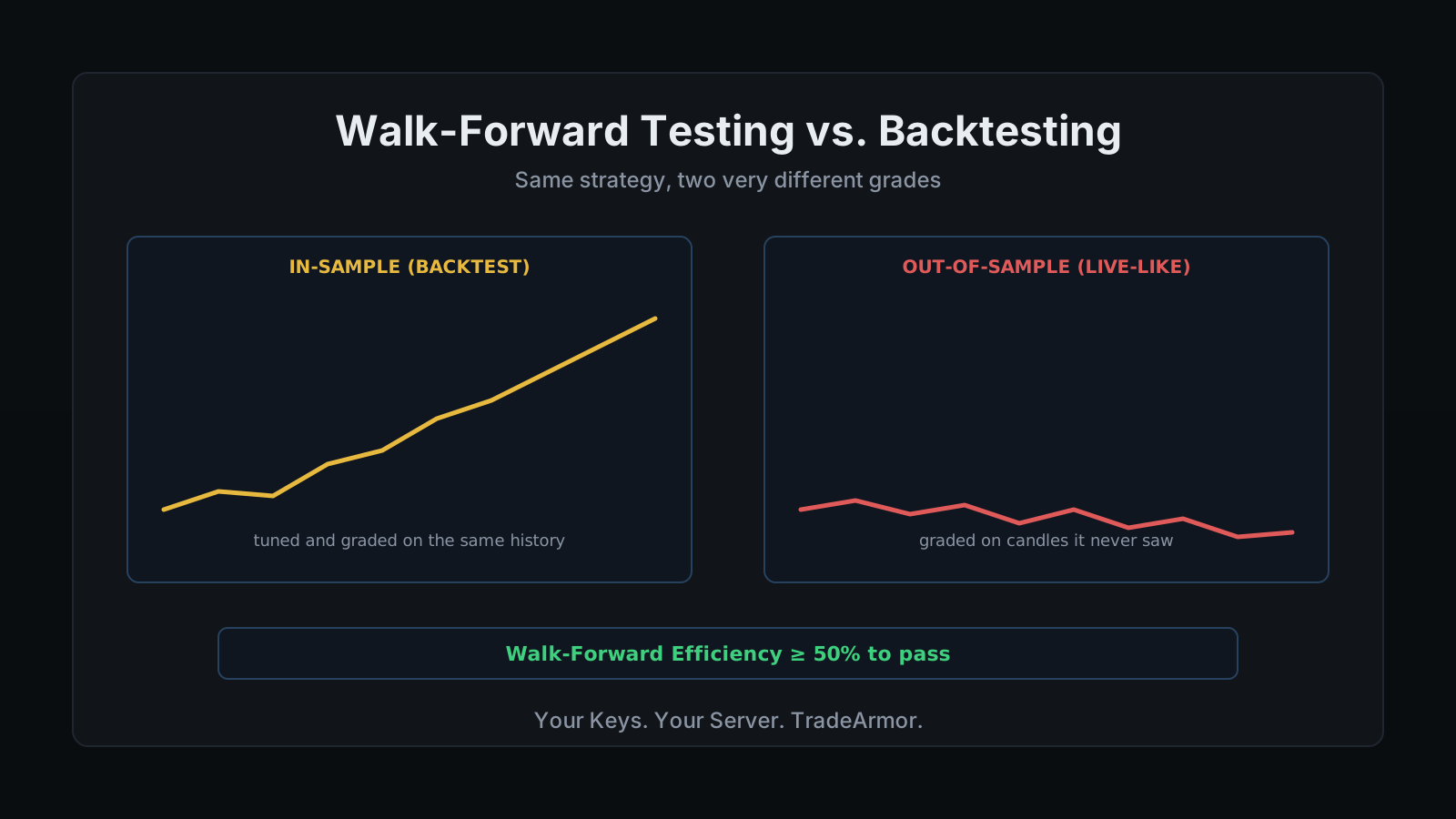
A backtest that looks unstoppable is one of the easiest things in trading to produce, and one of the easiest to fake without ever meaning to, which is exactly the failure mode walk-forward testing exists to catch. Tune the RSI period, the DCA spacing, and the stop distance against six months of the same candles enough times, and eventually one combination fits that history so well it looks like a genuine edge. Run those exact settings forward on candles the optimizer never touched, and the curve that felt inevitable often goes flat, or negative, the moment the market stops repeating itself.
Traders who want a bot that runs on its own still want to see the rules it's following, not just the headline result, and "set and forget, but actually see what it's doing" only holds up if what you're seeing was tested honestly in the first place. A standard backtest optimizes and grades itself on the same slice of history. Walk-forward testing splits that job in two, so the grade only ever comes from candles the strategy was never allowed to see during tuning.
TradeArmor is where I actually run this discipline: a self-hosted crypto trading platform, built on hardware I own, carrying three years of live BTC/USDC signal history, 15 real-time indicators, a plain-English AI strategy builder, and DCA, grid, futures, copy trading, backtesting, paper trading, and tax exports on one engine. The backtester is exactly the tool this guide is about using correctly, because the gap between a strategy that survives contact with real money and one that doesn't usually comes down to how honestly it was graded before either of us trusted it.
A Backtest Answers One Question, and It's the Wrong One
Run a normal backtest and you get an answer to exactly one question: how would these settings have performed on this exact history. That is a narrower question than it sounds. It says nothing about how the strategy would perform on history it hasn't seen, which is the only history that actually matters once the bot goes live. A strategy optimized on January through June knows January through June. It has no idea what July looks like, and neither do you, until you test it there honestly.
The trap is that a single-pass backtest can't tell the difference between "this rule captures something real about how BTC/USDC moves" and "this rule happens to match the noise in these particular six months." Both produce the same beautiful equity curve. Only testing on a separate, unseen window separates one from the other.
Overfitting Isn't Always Deliberate Cheating
Nobody sits down planning to overfit a strategy. It happens through a hundred small, reasonable-sounding decisions made with full knowledge of the very history being tested: picking RSI over Stochastic because RSI happened to test better, nudging a threshold from 30 to 28 because it caught one more winning trade, adding a third indicator because it filtered out a loss you'd already seen coming. Our piece on signal stacking vs. overfitting covers the indicator-count side of this problem. Walk-forward testing attacks the same failure from the testing-methodology side, and the two are worth reading together.
None of those individual decisions feels like cheating. Stacked together across dozens of tuning passes, they quietly shape a rule around the exact bumps in one stretch of price history, and a rule that specific has usually only ever traded one thing well: the past.
Ready to see how a strategy actually holds up? Try the backtester and run a rule across more than one window before you trust the first result you see.
What Walk-Forward Testing Actually Does
The mechanics are simpler than the name suggests. Optimize a strategy's settings on an in-sample window of candles. Test those exact settings, frozen, on the out-of-sample window immediately after it. Record that result. Slide both windows forward and repeat, all the way across your available history:
Window 1: optimize Jan-Jun -> test Jul
Window 2: optimize Feb-Jul -> test Aug
Window 3: optimize Mar-Aug -> test Sep
Stitch every out-of-sample segment together, end to end, and you get a single equity curve built entirely from candles the strategy never got to peek at before being graded on them. That curve is a far more honest preview of live trading than any single in-sample backtest, because it's assembled the same way live trading actually works: rules set now, results earned later, on data that didn't exist yet when the rules were written.
Anchored vs. Rolling Windows
There are two ways to slide the window, and they answer slightly different questions. Anchored walk-forward keeps the start date fixed and lets the in-sample window grow with every step, so window three might optimize on eight months of history instead of six. Rolling walk-forward keeps the window a fixed length and drops the oldest data as new data joins, so it's always learning from the same amount of recent history, never more.
Anchored suits a strategy you believe should hold up across the whole history you have, weighting every regime it's ever seen. Rolling suits crypto more often than people expect, because BTC/USDC has cycled through genuinely different regimes, low-volatility chop, trending runs, sharp drawdowns, inside a single year, and a strategy tuned on 18 months of ancient, irrelevant data can be worse than one tuned on the last three.
The Walk-Forward Efficiency Ratio
Once you have both numbers, the in-sample result and the out-of-sample result for the same window, divide the second by the first. That ratio is walk-forward efficiency, and a commonly cited rule of thumb treats 50 percent or better as a pass. A strategy that made half as much, or hit half the win rate, out-of-sample as it did in-sample is showing normal, expected decay, not failure. Every strategy performs a little worse on data it wasn't tuned to.
What fails the test is a ratio nowhere close to that: a strategy that prints money in-sample and does nothing, or loses, out-of-sample. That gap is the overfitting signature this entire method exists to expose, and it's exactly the gap a single backtest run can never show you, because a single backtest never puts the strategy in front of data it hasn't already memorized.
Running This on a Self-Hosted Bot
TradeArmor doesn't ship a single-click walk-forward optimizer button, and I'd rather tell you that plainly than let a features page imply otherwise. What it does give you is everything the routine actually needs. The backtester runs any of the three strategy modes, cava-signals, hybrid, or a fully custom boolean formula, against a historical date range you choose, and returns the equity curve, win rate, drawdown, and full trade log every time. Slice that date range into windows yourself, optimize only on the first, test the frozen settings on the next, and you've built a manual walk-forward routine on top of a real backtester rather than a toy simulation.
The cleanest out-of-sample test on the platform isn't historical at all. Paper trading runs a strategy against live market data with no capital at risk, and because that data doesn't exist yet at the moment you commit to the rule, it can't have leaked into your tuning by accident the way an old backtest window sometimes does. A strategy that holds up through several weeks of paper trading after passing a manual walk-forward pass on historical data has cleared two honest, independent tests, not one polished one.
Plenty of trading software will hand you a backtest chart that only goes up and call it proof. It's proof of one thing: that the number was reachable on that exact history, and nothing more.
A Practical Walk-Forward Routine for a Crypto Strategy
Start with a strategy mode and a rough rule, then split whatever history you're backtesting against roughly 70 percent in-sample, 30 percent out-of-sample, broken into several smaller windows rather than one long block. Optimize only inside the in-sample slices. Run the frozen result against each out-of-sample slice and note the walk-forward efficiency for each. A strategy, like the gated DCA logic TradeArmor uses for spacing entries, that holds a reasonable efficiency ratio across multiple windows earns a further test in paper trading before it ever touches a live exchange account.
Re-run the whole routine periodically, not once and done. Crypto doesn't sit still long enough for a strategy validated last spring to be assumed valid this fall, and a walk-forward pass from six months ago tells you less than you'd like about how the rule handles the market conditions showing up this week.
A single backtest tells you how a strategy would have performed on history it already knows by heart. Walk-forward testing tells you whether it can perform on history it's never seen, which is the only test that actually resembles what happens the moment real capital goes live. TradeArmor runs the backtester, the paper trading engine, and every strategy mode on hardware you own, where your keys never leave the machine and one subscription replaces the stack of a charting tool, a signal service, and a bot. See the plans and get started.