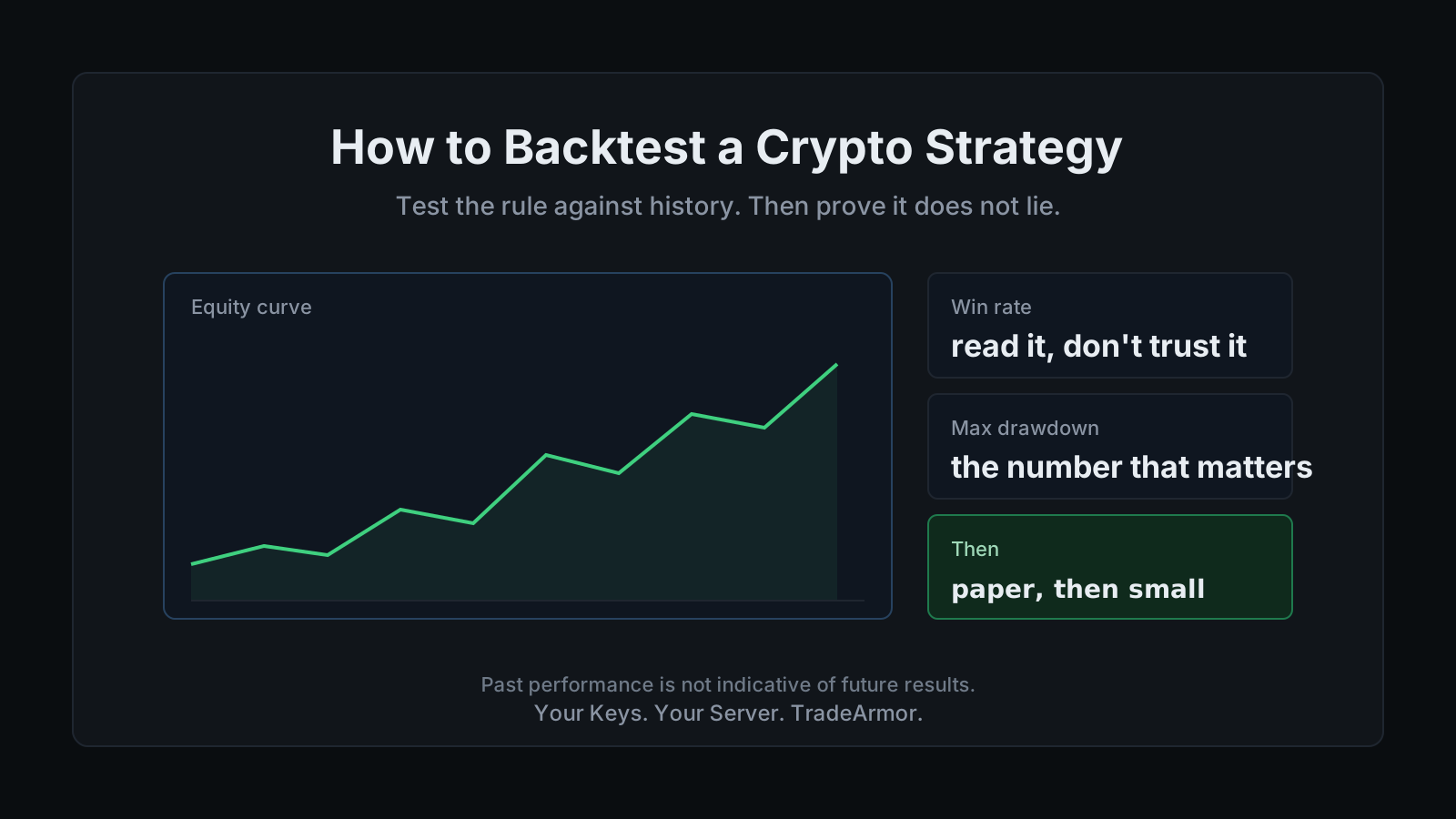
The strategy looked perfect on paper. Green equity curve, a win rate that made you feel clever, a drawdown that barely registered. Then you ran it live and it bled. If that sounds familiar, the backtest was not lying to you. You were lying to yourself, and the software handed you the pen.
This is the part of automated trading nobody romanticizes, and learning how to backtest crypto strategy properly is the cheapest insurance against it. You do not trust a black box, and you are right not to. You want to see the rules a strategy is following, not just the result it printed. A backtest is supposed to be that proof. Done honestly, it is the cheapest education in trading you will ever get. Done the way most people do it, it is an expensive way to feel confident about a strategy that was always going to lose.
So this is a guide to doing it honestly. I build and trade with TradeArmor, a self-hosted crypto trading platform you run on your own hardware, with built-in BTC/USDC signals carrying a three-year track record, 15 real-time indicators, a plain-English strategy builder, and DCA, grid, futures, copy trading, backtesting, paper trading, and tax reporting on one engine. Backtesting is one feature inside that, not the whole product. But it is the feature that decides whether everything else is built on a real edge or a fantasy, so it is worth getting right.
What a Backtest Actually Is
A backtest runs your trading rules against historical price data and simulates what would have happened if you had been running them the whole time. You feed it past candles. It walks forward through them one at a time, fires every entry and exit your rule would have triggered, and reports the outcome.
The outputs that matter are four numbers and a list. An equity curve, so you can see the shape of the gains and the pain. A win rate. A maximum drawdown, which is the worst peak-to-trough fall the strategy put you through. And a trade log, the full record of every simulated buy and sell so you can audit individual decisions instead of trusting a summary.
That is the whole machine. It is genuinely useful and it is genuinely dangerous, for the same reason: it gives you a precise number for something that is fundamentally uncertain. The number feels like knowledge. Most of the work in backtesting is making sure it actually is.
See how the full platform fits around the backtester, because a backtest is only as good as the engine that later has to execute the strategy for real.
What a Backtest Can and Cannot Tell You
A good backtest can tell you a few real things. Whether your rule is internally consistent, meaning it does what you think it does. Whether it survived a stretch of genuinely different market conditions, a bull run, a chop zone, a crash. How deep the drawdowns got, which is the number that tells you whether you could actually have held the position without panic-closing it at the bottom.
What a backtest cannot tell you is whether the strategy will make money next month. Markets are not a fixed dataset you can study your way to certainty over. Past performance is not indicative of future results, and a backtest is past performance by definition. Anyone selling you a backtest as a forecast is selling you a forecast, not a backtest.
The honest framing is this. A backtest is a filter that rejects bad strategies, not a crystal ball that confirms good ones. A rule that loses badly over three years of history is almost certainly going to lose. A rule that wins over three years of history might win, might break, and definitely needs more testing before it sees real capital. The filter is one-directional. Treat it that way and it earns its keep.
The Three Biases That Fake Your Results
Most backtests that lie do it through one of three well-documented biases. Each one inflates the result in a way that feels great right up until live trading corrects you.
Look-ahead bias is using information that was not available at the moment of the trade. The textbook example is buying at a candle's open based on that same candle's close, which has not happened yet when the open prints. The data leaks from the future into the decision. It is the most common bug in homemade backtests and the most flattering, because a strategy that can see the future tends to do quite well.
Survivorship bias shows up when you test across a basket of coins using today's list of coins. The tokens that went to zero and got delisted are missing from your data, so your test only ever sees the ones that made it. Your win rate inherits the survival of the survivors. For a single liquid pair like BTC/USDC this matters less. The moment you start backtesting a rotation across alts, it matters a lot.
Overfitting is the one everyone has read about and almost everyone still does. You tune the strategy so tightly to one window of history that it memorizes the noise instead of learning a pattern. The tell is a strategy with a dozen parameters that scores beautifully on the exact range you optimized it on and collapses on any other range. Crypto data is volatile and abundant, which means with enough knobs you can fit almost any curve you want. Curve-fitting is just overfitting wearing a suit.
The defense against all three is discipline, not cleverness. Compute every decision only from data that existed at that moment. Include the losers in your universe. And keep the parameter count low enough that the strategy has to find a real edge instead of a flattering coincidence.
The Costs a Backtest Quietly Forgets
Even a bias-free backtest can mislead you if it trades in a frictionless world. Real trading has costs, and a thin edge dies on them.
Trading fees are the obvious one. A strategy that turns over the book ten times a day pays fees ten times a day, and a backtest that assumes zero fees will show profits that the fee schedule eats entirely. Put your exchange's actual maker and taker fees into the model.
Slippage is the subtler one. Your backtest fills at the historical price. A real order fills at whatever the order book offers when it arrives, which on a thin pair or a fast move is worse, sometimes much worse. The higher your frequency and the smaller the coin, the bigger the gap between the backtested fill and the real one. A backtest is the easiest place in trading to assume perfect fills, and perfect fills are the one thing the market never gives you.
Bake both in. A strategy that only works at zero cost is not a strategy, it is a tax shelter for the exchange.
Out-of-Sample and Walk-Forward: The Honest Tests
Here is the single habit that separates a backtest you can lean on from one you cannot. Never judge a strategy on the same data you used to build it.
Split your history. Tune the strategy on one slice, the in-sample period. Then test it, untouched, on a slice it has never seen, the out-of-sample period. If it holds up on data it was never fit to, you have evidence of a real pattern. If it falls apart, you overfit, and you just found out for free instead of with capital.
Walk-forward testing takes this further. You optimize on a rolling window, test on the period immediately after, then roll the window forward and repeat, all the way through your history. It mimics how you would actually run a strategy over time, re-tuning periodically as conditions shift, and it punishes strategies that only worked because of one lucky regime. It is more work. It is also the closest a backtest gets to honesty.
If you want the deeper mechanics of how a bot turns these rules into live orders once they pass, the guide to how crypto trading bots work covers the execution side that a backtest only simulates.
How to Backtest Crypto Strategy in TradeArmor
In practice, the whole point of learning how to backtest crypto strategy is that you should not have to write a backtesting harness from scratch to do any of it. The backtester is built into the platform and tests all three strategy modes.
You can backtest signal mode, where the built-in BTC/USDC signals drive entries and exits, to see how the three-year signal feed behaved over a window you choose. You can backtest hybrid mode, where a signal proposes the trade and your own indicator filter has to agree before it fires. And you can backtest custom mode, the plain-English boolean formulas you build yourself, things like RSI_BUY && (MACD_BUY || SUPERTREND_BUY).
That last point matters more than it sounds. A formula you wrote in plain English is a hypothesis. The backtester is where you check it before it costs anything. You set the historical window, run it, and read the equity curve, win rate, drawdown, and trade log directly in the dashboard. No Python, no pandas, no command line, no separate data pipeline to maintain. The same rule you can read aloud is the rule you can test.
There is also a public, no-install version. The free DCA backtester runs in your browser, lets you set DCA levels, trigger spacing, and a size multiplier against real historical data, and shows you the equity curve and the exact buy-level triggers. It is the fastest way to feel how dollar-cost-averaging logic behaves before you commit to anything, and it pairs well with the full DCA strategy guide if you want the theory behind what you are seeing.
A Real Workflow: Backtest, Paper, Then Small
A clean backtest is the first rung of a ladder, not the finish line. Here is the sequence I actually run before a new rule touches meaningful size.
First, backtest it, with fees and slippage on, across more than one market regime, and check it out-of-sample. If it survives, it earns the next rung.
Second, paper trade it. Paper trading runs the same strategy on live market data with a simulated balance and no real execution. This is where you catch the things a backtest structurally cannot model: live latency, the gap between a signal firing and an order landing, the way a fast candle moves the fill. A strategy can pass a backtest and still stumble here, which is exactly why the step exists.
Third, run it live with small size. Small enough that being wrong is tuition, not a wound. You are no longer testing the logic at this point. You are testing yourself, and whether the drawdown you accepted on a chart is one you can actually sit through with money on the line.
Each rung kills strategies the previous one approved. That is the feature, not a flaw. A rule that has not survived a backtest, a paper run, and a small live run is still a guess wearing a lab coat.
Where Backtesting Fits in the Bigger System
A backtest validates the entry and exit logic. It does not validate the rest of the operation, and the rest of the operation is where most accounts are actually won or lost. Position sizing, take-profit and trailing rules, and a plan for trades that move against you matter as much as the entry that a backtest obsesses over. That is the domain of the DCA engine and its gating logic, and it is usually where the difference between a real engine and a toy becomes obvious.
One thing no backtest can score, however clean your methodology: your custody. A strategy runs the same logic whether your exchange API key sits in a local config on your own machine or on a third-party server. What changes is your exposure if that server is breached. On a self-hosted bot the key stays on your hardware, carries trade permission only, and never withdrawal. The strategy is yours to test. The keys should be yours to keep.
That is how to backtest crypto strategy honestly. Test the rule against real history with real costs, prove it on data it has never seen, then paper trade it, then run it small, and keep your keys on your own machine the entire time. The backtest is not a promise. It is a filter, and a good one is the difference between trading a strategy and hoping for one. See the plans and build something worth testing.
TradeArmor is a trading automation tool, not an investment adviser. Backtest results and signals are algorithmic outputs, not personalized investment advice. Past performance is not indicative of future results. Trading cryptocurrency carries substantial risk including the total loss of capital.