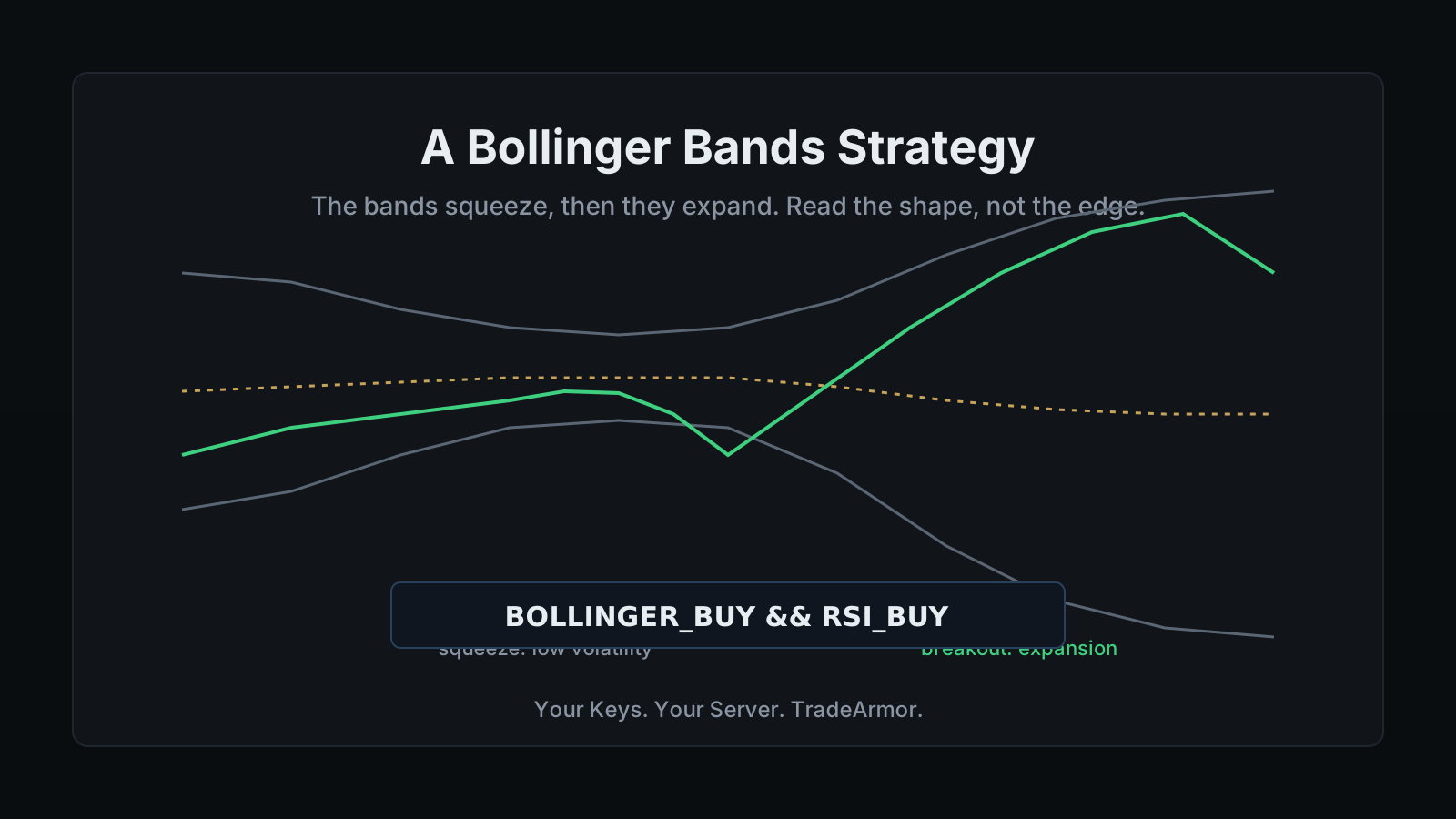
Here is the trade that separates a working Bollinger Bands strategy from just staring at the lines. Price is grinding higher, tagging the upper band candle after candle, and every touch whispers the same thing: overbought, fade it, it has to come back to the middle. So you short it. Then it tags the band again, and again, and your stop is gone, because a market in a real trend will ride the outer band for weeks and never look back. The bands did exactly what they were built to do. You read the edge and missed the shape.
That gap, between what an indicator draws and what the market is actually doing, is where most automated strategies quietly go broke. I build and trade with TradeArmor, a self-hosted crypto trading bot that runs on hardware you own, with built-in BTC/USDC signals carrying a three-year track record, 15 real-time indicators, a plain-English AI strategy builder, and DCA, grid, futures, copy trading, backtesting, paper trading, and tax reporting on one engine. Bollinger Bands is one of those 15 indicators. This is a guide to what a Bollinger Bands strategy for crypto actually measures, the two opposite ways to trade it, and how to turn either one into a rule a bot follows instead of a chart you second-guess.
I am writing the mechanics instead of a pitch, because the people who want to automate an indicator usually want two things at once that most tools refuse to give them together. They want a rule that runs without them, and they want to be able to open the hood and read exactly what that rule is. A Bollinger Bands strategy can do both, but only if you understand the one thing the indicator will not tell you outright: which market you are in right now.
What Bollinger Bands Actually Measure
John Bollinger built these bands in the 1980s, and the design is simpler than the reputation suggests. There are three lines. The middle band is a moving average, usually a 20-period simple moving average. The upper and lower bands sit a set number of standard deviations away from that middle line, two by default.
Standard deviation is the whole trick. It is a measure of how far price has been ranging from its own average lately, which is to say a measure of volatility. When the market moves hard, the deviation grows and the bands push apart. When it goes quiet, the deviation shrinks and the bands squeeze in toward the middle line. The bands are not predicting anything. They are drawing a live picture of how excited or bored the asset has been.
That single behavior gives you two derived readings worth knowing. Bandwidth is how far apart the bands are, so it maps volatility directly. Percent B tells you where price sits inside the channel, zero at the lower band and one at the upper. You do not need to compute either by hand, but knowing they exist explains why the bands are useful for two completely different jobs.
The Two Bollinger Bands Strategies
There is not one Bollinger Bands strategy. There are two, they are opposites, and running the wrong one for the current market is the fast way to donate to the exchange.
Mean reversion in a range
When the bands are flat and roughly parallel, the market is ranging. In that world, a stretch to the outer band is an overreaction that tends to snap back toward the middle. You buy when price tags the lower band, sell when it reverts to the 20-period middle line, and you take the small, repeatable moves a sideways market hands out. Pairing the lower-band touch with RSI reading oversold sharpens it, because now two independent tools have to agree that the stretch is real.
The rule that keeps this strategy alive is discipline about when you use it. Mean reversion only works while the bands stay flat. The moment they start expanding, the range is breaking and the snap-back trade becomes the walk-the-bands trade that runs you over.
The squeeze breakout
The squeeze is the setup most traders come to Bollinger Bands for, and the one worth the most respect. When the bands contract to their narrowest width in a defined lookback, volatility has bottomed out. Quiet does not last in crypto. A squeeze is a coiled spring, a compression that tends to precede a violent expansion.
The squeeze does not tell you which way price breaks. That is the part people skip. You wait for the first decisive close outside the band, ideally with volume running well above its recent average, and you trade that direction rather than guessing ahead of it. Public backtests of squeeze breakouts tend to show a raw win rate somewhere in the 40 to 50 percent range, which only turns into a positive expectancy because the winners are cut to run at something like a three-to-one reward against a tight stop. In other words, the edge is in the risk management, not the arrow. Most indicator marketing has that backwards.
Best Bollinger Bands Settings for Crypto
The default 20-period band with two standard deviations was not designed with a 24/7 asset on a 15-minute chart in mind. It is a sane place to start, not a law.
Faster intraday operators sometimes shorten the middle band toward 15 periods so it reacts to crypto's speed sooner, accepting more noise in exchange. Longer-timeframe traders often go the other way, stretching toward a 50-period band with the outer bands at 2.5 standard deviations to cut the count of false touches and only flag the moves that matter. The standard deviation multiplier does more work than the period does: raise it and fewer stretches qualify as extreme, lower it and you get buried in signals.
None of those numbers is a recommendation, because the correct setting is a question you answer with data. You backtest the strategy across a few setting pairs on real historical candles, read the equity curve and the drawdown rather than the win count alone, then paper trade the survivor on live data before a real dollar is at risk. A setting that looks flawless on a trending year and collapses on a choppy one has told you precisely what you needed to know. There is a free DCA backtester you can run in the browser right now to feel how a parameter change moves an equity curve before you commit to anything.
One indicator is not a strategy, and a strategy is not the whole bot. Bollinger Bands, the other 14 indicators, built-in signals, DCA, grid, and futures all run on the same engine. See how the full platform fits together before you bet an account on a single pair of lines.
Turning a Bollinger Bands Strategy Into a Bot Rule
You should not have to write Python to say "buy when price stretches to the lower band and momentum confirms." That is a sentence, and a decent bot should let you write it almost that plainly. This is where boolean formulas come in.
TradeArmor computes all 15 indicators locally in real time and exposes each one as a buy or sell state you combine with logical operators: && for and, || for or, ! for not, with parentheses for grouping. A bare Bollinger entry is one line:
BOLLINGER_BUY
BOLLINGER_BUY fires when price reaches the lower band. On its own that is the naive version that gets walked over in a trend, so you gate it. Require a momentum tool to agree before the bot acts:
BOLLINGER_BUY && RSI_BUY
Now the bot only buys when price has stretched to the lower band and RSI confirms an oversold bounce, which strips out a chunk of the trend touches that would have wrecked the raw mean-reversion trade. If you want the deeper logic of pairing two readings that fail differently, the RSI and MACD combined strategy walks through the same idea in full, and the Supertrend indicator guide covers the trend-filter side of the same coin.
The point that carries across all of it is that the rule stays readable. The most common thing I hear from traders coming off other tools is some version of wanting the bot to run itself while still being able to see the exact condition it followed. A boolean formula answers that directly. When a trade goes wrong you can read which gate fired and fix it, instead of shrugging at an output you cannot explain. And if the syntax still is not your idea of a good evening, the plain-English AI strategy builder turns "buy at the lower band when RSI is oversold" into the formula for you. It is bring-your-own-key, so you plug in your own AI provider and pay no markup on top of the subscription. The AI writes the rule. You still read it before it trades.
Where the Bollinger Bands Strategy Fits in the Bigger System
An indicator decides whether to enter. It says nothing about how much to buy, when to take profit, or what to do when a position moves against you, and those are the jobs that actually decide the result. The cleanest way I run any indicator is as a gate: let a proven signal feed propose the trade, then require the indicator state to agree before the bot acts. Whatever fires the entry, position management decides whether you keep the gains, which is where the DCA engine and its buy-gate logic earn their keep. Entry timing gets all the attention in indicator guides. Sizing and exits quietly settle the account.
One thing no Bollinger setting can do, no matter how well tuned, is protect your keys. The same strategy runs identically whether your exchange API key sits on a third-party server or in a local config on your own machine. On a self-hosted bot the key stays on your hardware, carrying trade permission only, never withdrawal. The strategy is yours either way. The custody should be too.
The Honest Summary
A Bollinger Bands strategy for crypto is really two strategies on one indicator: mean reversion when the bands are flat, the squeeze breakout when they pinch and then expand. Read the shape of the bands before the edges, gate the entry with a momentum tool so a trend touch does not fake you out, write it as a boolean rule you can actually audit, backtest it before you trust it, and run it inside a system that also handles sizing, exits, and key custody. TradeArmor is the self-hosted platform I built to do all of that on hardware you own, where your keys never leave your machine and one subscription replaces the stack of a chart tool, a signal service, and a SaaS bot. See the plans and get started.
Frequently Asked Questions
What is a Bollinger Bands strategy in simple terms?
Bollinger Bands wrap price in three lines: a middle band that is usually a 20-period simple moving average, and an upper and lower band set two standard deviations away from it. Because standard deviation is a volatility measure, the bands widen when the market is moving hard and contract when it goes quiet. A Bollinger Bands strategy trades off that behavior in one of two ways: mean reversion, which fades a stretch to the outer band back toward the middle in a flat market, or the squeeze breakout, which waits for the bands to pinch tight and then trades the direction price breaks. They are opposite tactics for opposite conditions, and using the wrong one for the current market is the most common way traders lose with this indicator.
What are the best Bollinger Bands settings for crypto?
The default is a 20-period middle band with the outer bands at two standard deviations, and that default is a reasonable starting point rather than a rule. Because crypto is more volatile and trades around the clock, faster traders sometimes shorten the middle band toward 15 periods to react sooner, accepting more noise. Longer-timeframe position traders sometimes stretch it toward a 50-period band with bands at 2.5 standard deviations to cut false signals. The standard deviation multiplier matters more than people think: raise it and fewer touches count, lower it and you get flooded with them. There is no universally correct number, which is why you settle it with a backtest and paper trading instead of an opinion. Past performance does not guarantee future results.
What is a Bollinger Band squeeze?
A squeeze is when the bands contract to their narrowest width in a defined lookback, which means volatility has dropped to a local low. Quiet markets do not stay quiet, so a squeeze is read as a coiled spring: a period of compression that tends to precede a period of expansion. The squeeze itself does not tell you which direction price will break, only that a break is likely coming. Traders confirm the direction with the first decisive close outside the band, usually alongside a volume surge, rather than guessing ahead of it. On its own a squeeze is a heads-up, not an entry.
Why does price 'walk the bands' and break a Bollinger Bands strategy?
In a strong trend, price can ride along the outer band for a long stretch, printing touch after touch of the upper band on the way up or the lower band on the way down. This is called walking the bands. It destroys the naive mean-reversion trade, because a trader who shorts every tag of the upper band expecting a snap back to the middle gets run over by a market that simply keeps trending. The fix is to only run mean reversion when the bands are flat and roughly parallel, which signals a range, and to switch to the breakout read when the bands are expanding, which signals a trend. The bands tell you which regime you are in if you read their shape, not just their edges.
How do you use a Bollinger Bands strategy as a crypto trading bot rule?
In TradeArmor you express indicator states as boolean conditions and combine them with operators. A mean-reversion entry might be BOLLINGER_BUY && RSI_BUY, which fires when price stretches to the lower band and RSI confirms an oversold bounce, while a breakout entry pairs the squeeze condition with a confirming momentum state. Because the rule is written in plain operators, you can audit exactly why the bot bought instead of trusting a hidden model, and you never have to write Python to express it. Signals are algorithmic outputs, not investment advice, so backtest and paper trade any rule before it touches real capital.