You have watched a fast moving average cross above a slow one, felt sure the move was starting, bought the cross, and then watched price roll straight back over and stop you out two candles later. Do it enough times in a sideways market and the golden cross stops feeling like a signal and starts feeling like a tax. The problem is rarely the indicator. It is that a crossover on its own answers only half of the question a trade needs answered, and most guides sell you the pretty half.
This is a walkthrough of how an EMA crossover strategy actually behaves, where it earns money and where it bleeds it, and how to run it as a rule a machine executes for you instead of a chart you babysit. The bot doing the executing here is TradeArmor, a self-hosted crypto trading platform that runs on hardware you own: built-in BTC/USDC spot signals with a multi-year track record, 15 real-time technical indicators, a plain-English AI strategy builder, plus DCA, grid, futures, copy trading, backtesting, and paper trading, all behind API keys that never leave your machine. An EMA crossover is one small rule inside that operation. It is a good place to see how the whole thing thinks.
What an EMA Crossover Strategy Actually Is
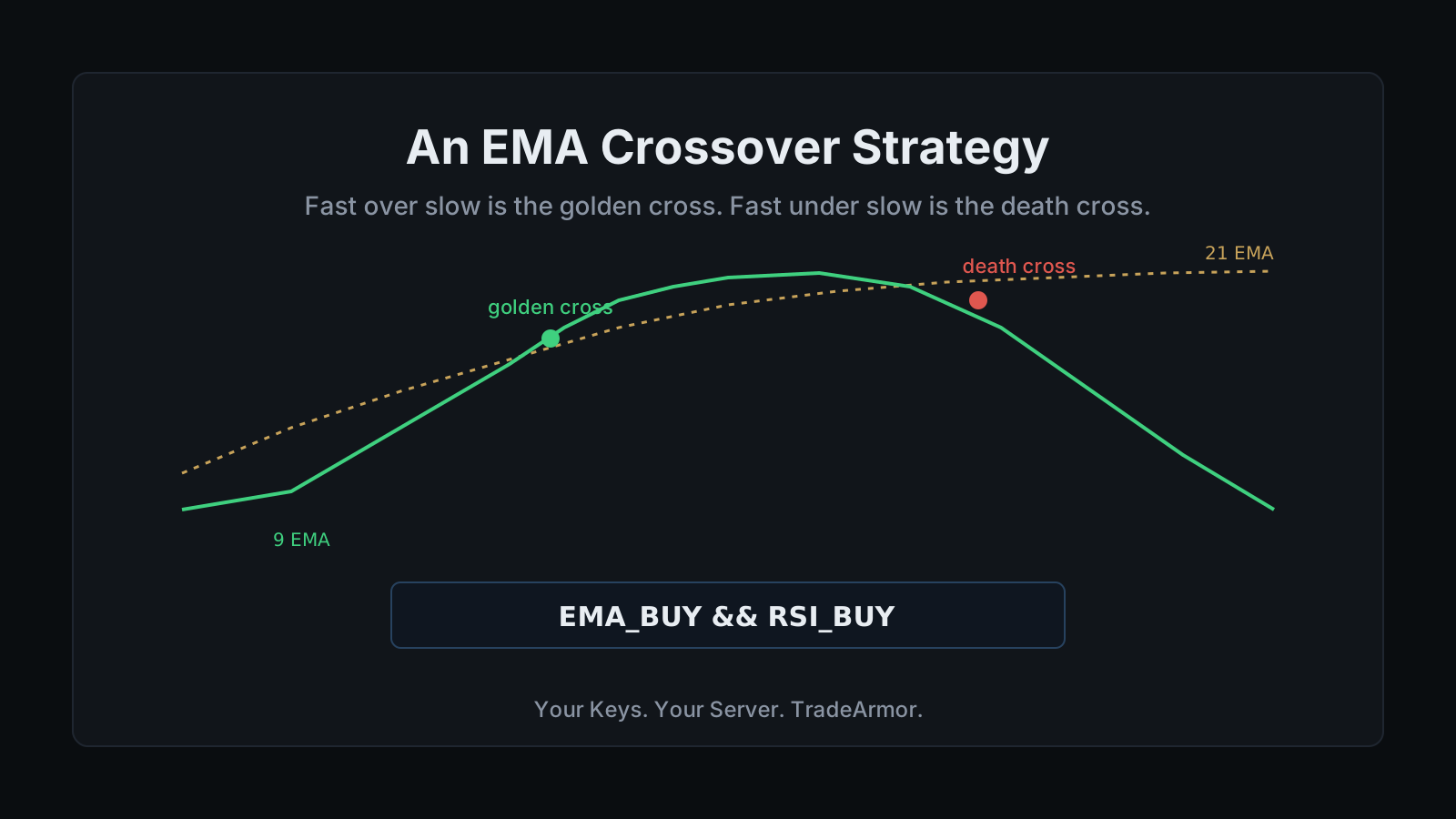
An exponential moving average smooths price into a single line, weighting recent candles more heavily than old ones. Run two of them at once, one fast and one slow, and you get a crossover system. When the fast EMA crosses above the slow EMA, momentum over the short window has overtaken the longer trend. That is the golden cross, and it reads bullish. When the fast EMA crosses below the slow EMA, momentum has rolled over. That is the death cross, and it reads bearish.
The appeal is that the rule is not a matter of interpretation. Either the fast line is above the slow line on this candle or it is below it. There is no drawing trendlines by feel, no arguing about where support sits. An EMA crossover strategy trades that one clean fact: the relationship between two lines, checked on every candle, acted on the moment it flips.
The cost of that cleanliness is that both lines are lagging by construction. A moving average is an average of prices that already printed, so a crossover confirms a move that is already underway rather than calling one before it starts. You are never buying the bottom. You are buying the confirmation that the bottom probably already happened.
Why EMA and Not SMA
The simple moving average gives every candle in its window the same weight. The exponential moving average front-loads the recent ones. Practically, that means an EMA turns sooner than an SMA of the same length, because it stops waiting on stale data to age out of the calculation. The market does not send a calendar invite before it turns, so most crossover traders want the faster reaction.
That speed is a genuine edge and a genuine liability at the same time. A 9 and 21 EMA pair can fire days, sometimes weeks, before a 50 and 200 crossover of the same instrument would, which lets you enter closer to the actual turn. It also means the lines react to every twitch, so in a market with no real trend they cross back and forth and hand you a stream of signals that go nowhere. You do not get the early entries without also getting the false starts. They are the same feature.
The Period Pairs That Matter
Two combinations do most of the work, and they answer different questions.
The 9 and 21 EMA pair is the short-term and swing-trading standard. It is responsive, it catches momentum shifts early, and it is the pair you reach for when you intend to hold for hours to days. It also whipsaws the most, so it is the pair that most needs a filter.
The 50 and 200 pair is the medium-term trend read. When the 50 crosses above the 200, that is the cross financial media actually means when it says "golden cross" on television. It confirms late and it survives noise, which makes it a poor day-trading trigger and a decent regime filter: a way to know which direction you should even be looking to trade.
There is no single correct pair. The right one is the one that matches your holding period. Anyone who tells you a specific two numbers are the secret is selling a course, not a strategy. You settle the choice the honest way, by testing it, and our free DCA backtester is one place to see how an entry rule would have behaved across real historical candles before you risk anything on it.
Where the Crossover Breaks, and How to Patch It
Every EMA crossover strategy has the same failure mode, and it has a name: the range. When price is chopping sideways instead of trending, it oscillates around both EMAs, the fast line saws through the slow line again and again, and the system fires a buy, then a sell, then a buy, each one stopping out before the next arrives. Backtests that look brilliant in a trending year turn ugly the moment the market goes flat.
The fix is not a cleverer EMA pair. It is confirmation. A crossover is good at one job, picking a direction, and bad at another, deciding whether a trend is real enough to trade. So you pair it with a second instrument that is good at the second job. Require RSI to confirm that momentum agrees. Require Supertrend, a volatility-scaled trend filter, to agree that a trend actually exists before you act on the cross. This is the same logic behind combining RSI and MACD: two tools that fail in different ways cover each other's blind spots, and the agreement between them throws out a chunk of each one's worst trades.
If you want the mechanics of why a bot checks these conditions candle by candle rather than pinging you to do it manually, the guide to how crypto trading bots work lays out the execution loop end to end. TradeArmor is the self-hosted platform that runs that loop on your own hardware, and you can see the plans whenever you want to skip ahead.
Writing an EMA Crossover Strategy as a Bot Rule
You should not have to write Python to express "buy when the 9 EMA crosses above the 21 EMA and RSI confirms." That is a sentence. A bot should let you write it almost as plainly as a sentence, and that is where boolean formulas come in.
TradeArmor computes all 15 indicators locally in real time and exposes each one as a buy or sell state you combine with logical operators: && for and, || for or, ! for not, with parentheses for grouping. The bare crossover entry is one line:
EMA_BUY
EMA_BUY is true while the fast EMA sits above the slow EMA, so it flips true on the golden cross and stays true until the death cross flips it back. Run alone, that is the naive version that whipsaws in a range, so you gate it. Require momentum to agree before you act on the cross:
EMA_BUY && RSI_BUY
Now the bot only buys when the crossover is in force and RSI confirms an oversold bounce, which strips out most of the sideways false starts. The exit side uses EMA_SELL. The point is legibility. A fill log tells you what the bot did; this formula tells you the exact rule it followed to do it. When a trade goes wrong you can read which gate failed and correct the rule, instead of shrugging at a result you cannot explain. That answers the two objections I hear most from traders coming off other tools: the distrust of a black box, and the refusal to hand execution to something whose logic they cannot inspect.
And if writing the syntax still is not your idea of a good evening, the plain-English AI strategy builder turns "buy when the 9 EMA crosses above the 21 and RSI is oversold" into the formula for you. It is bring-your-own-key: you plug in your own AI provider and pay no markup on top of the subscription. The AI writes the rule. You still read it before it trades.
One Rule Inside a Larger Operation
A crossover entry is a trigger, not a trading system. A real operation also has to decide how much to buy, when to take profit, how to scale into a position that keeps falling, and where the keys that authorize all of it are stored. That last one is not a footnote. A crossover run on a SaaS bot that holds withdrawal permissions on a server you do not control is a good rule wearing a bad custody model.
The cleanest way to run a crossover is as a filter on top of a proven feed rather than as the whole strategy. On TradeArmor that looks like "only buy when the cava-signal fires and EMA_BUY && RSI_BUY agrees," which keeps you on a strategy with a track record while adding your own confirmation layer. The DCA engine manages how the position is built from there, the exit rules manage how it is closed, and the whole thing runs on your machine where your API keys never leave your hardware. The most exciting part of a setup like that is how little it asks of you once it is running. No alerts to chase at midnight. The bot watches the candles. You review what it did.
An EMA crossover strategy is a legible, honest tool: two lines, one clean rule, early entries paid for with whipsaws you filter out with confirmation. Write it as a boolean formula so you can read the exact rule, back it with a momentum or trend gate so the range does not eat you alive, backtest it before you trust it, and run it inside a system that also handles sizing, exits, and self-custody. TradeArmor is the self-hosted platform I built to do all of that on hardware you own, where one subscription replaces the stack of a chart tool, a signal service, and a SaaS bot. See the plans and get started.