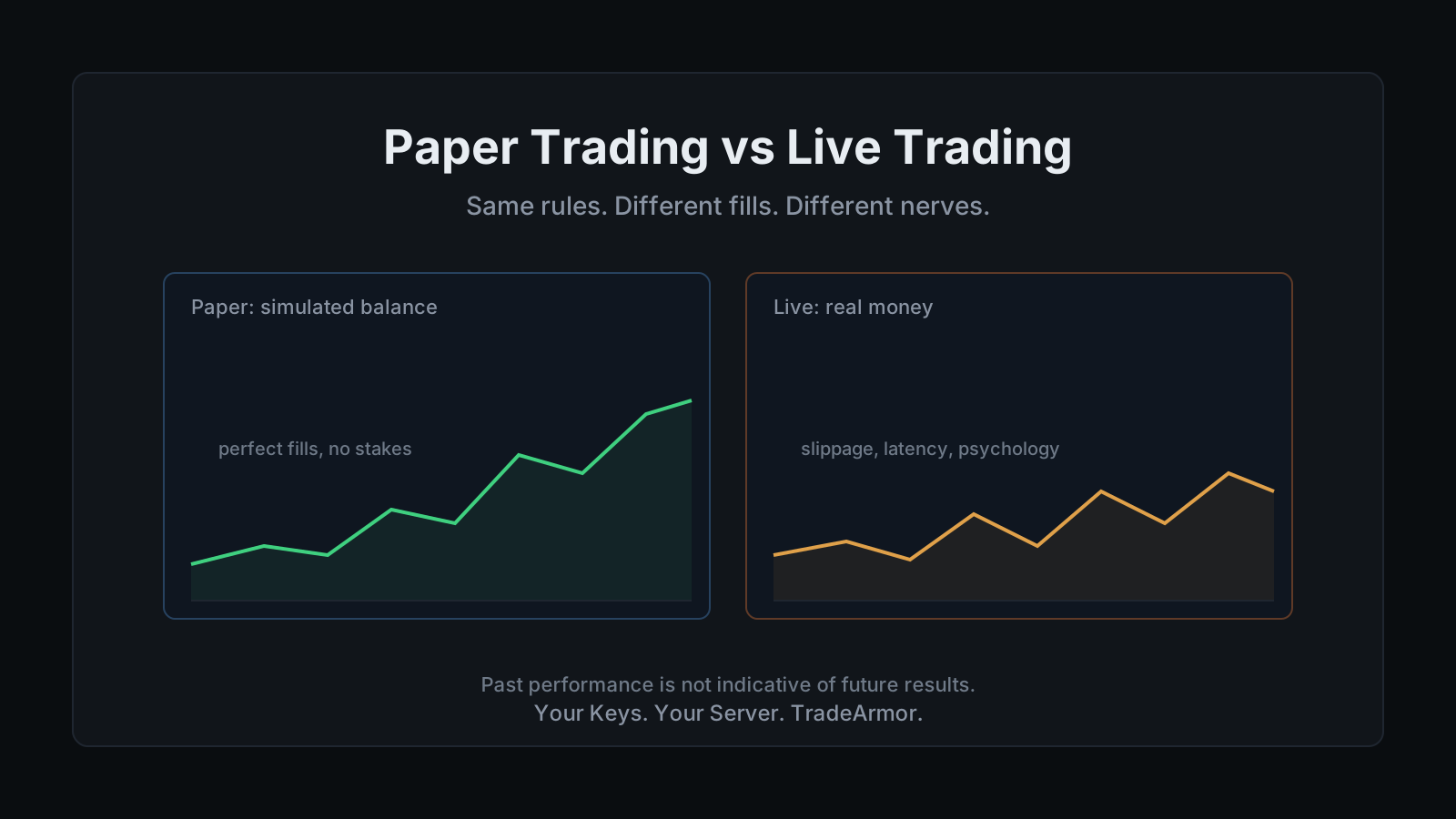
You paper traded the strategy for a month. The simulated balance climbed, the equity curve looked like something you would screenshot, and you finally felt ready. Then you funded the account, flipped it live, and the first week looked nothing like the paper run. Same rules. Same coins. Different result. If that gap has burned you, you are not bad at trading and the software did not break. You just ran into the real difference between paper trading vs live trading, the part of automated trading that no simulator can hand you.
This is the part people skip past because it is uncomfortable. You want something that just runs, but you also want to see exactly why the bot bought, and a paper run gives you both for free, which is precisely why it is so easy to trust more than it deserves. Paper trading is a real tool. It is also a partial one, and knowing where the line sits is the difference between switching to live with evidence and switching on a hunch.
So here is an honest map of paper trading vs live trading: what a paper run actually proves, what it quietly cannot, and how to know when you have earned the switch. I build and trade with TradeArmor, a self-hosted crypto trading platform you run on your own hardware, with built-in BTC/USDC signals carrying a three-year track record, 15 real-time indicators, a plain-English strategy builder, and DCA, grid, futures, copy trading, backtesting, paper trading, and tax reporting on one engine. Paper trading is one feature inside that. It is also the rung most people fall off, so it is worth getting right.
What Paper Trading Actually Is
Paper trading runs your strategy on live market data with a simulated balance and no real orders. The prices are real, streaming in from the exchange exactly as they would for a funded account. The fills are not. When your rule says buy, the bot records a buy in a fake ledger instead of sending an order to a real book.
That one structural fact shapes everything else. A paper trade executes unconditionally, because there is no counterparty required on the other side. The market touches your price, the trade fills, full size, every time. A live order has to find someone willing to take the opposite side at that price, and sometimes nobody is, so the order rests, slips, or gets rejected.
Paper trading is a strict step up from backtesting. A backtest runs against frozen history. Paper trading runs against the live tape, in real time, with the same signal latency and the same candle-by-candle uncertainty you will face for real. If you have not read the companion piece on how to backtest a crypto strategy honestly, start there, because paper trading is the rung directly above it on the same ladder.
See how paper mode fits into the full platform, because a simulated run is only worth as much as the engine that has to execute the same strategy for real.
What Paper Trading Proves, and What It Quietly Cannot
A paper run proves real things. It proves your rules fire when they should, on data you could not see in advance. It proves the strategy holds together in real time rather than only in the tidy world of historical candles. It surfaces logic bugs a backtest can hide, like a rule that triggers far more often than you expected once live volatility starts poking at it. That is genuine validation, and it is cheap.
What it cannot prove lives in two gaps. The first is execution. A simulator gives you mathematically perfect fills, the moment the global price feed touches your limit, your order fills at full size. Real markets do not work that way. The second is psychology, and a paper account does not simulate fear, greed, or the specific stomach-drop of watching real money draw down. Those are not footnotes. In live trading they are frequently the deciding variable.
The honest summary is that paper trading vs live trading is mostly a story about friction and stakes. The strategy is the same in both. What changes is everything around the strategy, and that everything is where accounts are won and lost.
The Execution Gap: Slippage, Latency, and the Missing Counterparty
Start with slippage, the difference between the price you expected and the price you got. Your paper fill lands at the quoted price. Your real fill lands at whatever the order book offers when the order arrives, which on a thin pair or during a fast move is worse, sometimes a lot worse. A strategy with a thin edge can be profitable on paper and unprofitable live for no reason other than slippage eating the margin.
Then latency. There is a delay between a signal firing and an order reaching the exchange. In a calm market it rounds to nothing. In a violent candle, the price can move meaningfully in that window, and you fill somewhere you did not plan. Paper trading at the quoted price pretends that window does not exist.
Then the counterparty itself. A live limit order has to be matched. Paper-trading models are never rejected for lack of a counterparty because they do not need one, while live models get rejected exactly when liquidity dries up, which tends to be the moment you most wanted the trade. A backtest assumes perfect fills, and a paper run assumes perfect fills, and the market is the one venue that has never once offered a perfect fill.
The takeaway is not that paper trading is useless. It is that paper trading systematically flatters you on execution, and the flattery is largest precisely in the fast, thin, ugly conditions where real money is most exposed.
The Psychology Gap Nobody Backtests
Here is the gap that surprises disciplined people most, because it has nothing to do with the code. A strategy you trust on paper is a strategy you have never actually had to sit through.
On a paper account, a 20% drawdown is a number. On a live account, the same 20% is your money, and the question stops being whether the strategy is sound and becomes whether you can keep your hands off it at the bottom. Most people who blow up an otherwise reasonable strategy do it by intervening, closing a position the bot would have held, or yanking the bot offline during the exact drawdown it was designed to trade through.
This is the quiet case for automation done right. A bot does not feel the drawdown, which is the entire point, but you still have to let it not feel the drawdown. That is a skill, and paper trading does not build it because nothing is at stake. The only way to test your own discipline is to put real money in front of it, in a size small enough that the test is affordable.
When to Switch From Paper to Live
The switch is a checklist, not a feeling. Switch when all three of these are true, and not before.
First, the strategy survived a real backtest, fees and slippage included, across more than one market regime, checked on data it was never tuned on. Second, it ran in paper trading on live data long enough to see a trend, a chop zone, and a drop, not just a friendly week. Third, you have a written plan for what happens when a position moves against you, because that is the moment your nerves will improvise if the plan does not.
When the checklist clears, go live with small size. Small enough that being wrong is tuition, not a wound. You are no longer testing the strategy at this point. You are testing yourself against real stakes, and that is a different exam. Scale up later, on live evidence, never on paper evidence. A clean paper run earns you a small live run. It does not earn you your full stack.
Paper Trading vs Live Trading in TradeArmor
In practice, the point of paper trading is that you should not have to choose between testing safely and testing realistically. On TradeArmor, a paper instance runs the full engine, the same signals, indicators, DCA logic, and sell rules as a live instance, against live market data with a simulated balance and no real execution. When you are ready, switching that instance from paper to live is a single setting change, not a rebuild.
Because the platform is multi-instance, you can do the genuinely useful thing: run a profitable strategy live while paper trading a new variant beside it, on the same live tape, and compare them honestly before a cent of real capital touches the new idea. You can paper trade signal mode, hybrid mode where your own indicator filter has to agree with a signal, or a custom boolean formula you wrote, the same modes covered in the DCA strategy guide and the broader walkthrough of how crypto trading bots work.
If you want to feel the mechanics before installing anything, the free DCA backtester runs in your browser against real historical data and shows you the equity curve and the exact buy-level triggers. It is the fastest way to see how dollar-cost-averaging behaves, and it pairs naturally with a paper run once you move from history to the live tape.
Where This Fits in the Bigger System
Paper trading validates a strategy under live conditions minus the friction and minus the stakes. The friction you close by going live small. The stakes you close by going live at all. But the system around the strategy matters as much as the entries a paper run obsesses over, things like position sizing, take-profit and trailing rules, and a plan for averaging into a position that has moved against you. That last one is the domain of the DCA engine and its gating logic, and it is usually where a real engine separates from a toy.
One thing neither a paper run nor a live run should ever compromise is custody. The strategy runs the same logic whether your exchange API key sits in a local config on your own machine or on a third-party server. What changes is your exposure if that server is breached. On a self-hosted bot the key stays on your hardware, carries trade permission only, never withdrawal, and there is no vendor database holding it to be leaked.
That is the honest read on paper trading vs live trading. Paper trading proves your logic on live data for free, then hands you a result that is flattered on execution and silent on psychology. Cross the gap deliberately: backtest it, paper trade it through more than one market mood, then go live small and let the bot do the part you hired it for, all while your keys stay on your own machine. See the plans and build something worth taking live.
TradeArmor is a trading automation tool, not an investment adviser. Signals and simulated results are algorithmic outputs, not personalized investment advice. Past performance is not indicative of future results. Trading cryptocurrency carries substantial risk including the total loss of capital.