You have read enough strategy threads to know what you want the bot to do. Buy when the market is genuinely oversold and the trend is turning up, not just because a single line dipped under 30. The problem is the gap between knowing that and getting a piece of software to run it. One side of the bot market hands you a fixed signal and zero control. The other side tells you to write a Python strategy, learn pandas, and babysit a command line. You wanted a plain English crypto strategy builder, something between plug-and-play and write-your-own, and nobody seemed to sell it.
That middle is exactly where it lives. The idea is simple. You describe the rule in a sentence a human would say out loud, and the engine turns it into logic the bot executes on every candle. No language to learn. No file to debug at the open. You write the intent and read the result.
I build and trade with TradeArmor, so I will use it for the concrete examples. It is a self-hosted crypto trading bot you run on your own hardware, with built-in BTC/USDC signals carrying a three-year track record, 15 real-time indicators, a plain-English AI strategy builder, and DCA, grid, futures, copy trading, backtesting, paper trading, and tax reporting on one engine. The strategy builder is one mode inside that, not the whole product. But it is the part that answers the question most people actually have, which is how to express their own idea without becoming a developer to do it.
Why a Sentence Beats a Python File
Open-source Python frameworks are genuinely powerful. Freqtrade lets a developer implement almost anything, backtest it against years of data, and deploy across many exchanges, all at no subscription cost. The catch is in the requirements: Python 3.11 or newer, a virtual environment or Docker, comfort on the command line, and a machine to run it on. It is built for quant-curious developers, not for a trader who knows the setup they want and does not want a second job maintaining it.
The boolean formula approach removes that tax. Your strategy becomes one readable line instead of a script with dependencies. You can look at it and know what it does. You can hand it to another trader and they can read it too. Python is a wonderful language. It is a poor place to keep a trading rule you wrote at midnight and have to reread under pressure six weeks later.
There is a second reason that matters more than convenience. A formula you can read is a formula you can audit. When the bot buys, you can point at the exact condition that fired. That is the opposite of a black box, and in a market where false signals are the tax everyone pays, being able to see the rule is not a luxury. A strategy you cannot read is a strategy you are choosing to trust on vibes.
What a Boolean Formula Actually Is
Strip away the intimidating word and a boolean formula is just a rule that resolves to true or false. Either the conditions are met right now or they are not. If they are, the bot acts. If they are not, it waits for the next candle and checks again.
TradeArmor computes all 15 indicators locally in real time and exposes each one as two states: a buy state and a sell state. RSI_BUY is true when RSI sits in your oversold zone. MACD_BUY is true when the MACD line is above its signal line. SUPERTREND_BUY is true when Supertrend has flipped bullish. Each state is a small fact about the market that is either on or off at this moment.
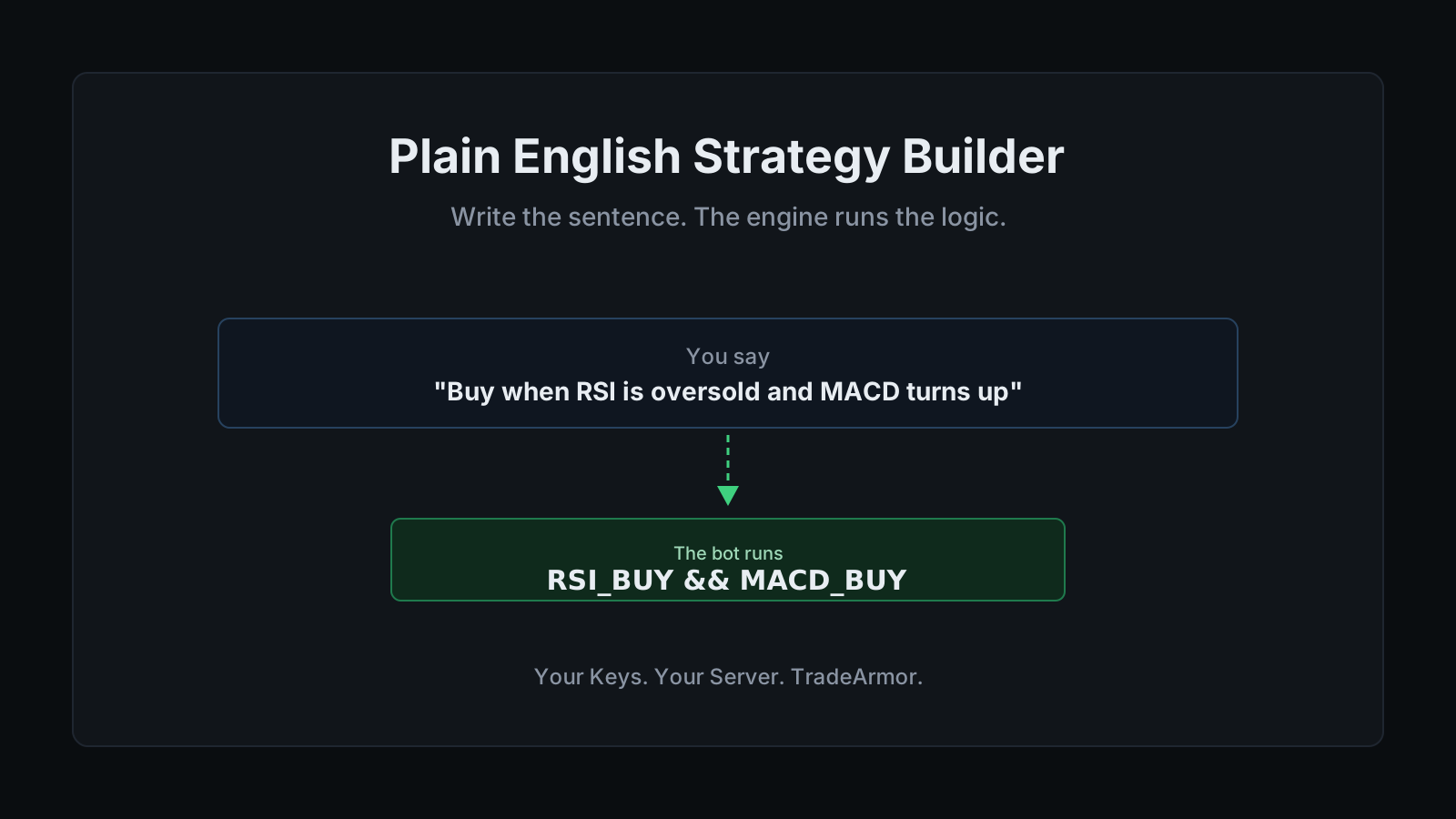
A formula combines those facts. The sentence "buy when RSI is oversold and MACD has turned up" becomes one line:
RSI_BUY && MACD_BUY
That is the whole translation. The sentence and the rule are almost the same length, which is the point. You are not encoding your idea into a foreign syntax. You are writing it down in a shorthand you can still read aloud.
The Four Operators You Already Know
You do not need new vocabulary to build these. The operators are the same logical pieces from any spreadsheet formula or first week of a logic class.
Use && for and. Both sides must be true. RSI_BUY && MACD_BUY fires only when oversold momentum and an upward trend agree at the same moment. This is the agreement filter, and it is how you cut the trades where one indicator was clearly wrong.
Use || for or. Either side firing is enough. RSI_BUY || SUPERTREND_BUY enters when either an oversold dip or a fresh trend flip shows up, then leans on your exit and position rules to manage the wider entry.
Use ! for not, to invert a condition. Useful for "enter on this signal, but not while that other condition is active."
Use parentheses to group. They control which part evaluates first, exactly like in arithmetic. RSI_BUY && (MACD_BUY || SUPERTREND_BUY) means RSI must be oversold and at least one of the two trend tools must agree. That single line is a real multi-condition strategy, and you can read it without a manual.
See how the full platform fits around the strategy builder, because the formula is the entry logic, not the whole operation.
Five Plain English Rules, Five Formulas
Here is the builder in practice. Each one starts as a sentence, ends as a line the bot runs.
Trend following. "Only buy when the trend has clearly turned up." Supertrend is built for this. The rule is one state:
SUPERTREND_BUY
Mean reversion. "Buy the oversold dip, but only when momentum is also turning, not while it keeps falling." The agreement filter from earlier:
RSI_BUY && MACD_BUY
Multi-condition trend. "Buy when momentum is oversold and at least one trend tool agrees." Parentheses do the work:
RSI_BUY && (MACD_BUY || SUPERTREND_BUY)
Volume-confirmed entry. "Take the momentum signal, but only when there is real participation behind it." You add a volume or VWAP condition to the agreement:
RSI_BUY && MACD_BUY && VWAP_BUY
Hybrid with a proven signal. "Let the track-record signal propose the trade, and only act when my own filter agrees." This is the mode I run most, because it keeps a proven signal feed doing the heavy lifting while your formula adds a confirmation layer:
SIGNAL_BUY && RSI_BUY
None of those required a developer. Each is a sentence a trader would say, written in four operators and a handful of indicator states. If you want the indicator mechanics behind two of them, the RSI and MACD combined guide and the Supertrend explainer walk through what each state actually measures before you trust it.
When the Plain English Crypto Strategy Builder Writes It for You
Some traders know exactly what they want and still do not want to think in && and || on a given evening. That is what the plain-English AI strategy builder is for. You type the sentence, "buy when RSI is oversold and MACD crosses up," and it writes the formula for you, validates it, and suggests fixes if the logic is off.
The part that matters is the billing model. The AI assistant is bring your own key. You plug in your own AI provider and pay that provider directly. TradeArmor passes none of the cost on. Every bot charging a premium for AI features is billing you for someone else's model with a markup stacked on top. Here the AI writes the rule, you read the rule before it trades, and the cost is whatever your own provider charges and nothing more.
The plain English crypto strategy builder and the formula engine are the same system from two doors. One door you type a formula. The other door you type a sentence and the assistant types the formula. Either way you end up with a legible rule you can audit, which is the only honest way to run automation.
Where the Formula Fits in the Bigger System
A good entry formula is one tool in a larger operation, not the operation. Once the rule fires, position management decides whether you keep the gains. Sizing, take-profit or trailing take-profit, and a plan for trades that move against you all matter as much as the entry. That is where the DCA engine and its gating logic come in, and it is usually where the difference between a real engine and a toy shows up. Entry timing gets all the attention. Exits and risk control quietly decide the account.
Before any of it touches real money, a formula is a hypothesis. Backtest it against historical candles, then paper trade it on live data, then run it small. A rule that has not survived a backtest and a paper run is a guess wearing a lab coat. There is even a free DCA backtester you can try in the browser right now without installing anything.
One last thing no formula can do, however well you write it: protect your keys. A boolean strategy formula runs the same on any platform. What changes is whether your exchange API key is sitting on a third-party server while it runs. On a self-hosted bot the key stays in a local config on your own machine, carrying trade permission only, never withdrawal. The strategy is yours. The custody should be too.
That is the whole pitch for a plain English crypto strategy builder. You describe the rule, the engine runs the logic, you read exactly what it does, and your keys never leave your hardware. Write the sentence, check the formula, and let it trade while you do something else. See the plans and start a build of your own.
TradeArmor is a trading automation tool, not an investment adviser. Signals and indicator outputs are algorithmic results, not personalized investment advice. Past performance is not indicative of future results. Trading cryptocurrency carries substantial risk including the total loss of capital.