You have read that RSI tells you when crypto is oversold and MACD tells you when the trend is turning. So you put both on the chart, and within a week they were arguing with each other. RSI flashed oversold while MACD kept pointing down. You bought, price kept falling, and you decided the indicators were broken.
They were not broken. They were doing exactly their jobs, which are different jobs, and nobody told you that using them together is the entire point. RSI and MACD are not two opinions on the same question. They answer two different questions, and an RSI MACD strategy works by making each one cover the other's blind spot. This is a guide to how that actually works, mechanism by mechanism, and how to turn it into a rule a bot runs for you instead of a chart you stare at.
I build and trade with TradeArmor, so I will use it for the concrete examples. It is a self-hosted crypto trading bot that runs on your own hardware, with built-in BTC/USDC signals carrying a three-year track record, 15 real-time indicators, a plain-English AI strategy builder, and DCA, grid, futures, copy trading, backtesting, paper trading, and tax reporting on one engine. The reason I am writing an indicator guide rather than a pitch is simple. If you want to run RSI and MACD together, you should understand what each one measures before you let any software trade on it. The bot is the easy part. The logic is the part people get wrong.
What RSI Actually Measures
RSI, the Relative Strength Index, is a momentum oscillator. It compares the size of recent gains to the size of recent losses over a lookback window, then squeezes the result onto a scale from 0 to 100. The default window is 14 candles, a number that dates back to its design for daily stock charts in the 1970s.
Three levels matter. Above 70 is conventionally called overbought, below 30 oversold, and 50 is the midline that separates bullish momentum from bearish. Most beginners learn only the first two and treat them as buy and sell buttons. That is the mistake that got you here.
Oversold does not mean cheap. It means price has fallen fast relative to its recent range. In a real downtrend, RSI can sit under 30 for days while price keeps sliding, punishing everyone who read "oversold" as "bottom." This is RSI's blind spot: it measures the speed of a move, not its direction or its durability. On its own, RSI is a stopwatch with no compass.
What MACD Actually Measures
MACD, Moving Average Convergence Divergence, is a trend and momentum tool built from moving averages. It subtracts a 26-period exponential moving average from a 12-period one to produce the MACD line, then plots a 9-period average of that line as the signal line. The gap between the two is drawn as a histogram. Those 12, 26, and 9 settings are the defaults you will see almost everywhere.
The event traders watch for is the crossover. When the MACD line crosses above the signal line, momentum is shifting up. When it crosses below, momentum is shifting down. The histogram just shows that gap widening or shrinking, so you can see a cross coming before it lands.
MACD's strength is direction. It is good at telling you which way the trend is leaning and when that lean is changing. Its weakness is timing. Because it is built from moving averages, it lags. By the time MACD confirms a turn, part of the move is already gone. MACD is a compass with a slow needle.
A stopwatch with no compass, and a compass with a slow needle. Put them in the same hand and you have something closer to a working instrument.
Why RSI and MACD Complement Each Other
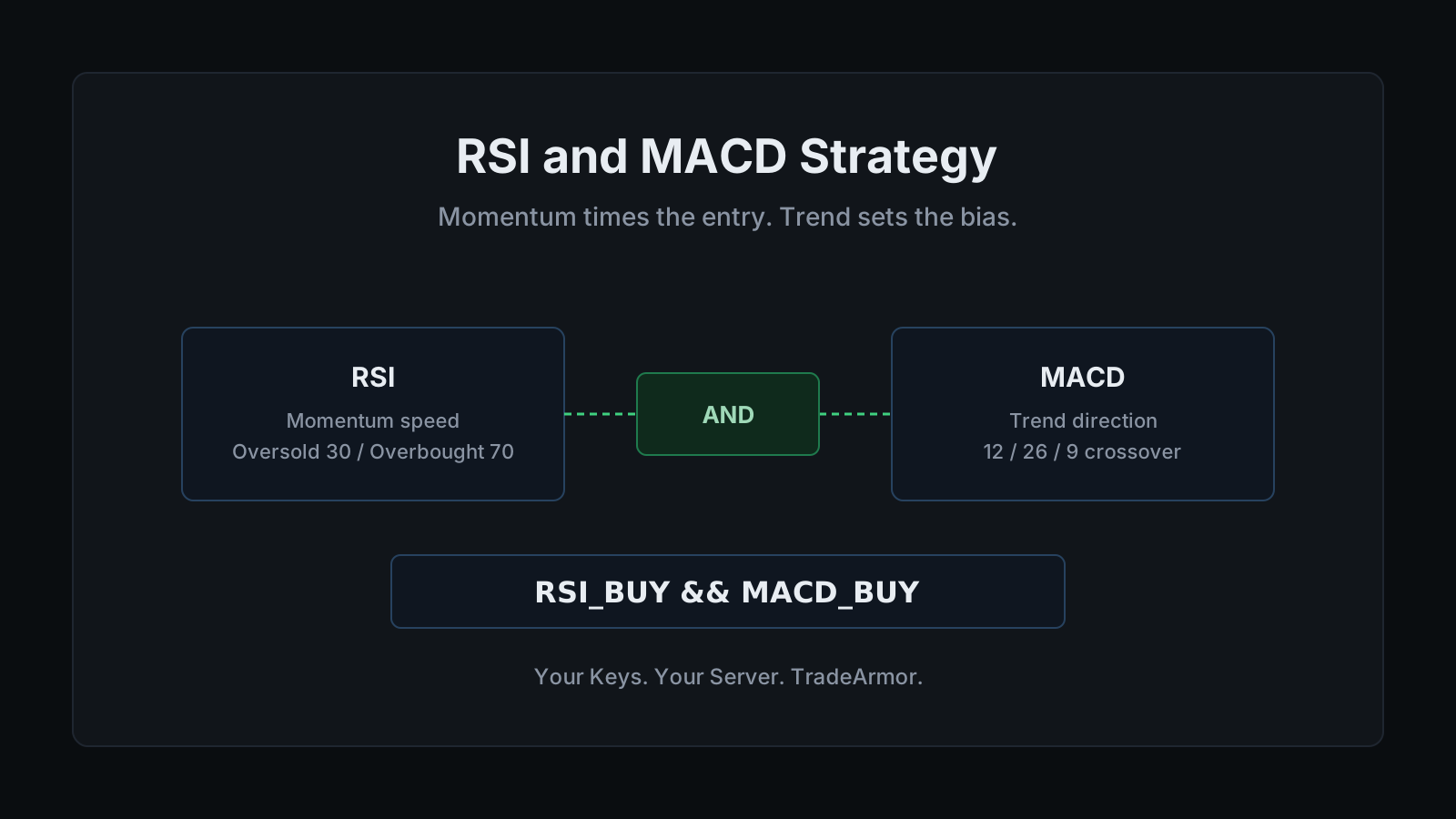
Here is the whole idea in one line. MACD tells you which direction to lean. RSI tells you when the timing is good to act on that lean. One sets the bias, the other times the entry.
Run them separately and each fails in a predictable way. RSI alone buys every oversold reading, including the ones in the middle of a crash. MACD alone catches the trend but enters late and gets chopped up in sideways markets, firing crossover after crossover that goes nowhere. The errors are different, which is exactly why combining them helps. When you require both to agree, you throw out the trades where one of them was clearly wrong.
Picture a long entry. MACD line crosses above its signal line, so the trend bias has turned up. At the same moment RSI climbs back above 50 from below, so momentum is confirming rather than fading. Now the oversold RSI reading you were tempted by earlier has trend agreement behind it. That is a higher-quality entry than either signal alone, not because the win rate is magic, but because you filtered out the setups where the two disagreed.
The cost is real and worth saying plainly. Requiring agreement means you take fewer trades and you miss some good ones where only one indicator fired in time. You are trading frequency for quality. In choppy crypto markets, where false signals are the tax everyone pays, that is usually the right trade. It is also why a black-box bot that hides which condition fired is useless here. If you cannot see whether the entry came from RSI, MACD, or both, you cannot tell a working rule from a lucky one.
Indicators are one mode, not the whole bot. RSI and MACD formulas, built-in signals, DCA, grid, and futures all run on the same engine. See how the full platform fits together before you commit to a single strategy.
Turning an RSI MACD Strategy Into a Boolean Formula
You should not need to write Python to express "buy when RSI is oversold and MACD has turned up." That is a sentence. A bot should let you write it as close to a sentence as code allows, which is where boolean formulas come in.
TradeArmor computes all 15 indicators locally in real time and exposes each one as a buy or sell state you can combine with logical operators. The operators are the ones you already know: && for and, || for or, ! for not, plus parentheses for grouping. An RSI MACD strategy entry becomes one readable line:
RSI_BUY && MACD_BUY
RSI_BUY is true when RSI sits in your oversold zone. MACD_BUY is true when the MACD line is above its signal line. The && means the bot only buys when both are true at once, which is the agreement filter we just described, enforced automatically on every candle.
You can tighten or loosen the rule from there. Want trend confirmation without demanding a fresh oversold dip? Combine MACD with the RSI midline instead of the oversold zone. Want a wider entry that fires when either momentum tool turns up, then leans on your DCA and exit rules to manage the rest? Swap the && for ||:
RSI_BUY || MACD_BUY
The exit side works the same way, with RSI_SELL and MACD_SELL states you assemble into a full-sell or partial-sell condition. The point is that the logic stays legible. You are not trusting a hidden model. You are reading the exact rule the bot follows, which is the only honest way to run automation.
If boolean syntax still is not your idea of a good evening, the plain-English AI strategy builder takes the sentence "buy when RSI is oversold and MACD crosses up" and writes the formula for you. It is bring-your-own-key, so you plug in your own AI provider and pay no markup on top of the subscription. The AI writes the rule. You still read it before it trades. Those two facts are the whole pitch.
Settings, Timeframes, and the Crypto Adjustment
The defaults exist for a reason, and ignoring them blindly is as silly as following them blindly. RSI 14 and MACD 12, 26, 9 were tuned for daily charts of stocks that close overnight and on weekends. Crypto never closes, and a lot of bot operators run faster timeframes than a daily candle.
On a 1-hour or 15-minute crypto chart, the standard settings can feel sluggish, confirming turns well after they happened. Many traders shorten the windows for faster markets, using something in the neighborhood of RSI 10 and MACD 8, 21, 5, accepting more signals and more noise in exchange for earlier entries. There is no universally correct number. Faster settings react sooner and whipsaw more. Slower settings lag but lie less.
This is exactly the question you should never answer with your live account. You answer it with a backtest, then paper trading. Run your RSI MACD strategy against real historical candles, compare a few setting combinations, look at the equity curve and the drawdown rather than just the win count, then run the winner on a simulated balance on live data before a single real dollar is at risk. TradeArmor ships backtesting and paper trading on every strategy mode, and there is a free DCA backtester you can try in the browser right now without installing anything. A strategy that has not survived a backtest and a paper run is a guess wearing a lab coat.
Where RSI and MACD Fit in the Bigger System
A combined indicator entry is one tool in a larger operation, not the operation itself. The cleanest way to run it is hybrid: let a proven signal feed propose the trade, then use RSI and MACD as filter gates that decide whether to act. On TradeArmor that looks like "only buy when the cava-signal fires and RSI_BUY && MACD_BUY agrees," which keeps you on a strategy with a track record while adding your own confirmation layer on top.
Whatever fires the entry, position management decides whether you keep the gains. A clean RSI MACD strategy entry still needs sane sizing, a take-profit or trailing take-profit, and a plan for trades that move against you. That is where the DCA engine and its gating logic come in, and where the difference between a real engine and a toy shows up. Entry timing gets all the attention. Exits and risk control quietly decide the account.
One more thing the indicators cannot do, no matter how well you tune them: protect your keys. An RSI MACD strategy runs the same on any platform. What changes is whether your exchange API key is sitting on someone else's server while it runs. On a self-hosted bot the key stays in a local config on your own machine, carrying trade permission only, never withdrawal. The strategy is yours either way. The custody should be too.
The Honest Summary
RSI measures momentum speed. MACD measures trend direction. Used alone, each has a blind spot the other covers, and an RSI MACD strategy works by requiring both to agree before it acts, trading some frequency for fewer false signals. Write it as a boolean formula so you can read the exact rule, backtest it before you trust it, and run it inside a system that also handles sizing, exits, and key custody. TradeArmor is the self-hosted platform I built to do all of that on hardware you own, where your keys never leave your machine and one subscription replaces the stack of a chart tool, a signal service, and a SaaS bot. See the plans and start.
Frequently Asked Questions
Is RSI or MACD better for crypto trading?
Neither is better, because they measure different things. RSI gauges momentum speed and flags overbought and oversold extremes. MACD gauges trend direction and momentum shifts through moving-average crossovers. The reason to combine them is precisely that they fail differently. RSI buys falling knives in a downtrend, MACD enters late and whipsaws in a range. Requiring both to agree removes a chunk of each one's worst trades. Asking which is better is like asking whether a compass or a stopwatch is better for navigation.
What are the best RSI and MACD settings for crypto?
The defaults are RSI 14 and MACD 12, 26, 9, both designed for daily charts. Crypto trades around the clock and many bot operators run faster timeframes, so shorter windows such as RSI 10 and MACD 8, 21, 5 are common on 1-hour and 15-minute charts. Faster settings enter sooner and produce more false signals, slower settings lag but are cleaner. There is no single correct answer, which is why you settle it with a backtest and paper trading rather than opinion. Past performance does not guarantee future results.
How do you write an RSI MACD strategy as a trading bot rule?
In TradeArmor you combine indicator buy and sell states with boolean operators. A basic combined entry is RSI_BUY && MACD_BUY, which buys only when RSI is in its oversold zone and the MACD line is above its signal line at the same time. Swap && for || to fire when either turns up. The exit side uses RSI_SELL and MACD_SELL. The whole rule stays readable, so you can audit exactly why the bot bought instead of trusting a hidden model.
Does combining RSI and MACD guarantee more winning trades?
No. Combining them filters out trades where the two indicators disagree, which tends to improve entry quality, but it also means fewer trades and some missed moves. No indicator combination predicts the market, and signals are algorithmic outputs, not investment advice. The honest test is to backtest the rule on historical data, paper trade it, then run it small before scaling. A bot executes a bad strategy flawlessly, so the strategy still has to be sound.
Do I need TradingView to run RSI and MACD on a bot?
No. TradeArmor computes all 15 indicators locally in real time, including RSI and MACD, with no external data vendor and no TradingView subscription required. You can still wire in a TradingView webhook if you prefer your own signal source, but the indicators themselves run on your own machine against live candles, which is also why your strategy keeps working even if a third-party service goes down.